
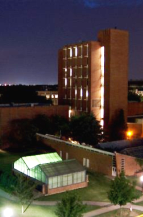
We also rely on a variety of instruments available on campus to perform some of our work.The Samuel Roberts Noble Electron Microscopy Laboratory,located in the Biology/Microbiology building hosts a high-resolution SEM (JEOL 880) and a TEM (JEOL 2000FX) electron microscopes.
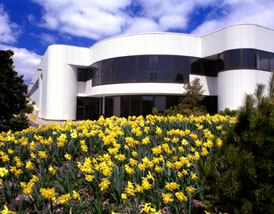
In addition, we use the EXAFS facilities at the National Synchrotron Light Source (NSLS) located in Brookhaven National Laboratory (NY). EXAFS experiments have allowed us to determine the crystal structure and details of chemical and physical phase transformations in our catalysts at different stages of the SWNT production process.
|
|



Collaborations among:
 NSLS User Administration Office