Paul A. Lawson
Assistant Professor, Microbial Ecology and Environmental Microbiology
THE LAWSON MOLECULAR SYSTEMATICS LABORATORY
Paul obtained his first degree in Special Biochemisty at the University of London (Royal Holloway College) in 1984 where his third year project involved the transfer of antibiotic resistance via plasmids between species of Streptococcus. Upon graduation he joined an MRC Periodontal Research Unit at the London Hospital Medical College where he worked on the isolation and characterisation of anaerobic bacteria. 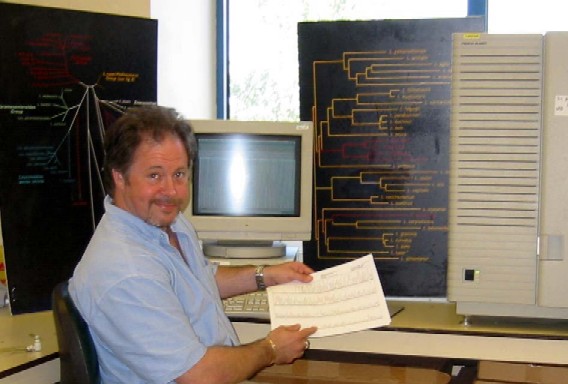 In 1986 he joined the Directors Laboratory at the Imperial Cancer Research Fund where he was part of a team investigating the genetic inheritance of Colon Cancer. Paul then returned to the LHMC in the Department of Oral Microbiology where he continued his research for his thesis entitled 'A molecular and systematic study of the genus Fusobacterium with particular reference to Fusobacterium nucleatum and Fusobacterium necrophorum'. Upon completion of this study Paul joined the Systematics Research Group of Professor M.D. Collins at the BBSRC Institute of Food Research. His interests involve the particular emphasis on molecular based methodologies, of a wide range of both anaerobic and aerobic organisms. A major area of interest was with the genus Clostridium, which represents a heterogeneous and exceedingly problematic group of anaerobic spore-forming bacteria.However his research activities extend far beyond the systematics of clostridia and he is interested in microbial phylogeny in the broadest context embracing clinical, veterinary and environmental sources for the isolation of novel bacterial biodiversity. It was from here that Paul was appointed to the University of Reading in 1999 having had fourteen years experience in microbial characterization and molecular biology techniques which has resulted in over 100 peer-reviewed publications to date. In 2005 Paul took up his present faculty position.
In my laboratory we investigate the enormous biodiversity of bacterial life present in a wide ranging number of habitats. Although employing molecular techniques to study microorganisms, we also appreciate the traditional skills of the microbiologist. It is only in the seamless use of both modern and traditional techniques that we can begin to understand the complex interrelationships of organisms, shifts in population structures occurring due to changes in environmental conditions or particular stresses placed upon a particular ecosystem and the interplay of microorganisms within the biosphere.
1) Investigation of the bacterial microflora of the human intestinal tract
The composition of the human large intestinal microflora has a profound influence on health and disease through its involvement in nutrition, pathogenesis, and immunology of the host. A proper comprehension of the diversity of species present and their numerical preponderance is therefore of utmost importance. Although this microflora has been the subject of intensive investigation, using anaerobic culturing techniques combined with phenotypic methods of characterisation, there is now a universal recognition that these approaches have provided a vastly incomplete picture of the predominant gut flora diversity and as much as 80% may have eluded scientific description. Molecular phylogenetic studies are now being employed to provide as complete as possible inventory of the microbial biodiversity present.
2) Investigation into the biodiversity of the Aquatic Sea Mammals of the North Sea
In collaboration with the SAC Veterinary Science Division and forms part of an ongoing study of Scottish Strandings supported in part by the UK Department of the Environment, Transport and the Regions as part of its coordinated programme of research on the North Sea. Little is known of the microorganisms that make up the natural flora of aquatic mammals (seals, otters, porpoises, whales etc) residing in the North Sea. Many animals are found dead or dying on Scottish beaches and this study aims to add to our knowledge of both commensal organisms and those pathogens which may cause disease and which may lead to Strandings and even death.
3) Characterization of bacteria from the Vestfold Hills region of the Antartic
This study in collaboration with Prof. Peter Hirsch of the University of Kiel, Germany has a two-fold objective a) to isolate and characterize novel bacterial types from this little studied environment and b) to ascertain if the influence of man has contaminated this area by introducing bacteria that are not native to this landscape. Many of these organisms require exacting growth requirements and may take many months to isolate in pure culture. Prof. Hirsch is a leading authority in this area and over many years has introduced techniques necessary to grow and characterize these bacteria.
4) Investigation of the intestinal flora of children with late onset autism
Autism is characterised by delays in understanding and use of language, unusual response to sensory stimuli, resistance to change and emphasis on routines and with difficulties in normal social interactions. The disease usually manifests itself in early infancy but in at least one third of patients, the onset is delayed until 18-24 months of age. In approximately 10% of cases a genetic disposition is apparent but in the majority of patients no underlying aetiology as been determined. Therapy centred on speech, language, psychological and behavioural themes have been shown to give some benefits, but these are both labour-intensive and expensive. There is evidence that some cases of autism, notably late onset or regressive autism, may involve abnormal intestinal flora since the oral administration of the antibiotic vancomycin, which is very poorly absorbed, leads to significant improvement in some children with this form of autism. Molecular phylogenetic studies in collaboration with Prof. Sydney Finegold, of the Department of Medicine, UCLA School of Medicine USA, are now being employed to investigate the intestinal flora of children with late onset autism undergoing this treatment.
5) Microbial Identification Service
Unidentified bacteria that require a rapid identification are taken as pure cultures or isolated DNA. Samples are subjected to 16S rDNA sequence analysis. A report is then generated providing details of the analysis prior to further characterisation if requested.
6) Identification of Novel Emerging Human and Animal Pathogens
An increasing number of novel organisms, that have previously eluded identification by traditional methods, including many potentially pathogenic bacteria, are now being revealed by modern molecular methodologies. Many of these organisms are anaerobes co-existing in complex community structures; some may act as opportunistic pathogens causing veterinary or clinical problems only when particular circumstances arise. Some organisms are present as a “reservoir” in the environment from where they may infect both man and animals when contact is made and/or the appropriate conditions arise. In my laboratory in collaboration with a number of international groups we are adding to the knowledge of base line microbial communities in man and animals and organisms which arise and cause disease processes.
In addition to the above, large numbers of organisms from diverse habits such as clinical, veterinary and environmental sources are identified and characterized. Several laboratories are currently involved in collaborative studies including the Centers for Disease Control and Prevention, Atlanta, USA, The Culture Collection of the University of Göteborg, Sweden, Health Protection Agency, London, and the Department of Gastrointestinal Microbiolgy (DIFE), Germany.
Recent Publications (2003 - present):
- Finegold SM, Vaisanen, M.L., Molitoris, D., C., Song Y, Liu, Collins M.D, and Lawson P.A, (2003) Cetobacterium somerae sp. nov., from human faeces and emended description of the genus Cetobacterium. Systematic and Applied Microbiology, 26: 177-181.
- Wolin, M.J., Miller, T.L., Collins, M.D. and Lawson, P.A. (2003) Formate requirement for growth and homoacetogenic fermentation by a bacterium from human feces: Description of Bryantella formatexigens gen. nov., sp. nov. Applied and Environmental Microbiology, 69: 6321-6326.
- Lawson, P.A., Molitoris, D.R., Song, Y., Collins, M.D. and Finegold, S.M. (2004). Anaerotruncus colihominis gen. nov., sp. nov., from human faeces. International Journal of Systematic and Evolutionary Microbiology, 54: 413-417.
- Whitehead, T.R., Cotta, M.A., Collins, M.D. and Lawson, P.A. (2004). Description of Hespellia stercorisuis gen. nov. sp. nov., and Hespellia porcina sp. nov., isolated from manure storage pits. International Journal of Systematic and Evolutionary Microbiology 54: 241-245.
- Dunsmore, B.C., Whitefield, T.B., Lawson, P.A. and Collins, M.D. (2004). Corrosion by Sulfate-Reducing Bacteria that Utilize Nitrate. Corrosion, 60: 1-10.
- Collins, M.D, Routh, J., Saraswathy, A., Lawson, P.A., Schumann, P., Welinder-Olsson, C. and Falsen, E. (2004). Arsenicicoccus bolidensis gen. nov., sp. nov., a novel actinomycete isolated from contaminated lake sediment. International Journal of Systematic and Evolutionary Microbiology, 54: 605-608.
- Finegold S.M, Lawson, P.A., Vaisanen, M.L., Molitoris, D., Song Y, Liu, C. and Collins M.D. (2004). Anaerofustis stercorihominis gen. nov., sp. nov., from human faeces. Anaerobe, 10: 41-45.
- Holmstrøm, K., Collins, Moller, T., Falsen, E. and Lawson, P.A. (2004). Subdoligranulum variabile gen. nov., sp. nov. from human faeces. Anaerobe, 10: 197-203.
- Cotta, M.A, Whitehead, M.A., Collins, M.D. and Lawson, P.A. (2004). Atopostipes suistercus gen. nov., sp. nov., isolated from a pig manure storage pit. Anaerobe, 10: 191-195.
- Collins, M.D., Falsen, E., Brownlee and Lawson, P.A. (2004). Helcococcus sueciensis sp. nov., isolated from human wound. International Journal of Systematic and Evolutionary Microbiology, 54: 1557-1560.
- Lawson, P.A., Geoffrey Foster, Enevold Falsen, Nick Davison and Matthew D. Collins. (2004). Streptococcus halichoerius sp. nov., isolated from grey seals (Halichoerus grypus). International Journal of Systematic and Evolutionary Microbiology, 54: 1753-1756.
- Greetham, H., Collins, M.D., Gibson, G.R., Giffard, C., Falsen, E. and Lawson, P.A. (2004). Sutterella stercoricanis sp. nov., isolated from canine faeces. International Journal of Systematic and Evolutionary Microbiology, 54: 1581-1584.
- Namsolleck, P., Thiel, R., Lawson, P.., Holmstrøm, K., Rajilic, M., Vaughan, E.E., Rigottier-Gois, L., Collins, M.D., De Vos, W. and Blaut, M. (2004). Molecular Methods for the Analysis of Gut Microbiota. Microbial Ecology in Health and Disease, 16: 71-85.
- Engbaek, K. and Lawson, P.A. (2004). Identification of Bartonella species in rodents, shrews and cats in Denmark: detection of two B. henselae variants, one in cats and the other in the long-tailed field mouse. APMIS, 112: 336-341.
- Foster, G., Holmes, B., Steigerwalt, A.G., Lawson, P.A., Thorne, P., Byrer, D.E., Ross, H.M., Xerry, J., Thompson, P.M., and Collins, M.D. (2004) Campylobacter insulaenigrae sp. nov. Isolated from marine mammals. International Journal of Systematic and Evolutionary Microbiology, 54: 2369-2373.
- Labrenz, M., Lawson, P.A., Tindall, B.J., Collins, M.D., and Hirsch, P. (2004) Roseosalinus antarcticus gen. nov., sp. nov., a novel aerobic bchl a-producing alpha-Proteobacterium isolated from hypersaline Ekho Lake. International Journal of Systematic and Evolutionary Microbiology. 55: 41-47.
- Vela, A.I, Collins, M.D., P.A. Lawson, and Fernandez, J. (2004). Uruburuella suis gen. nov., sp. nov., isolated from clinical specimens of pigs. International Journal of Systematic and Evolutionary Microbiology. 55: 643-647.
- Lawson, P.A., Foster, G. Enevold Falsen, Nick Davison and Matthew D. Collins. (2005). Streptococcus marimammalium sp. nov., isolated from seals International Journal of Systematic and Evolutionary Microbiology. 55: 271-274
- Hall, V, Collins, M.D., Enevold Falsen, and Brian I. Duerden. (2005). Actinomyces dentailis sp. nov., from human dental abscess. International Journal of Systematic and Evolutionary Microbiology. 55: 427-431.
- Lawson, P.A., Geoffrey Foster, Enevold Falsen, Nick Davison and Matthew D. Collins. (2005). Streptococcus castoreus sp. nov., isolated from a beaver. International Journal of Systematic and Evolutionary Microbiology. 55: 843-846.
- Falsen, E., Collins, M.D., Welinder-Olsson, C., Song, Y., Finegold, S.M., and Lawson, P.A. (2005) Fastidiosipila sanguinis gen. nov., sp. nov., a new Gram-positive, coccus-shaped organism from human blood. International Journal of Systematic and Evolutionary Microbiology. 55: 853-858.
- Lawson, P.A., Greetham, H., Gibson, G.R., Giffard, C., Falsen, E. and Collins, M.D. (2005). Slackia faecalicanis sp. nov., isolated from canine feces. International Journal of Systematic and Evolutionary Microbiology. 55: 1243 - 1246.
- Lawson, P.A., Foster, Malnick, H., Collins, M.D., Bendall, R., and Hartley, J.W. (2005). Description of Kingella potos sp. nov., isolated from the wound infection caused by a bite from an animal. Journal of Clinical Microbiology, 43: 3526-3529.
- Lawson, P.A., Collins, M.D., Falsen, E., amd Geoffrey Foster, (2005). Catellicoccus marimammalium gen. nov. sp. nov., a novel Gram-positve, catalase-negative, coccus-shaped bacterium from porpoise and grey seal. Journal of Systematic and Evolutionary Microbiology. 56: 429-32.
- Lawson, P.A. and Collins, M.D. (2005) Genus Facklamia. In Bergey’s Manual of Systematic Bacteriology. Williams and Wilkins. (In-press).
- Collins, M.D. and Lawson, P.A. (2005). Genus Atopobacter. In Bergey’s Manual of Systematic Bacteriology. Williams and Wilkins. (In-press).
- Collins, M.D. and Lawson, P.A. (2005). Genus Eremococcus. In Bergey’s Manual of Systematic Bacteriology. Williams and Wilkins. (In-press).
- Collins, M.D., Falsen, E., Brownlee and Lawson, P.A. (2005). Atopococcus tabaci sp. nov., gen. nov., isolated from cell culture medium. International Journal of Systematic and Evolutionary Microbiology, 55: 1693-1696
- Foster, G, Malnick, H., Lawson P.A., Kirkwood, J., MacGregor, S.K. and Matthew D. Collins. (2005). Suttonella ornithocola sp. nov., from birds of the tit families, and emended description of the genus Suttonella. International Journal of Systematic and Evolutionary Microbiology, 55: 2269 – 2272.
- Whitehead, T.R., Cotta, M.A., Collins, M.D., Falsen, E. and Lawson, P.A. (2005). Bacteroides coprosuis sp. nov., isolated from swine-manure storage pits Int J Syst Evol Microbiol, 55: 2515 – 2518.
- Allen, T.D., Lawson, P.A., Collins, M.D., Falsen, E. and Tanner, R.S (2006). Cloacibacterium normanensis gen. nov., sp. nov., a new bacterium of the family Flavobacteriaceae isolated from municipal wastewater. Int J Syst Evol Microbiol. 56: 1311-1316.
- Mohan, R., Namsolleck, P., Lawson, P., Osterhoff, M., Collins, M.D., Alpert, C.A. and Blaut, M. (2006). Clostridium asparagiforme sp. nov., Isolated from a Human Faecal Sample. Syst Appl Microbiol. 29: 292-9.
For more information about this program, contact the Department or Dr. Paul Lawson.
Other related web pages: