
an online project by Susan Fielding, James Hetfield, and Lynn Whitaker
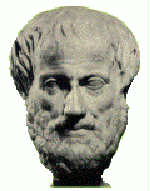 Aristotle defined rhetoric as "an ability, in each [particular] case, to see the availible means of persuasion." (Aristotle 36)
He then divided the means of persuasion into two categories: atechnic and entechnic pisteis. Atechnic pisteis are those external to argumentation, i.e. blackmail or threats. Entechnic pisteis are the means of persuasuion internal to an argument: logos, pathos, and ethos.
Aristotle defined rhetoric as "an ability, in each [particular] case, to see the availible means of persuasion." (Aristotle 36)
He then divided the means of persuasion into two categories: atechnic and entechnic pisteis. Atechnic pisteis are those external to argumentation, i.e. blackmail or threats. Entechnic pisteis are the means of persuasuion internal to an argument: logos, pathos, and ethos.

Sensitivity to the pathos, or the emotional power of language, is another key consideration for creators of argumentation-persuasion presentations. Pathos appeals to a viewpoint or course of action. The pathos of a piece derives partly from the communicators choice of language. Connotative language, for example, are words with strong emotional overtones and have the ability to move the audience to accept a point of view and may even spur them to act. Adolf Hitler, during World War II, was very effective with the use of propaganda filled with elements of pathos in order to convince the country and rally support for his cause.
The delivery of any good argumentation-persuasion presentation involves an interplay of logos, pathos, and ethos. The exact balance among these factors is determined by the audience and purpose, that is, whether or not you want the audience simply to agree with your view or whether you also want them to take action. For the execution of this, the presentation should be tailored to the audience and its needs. How much the audience knows about the issue, how they feel about you and your position, what their values and attitudes are, and what motivates them should all be taken into account.
The World Wide Web(WWW), a confluence of improving technology and information, has a sheer volume problem in which ethos, a primary component of classical rhetoric, is missing. The absence of traditional establishment of ethos causes people to fall into situations in which they are fundamentally deficient. To engage in an argument on the WWW without consideration of ethos is akin to passing gossip, only in this situation the "wildfire" of information has ample fuel and space in which to grow. The problem of overabundant information on the WWW is enhanced by the desire of most computer users to read and process information. Kenneth Burke elucidates an analogous problem in his book, "Counter-Statement," on page 53:
"And, if it is a form of self-expression to utter our emotions, it is just as truly a form of self-expression to provoke emotions in others, if we happen to prefer such a practice, even though the emotions aimed at were not the predominant emotion of our own lives."
Internet communication technologies allow users in many different geographic locations to meet online in a virtual space. However, these bodyless forms of communication are intrinsically pseudonymous. Identities created in this virtual space do not have to conform to a user's real identity, and often , due to both distance and privacy concerns, one is unable to dicover the real world identity of an online persona. The absence of traditional means for establishing identity requires that we sharpen our language skills and develop new methods for establishing and evaluating ethos in these communication channels.
Burke realizes that people fail to utilize critical reading and writing practices in their interpretation of information. This occurs now on the WWW. People 'surf' without giving any thought to the information encountered.People cannot be intimidated by the large amount of work required by this new literacy.
Government regulation of information is one possible solution. This is an uphill battle against the average computer user and the belief, as Laura Gurak elucidates, that "individuals are against most forms of gate keeping in cyberspace and instead rely on what they see as the self-regulating mechanism of the net community to weed out false or unwarranted information" (Gurak 84). This is a formidable communication obstacle on its own, but coupled with the expedience of email and search engines, the potential miscommunication increases. Ethos does not exist for the most part on the WWW.
Why is ethos so important? It is a cornerstone of classical rhetoric, for, "the speakers and their messages are often considered the most important feature in rhetoric, because if audiences do not trust a speaker, they will probably not listen to his or her message" (Gurak 84). A successful speaker makes eye contact and uses various cadences of speech. The speaker also uses gestures. Most importantly, the speaker is able to make major or minor adjustments in their discourse as an examination of the audience warrants. In other words, the speaker is able to increase ethos upon analysis of the audience.
The above tenets of classical rhetoric are missing from the WWW. Body gestures? Missing. Cadences? Non-existent, due to the flexible and most forgiving interface known as the keyboard. Eye contact? Blank. The problem of sheer volume and WWW information collides seamlessly. Any person without regard to ethos can place information on the WWW without fear of rejection. In classical rhetoric a conveyance of confidence is instrumental in ethos establishment. Without web ethos, persuasion towards information seekers is whittled down to a sort of visual appeasement, mainly with colorful graphics, sound, and rampant use of large fonts. The enticement of WWW information seekers is also analogous to the problem of television 'surfers.' Volume of information on the WWW is coupled with the ingrained tendency to 'web surf,' or the act of a computer user to briefly visit several sites in rapid sequence. Cable TV and remote controls only enhance this deficiency. This has amplified the lack of critical analysis which is required in order to generate feasible judgments of data. Critical reading and writing skills could provide web surfers the skills required to successfully 'surf' the WWW.
For traditional text, critical reading and writing skills contain two components. The first, functional print literacy, is defined by the ability to read and write in a particular language (class notes, 8/24/99), and critical print literacy, the ability to understand and comprehend a particular language (class notes, 8/24/99). The advent of the Internet has produced two more regions of literacy. First, functional digital literacy, which encompasses the ability to send and receive email, access and compose web sites, and the ability to use various software (class notes, 8/24/99), and critical digital literacy, which encompasses the ability to understand HTML as well as the ability to read and write effective email and web sites (class notes, 8/24/99). Here, then, are four regions of literacy which must be completely combined in order for web users to utilize and understand the vast information of the WWW.
Despite the many problematic aspects of WWW based communication, it is growing daily in importance and so, therefore, is the need to find solutions to the challenges involved. Many are turning to the computer for these solutions and attempting to build systems for establishing ethos into the communication channel itself. These computerized rhetorical tools include:
These are just a few of the tools that have been developed to help WWW users establish ethos for themselves and determine the ethos of others. Here we analize three web sites that use these and other techniques to help bring identity to the bodyless online world.
Epinions.com is a non-profit online database of comsumer opinions. Covering everything from Stephen King books to Caribbean vacations, Epinions seeks to provide readers with product reviews written by other readers. It is important for Epinions to help its readers establish the ethos of other readers to let them decide which reviews to trust. Epinions.com uses verified user logins, user biographies and a system of reader evaluations to establish "Webs of Trust"
Click here for our analysis of Epinions

Ebay.com allows users to participate in online auctions, putting buyers and sellers from all over the world in touch with each other. Ebay brokers the sale to the point of exchange of money and items, which happens directly between the buyer and seller. Establish the reputation of buyers and sellers is especially important on Ebay due to the constant exchange of money for goods. Ebay uses verified user logins, a user history database, and user ratings to allow Ebay users to establish and examine the Ethos of other Ebay users.
Click here for our analysis of Ebay

Slashdot.org is an online news index that allows readers to leave comments on news articles from elsewhere on the WWW. Due to the high volume of user comments, slashdot has introduced a filtering system which allows users to choose a relevence threshold underwhich to ignore posts. Moderators rate comments for relevence and moderators are randomly chosen based on their "karma", a automatically established numerical rating representing their history of posting relevant comments.
Click here for our analysis of slashdot