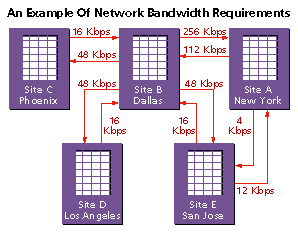
Let's say that you wanted to connect five campus locations across the country. After studying your applications, you determine that your connection needs are as follows:
In this configuration, traffic flows from Site "A" to Site "B" require a maximum speed of 256 Kbps; Connections between sites "C," "D" and "E" to Site B require a maximum speed of 48 Kbps; and Site E exchanges a small amount of traffic with Site A, at 12 Kbps.
This would require a leased-line network design like this:

In addition to being costly, this design wastes bandwidth in the following areas:
The leased-line design also limits flexibility:
These requirements could be met with a frame relay network design like this:
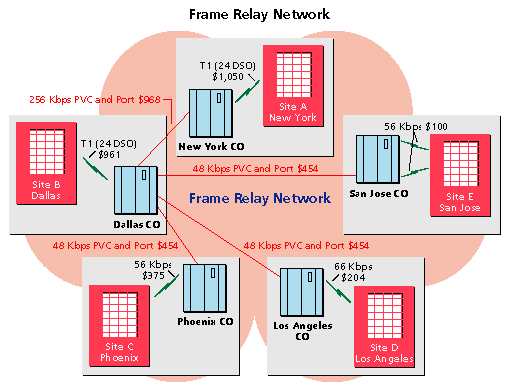
A cost comparison shows that the frame relay network saves between $26,872 and $37,192 in the first year, and $31,872 and $42,192 per ongoing year, as compared to the leased-line alternative.
Why the savings range? If you're willing to let the carrier throw away your traffic when its network gets congested, you can elect for a "0 CIR" link. Using 0 CIR, link costs were reduced by as much as $6,000 for a single link in this example. It's a little more risky to the customer, but carriers are now backing up their 0 CIR service with performance guarantees.