Michael J. McInerney

George Lynn Cross Research Professor
George Lynn Cross Endowed Professor
Applied Microbial Physiology


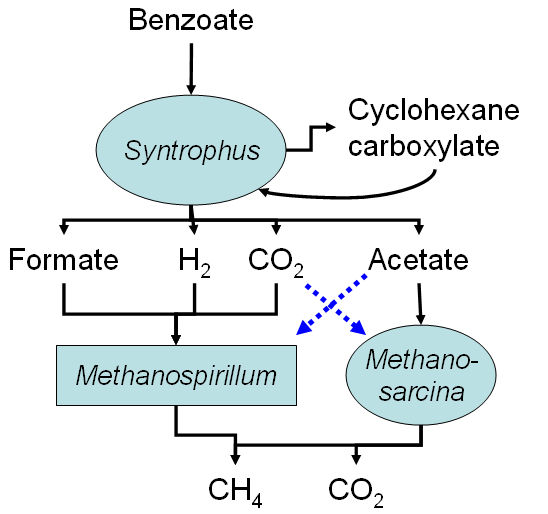
My laboratory has two areas of research, syntrophic metabolism and the development of microbial processes for oil recovery. Bacteria capable of syntrophic metabolism exist on minimal energy budgets using reactions that proceed close to thermodynamic limits. Syntrophic metabolism requires interspecies interactions, where the degradation of a substrate by one species is made thermodynamically possible by end product removal (hydrogen or formate) by another species. In the second area, we are developing microbial processes to recover entrapped oil in domestic oil reservoirs. Over 200 billion barrels of oil remain entrapped in U. S. oil reservoirs after current technology reaches its economic limits. Microbial technologies may provide an economic approach to recover entrapped oil and reduce our nation’s dependence on foreign imports.

Syntrophic Metabolism

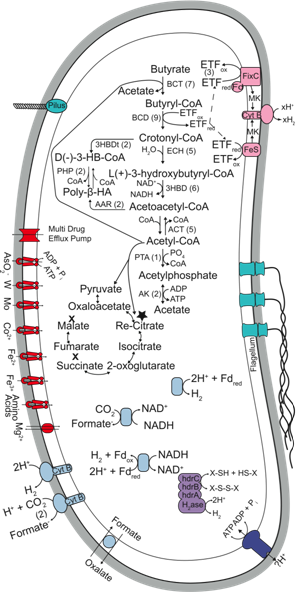
We are studying the metabolism and energetics of the syntrophic bacterium, Syntrophus aciditrophicus, which uses benzoate and fatty acids when grown with hydrogen-using bacteria. We are using genomics, proteomics, functional genomics, and biochemistry to understand the pathways involved and the mechanisms for ATP synthesis. The genome of S. aciditrophicus has been sequenced and we are preparing microarrays to conduct functional genomic studies in collaboration with Professor Robert P. Gunsalus at UCLA (http://www.mimg.ucla.edu/faculty/gunsalus/). Proteomic studies are being done in collaboration with Professors Rachel and Joseph Loo at UCLA (http://www.biochemistry.ucla.edu/biochem/Faculty/Loo/). In the future, we will delineate the regulatory networks for syntrophy and elucidate the mechanisms of reverse electron transport.

Oil Recovery

We have a multidisciplinary group to develop microbial detergents (biosurfactants) for oil recovery and other applications like groundwater remediation. We found that lipopeptide biosurfactants recover substantial amounts of entrapped oil from sandstone cores. We completed a field project that showed in situ production of lipopeptide biosurfactants at concentrations 4 to 10 times that needed to mobilize substantial amounts of entrapped oil. We are currently working to understand how the structure of the lipopeptide biosurfactants affects interfacial activity. We are also studying the microbial ecology of oil fields to determine the prevalence of biosurfactant-producing bacteria and how nutrient additions affect the microbial community.


Selected Recent Publications

  1. H. Mouttaki, M. A. Nanny, and M. J. McInerney. 2007. Cyclohexane carboxylate and benzoate formation from crotonate in Syntrophus aciditrophicus. Appl. Environ. Microbiol. 73: 930-938.
  2. F. Peters, Y. Shinoda, M. J. McInerney, and M. Boll. 2007. Cyclohex-1,5-diene-1-carbonyl-coenzyme A hydratases of Geobacter metallireducens and Syntrophus aciditrophicus: evidence for a common benzoyl-CoA pathway in facultative and obligate anaerobes. J. Bacteriol. 189: 1055-1060
  3. N. Youssef, D. R. Simpson, K. E. Duncan, M. J. McInerney, M. Folmsbee, T. Fincher, and R. M. Knapp. 2007. In-situ biosurfactant production by injected Bacillus strains in a limestone petroleum reservoir. Appl. Environ. Microbiol. 73:1239-1247.
  4. M. J. McInerney, L. Rohlin, H. Mouttaki, U. Kim, R. Krupp, L. Rios-Hernandez, J. Sieber, C. G. Struchtemeyer, A. Bhattacharyya, J. W. Campbell, R. P. Gunsalus. 2006. Genome of Syntrophus aciditrophicus: lifestyle at the thermodynamic limit of microbial growth. Proc. Nat. Acad. Sci. (USA) 104: 7600-7605.
  5. N. H. Youssef, T. Nguyen, D. A. Sabatini, and M. J. McInerney. 2007. Basis for formulating biosurfactant mixtures to achieve ultra low interfacial tension values against hydrocarbons. J. Indust. Microbiol. Biotechnol. 34:497-507.
  6. C. L. Musslewhite, D. Swift, J. Gilpen, and M. J. McInerney. 2007. Spatial variability of sulfate reduction in a shallow aquifer. Environmental Microbiology 9(11):2810-2819.
  7. Michael J. McInerney, Christopher G. Struchtemeyer , Jessica Sieber, Housna Mouttaki , Alfons J. M. Stams, Bernhard Schink, Lars Rohlin, Robert P. Gunsalus. 2007. Physiology, ecology, phylogeny and genomics of microorganisms capable of syntrophic metabolism. Ann. NY Acad. Sci. 1125:58-72.
  8. K. Kuntze, Y. Shinoda, H. Moutakki, M. J. McInerney, C. Vogt, H.-H. Richnow and M. Boll. 2008. 6-Oxocyclohexene-1-carbonyl-CoA hydrolases from obligately anaerobic bacteria: characterization and identification of its gene and development of a functional marker for aromatic compounds-degrading anaerobes. Environ. Microbiol. (published on line, Feb. 28) 10.1111/j.1462-2920.2008.01570.x
  9. T. Nguyen, N. Youssef, M. J. McInerney, D. Sabatini. 2007. Rhamnolipid biosurfactant mixtures for environmental remediation. Water Research (in press).
  10. S. Maudgalya, M. J. McInerney, R. M. Knapp, D. P. Nagle, and M. M. Folmsbee. 2005. Tertiary oil recovery with microbial biosurfactant treatment of low-permeability Berea sandstone cores. 2005 SPE Production and Operations Symposium, Oklahoma City, OK, April 17-19, 2005, SPE 94213.
  11. C. G. Struchtemyer, M. S. Elshahed, K. E. Duncan, and M. J. McInerney, 2005. Evidence for acetoclastic methanogenesis in the presence of sulfate in a gas condensate-contaminated aquifer. Appl. Environ. Microbiol. 71: 5348-5353.
  12. N. H. Youssef, K. E. Duncan, and M. J. McInerney. 2005. Importance of the 3-hydroxy fatty acid composition of lipopeptides for biosurfactant activity. Appl. Environ. Microbiol. 71: 7690-7695.
  13. N. H. Youssef, K. E. Duncan, D. P. Nagle, K. N. Savage, R. M. Knapp, and M. J. McInerney. 2004. Comparison of methods to detect biosurfactant production by diverse microorganisms. J. Microbiol. Meth. 56: 339-347.
  14. M. Folmsbee, M. J. McInerney, and D. P. Nagle. 2004. Anaerobic growth of Bacillus mojavensis JF-2 and three other Bacillus strains requires deoxyribonucleotides or DNA. Appl. Environ. Microbiol. 70: 5252-5257. (selected as journal highlight of the month, Nov. ASM News)
  15. B. E. Jackson and M. J. McInerney. 2002. Anaerobic microbial metabolism can proceed close to thermodynamic limits. Nature 415: 454-456.
  16. M. S. Elshahed, V. K. Bhupathiraju, N. Q. Wofford, M. A. Nanny, and M. J. McInerney. 2001. Metabolism of benzoate, cyclohex-1-ene carboxylate and cyclohexane carboxylate by Syntrophus aciditrophicus strain SB in syntrophic association with H2-using microorganisms. Appl. Environ. Micrbiol. 67:1728-1738.
  17. M. S. Elshahed and M. J. McInerney. 2001. Fermentation of benzoate by Syntrophus aciditrophicus in pure culture. Appl. Environ. Microbiol. 67: 5520-5525.

For more information about this program, visit Dr. McInerney's Lab website or contact the Department or Dr. Mike McInerney.


Other related web pages: