By
Annette Price
Date
NORMAN, OK — Researchers at the Cooperative Institute for Severe and High-Impact Weather Research and Operations (CIWRO) at the University of Oklahoma are shedding new light on derechos — rare, rapid-moving windstorms capable of causing extensive damage across hundreds of miles.
The United States has experienced at least three derechos so far in 2025, including one June 28 that originated in South Dakota and moved through Iowa, Minnesota, and parts of Illinois and Wisconsin. Derechos can cause billions of dollars in damage and cause widespread power loss.
Although these extreme weather events are infrequent, their destructive power has made them a growing concern for meteorologists, emergency managers and the insurance industry.
“These storms are not your average thunderstorm,” said Andrew Wade, a CIWRO research scientist who specializes in studying derechos. “We’re talking about winds in the 75- to 100 mile-per-hour range — sometimes higher. That’s enough to bring down large trees, tear apart metal buildings and flatten crops. You’re going to see winds with the same intensity of a hurricane.”
Derechos are defined by long belts of damaging straight-line winds. Unlike tornadoes, which involve rotating winds on the ground for minutes, derechos deliver powerful gusts that move in a single direction for hours. Wade said that while tornadoes attract more public attention due to their deadly reputation, derechos often leave behind a broader path of destruction. He cited a Aug. 10, 2020, derecho, which ravaged swaths of agricultural areas across Iowa into central Indiana. It caused an estimated $11 billion in damage, making it the most expensive thunderstorm event in modern U.S. history, according to NOAA.
Wade said research on derechos has been limited because only three to 10 derechos occur in the United States each year, restricting the number of cases to study. CIWRO researchers are developing a long-term dataset on derechos, including events dating back to the 1950s. This dataset helps scientists better understand the environments that produce derechos and evaluate how well modern weather models can predict them.
“There’s only been one major study using convection-resolving models to examine derechos,” Wade said. “Now that we have a long-term dataset with modern wind reporting, we can revisit model and human forecasts, compare them to where storms actually occurred, and identifying patterns and discrepancies. That’s critical for improving forecast accuracy.”
When it comes to the formation of derechos, CIWRO researchers are examining effects of vertical wind shear extending deep into the upper atmosphere, up to 6 miles above the earth's surface. In many past studies, shear in squall line environments has been evaluated over shallower layers, 2 to 4 miles deep
Findings are being shared with CIWRO’s federal partners inside the NOAA Storm Prediction Center and at meteorological conferences. Ultimately, researchers hope their work will help forecasters improve both long-term outlooks and real-time predictions.
“We now have consistent criteria for what qualifies as a derecho, and we’re finding environmental signals that can help forecasters identify them sooner,” Wade said.
He said the greatest danger is to people outdoors or in structures vulnerable to wind damage like warehouses. Since derechos are mainly a summertime phenomenon, camping and water recreational activities can leave people vulnerable.
“We’ve seen fatalities when boats have capsized, like during the Lake Erie derecho on July 4, 1969,” Wade said. “Recreational vehicles, tents, grain silos — these don’t stand a chance in 90-mile-per-hour winds.”
Forecasters rely on standard severe thunderstorm watches and warnings to alert the public about derechos. The National Weather Service sends warnings for winds over 80 miles per hour as audible alerts to mobile phones in the area.
“Don’t ignore those emergency alerts,” Wade said. “When your phone warns you of high winds, ask yourself, ‘Where would I go if this were a hurricane?’ Because that’s the level of impact we’re sometimes seeing.”
With a deeper understanding of derechos and access to more reliable data, Wade is optimistic that forecasting will continue to improve.
“The newest derecho research is already being added into forecast operations, and it doesn’t stop with one or two findings,” he said. “We’re digging through NOAA archives to add even more cases to data set and we’re folding in many resources that have improved over the years, like the on-the-ground observations of mesonet networks and better reporting from the public.”
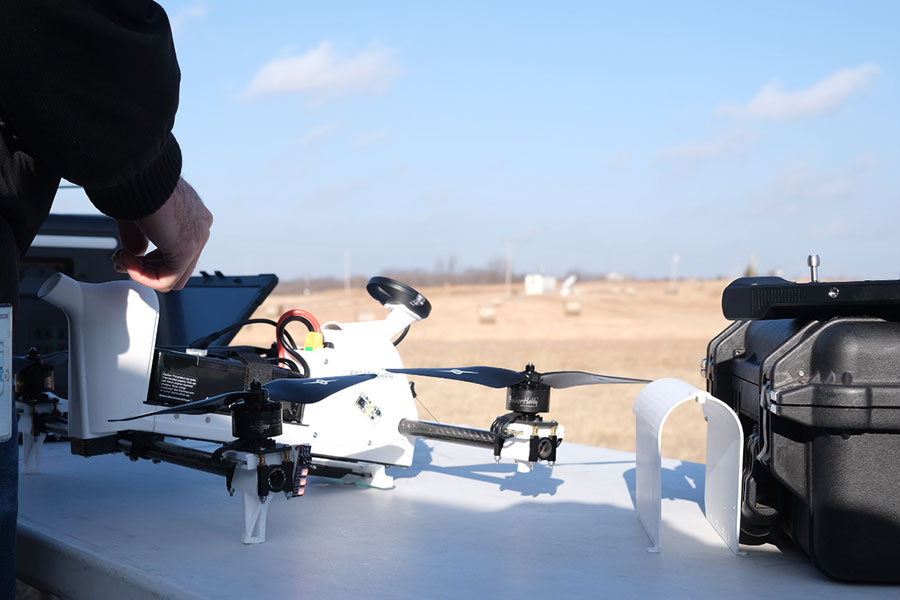
The National Weather Service has, for the first time, purchased vertical atmospheric profiles collected by drones — data collected by the University of Oklahoma (OU) and Meteomatics. The milestone is the next step forward for the Oklahoma 3D Mesonet.
Meteorologists and engineers achieved a research milestone when phased array radar was used in operations for the first time ever to help National Weather Service forecasters warn of an EF-2 tornado.
The 3D Mesonet project aims to make advancements in gathering spatiotemporal atmospheric data in the United States, allowing scientists to better predict short-term, high-impact weather, like thunderstorms, severe winds and winter precipitation.