Gibbs College students enrolled in Prof. Bloom’s Spring 2021 “Design + Build” class (CNS 4970/5970) have been working hard to create a mobile medical unit to meet the needs of rural members of the Wichita and Affiliated Tribes.
The mobile medical unit is an innovative community engagement project. The unit is comprised of many pre-cut, prepared materials that allow for “ease-of-construction” for those who may not have all the tools or experience for a traditional build. This helps to decrease some of the barriers associated with construction for future builds.

Credit: Ken Marold https://www.instagram.com/kenmarold/
The foundation of this project is a cooperative venture between assistant professor of Architecture Ken Marold and Construction Science faculty member Bryan Bloom. Marold conceptualized and designed the medical unit. He also created a fabrication strategy for building the unit quickly. Bloom then took over the construction leadership; guiding the Design + Build students in crafting the unit.
Bryan Bloom was in charge of instructing and assisting with the build, and he’s excited about what the techniques could mean for the discipline, as well as to get the unit finished and in use.
“This is a mobile medical clinic meant to serve the rural tribal member’s needs,” said Bloom. “It’s built on an engineered trailer platform, and we have designed and constructed a prefabricated componentized plywood frame, essentially a kit-of-parts approach, which we think can be applied in a number of ways in the discipline whether it’s deployable flat-packed buildings, affordable housing or even DIY projects. Essentially after the frame is cut out, the only tools someone needs to erect it is a drill and a rubber mallet.”
Designing the mobile medical unit has been an intensive process.

Credit: Ken Marold https://www.instagram.com/kenmarold/
“The biggest challenge was in the programming,” said Marold. “Not in a conventional, architectural programming sense, but in the computer programing, writing a streamlined and efficient end-to-end code strategy to holistically respond to any spatial and programmatic changes made.”
As the existing software would automatically adjust the entire design with any change, Marold had to create his own solutions.
“Basically, I needed to program (computer) the programming (architecture). This was a critical component in the design of the code for this project.”
“Since the materials are interlocking and tolerances are tight,” Marold explained, “we needed a flexible, parametric workflow that would essentially update every dependency if a spatial change was made. This was essential to a project like this within our given timeframe. With such a range of on-the-fly adjustments during design development, and with the depth of repetition and precision required for every single part, it would have been otherwise impossible to execute this type of system without the computer’s assistance in continuously updating every parametrized part.”
“In the end I designed and developed a piece of software to generate this project,” said Marold. “When the architectural design was done, there was no other step but to build; the kit of parts was CNC milled and a short 3-D puzzle-like assembly diagram was generated. No need for extensive construction drawings or even the need for any sort of drafting software; just Rhino, Grasshopper, and Illustrator.”

Credit: Ken Marold https://www.instagram.com/kenmarold/
Construction Science senior Asael Herrera was appreciative of the experience.
“I wanted to take this class to have the opportunity to give back to the community,” said Herrera. I didn’t know it would be a medical mobile unit, but it’s amazing to give back to our community in this way. This is a great experience because there are people learning and teaching across a variety of construction backgrounds.”
Matthew Homsher, a fellow senior, was also eager to tackle the project.
“I really wanted to work with Bryan, and I wanted to come to class every day and build,” said Homsher. “I worked on a similar project with Bryan when I was taking my second Materials and Methods class and jumped at the opportunity to work with him again. I love that we incorporate design-build elements, work hands-on, and get to work with a new pre-fabrication system.”
It’s not just the students who learn from these projects; Bloom works to build on his knowledge in the process as well.
“One of the things I try to convey to the students is, no matter how routine or unique the project is, that part of our job is to collaborate with the designer – to offer some practical field knowledge of how materials attach to each other, how to best sequence the work, how to keep weather out. So on this project, I’ve found that coupling that awareness with digital design and fabrication really broadens the lens of our capabilities as builders.”
The mobile medical unit is expected to be delivered to Anadarko, OK this June by Bloom and his team. The Wichita and Affiliated tribes will use the trailer to provide service to tribal members in southern and southwestern Oklahoma.
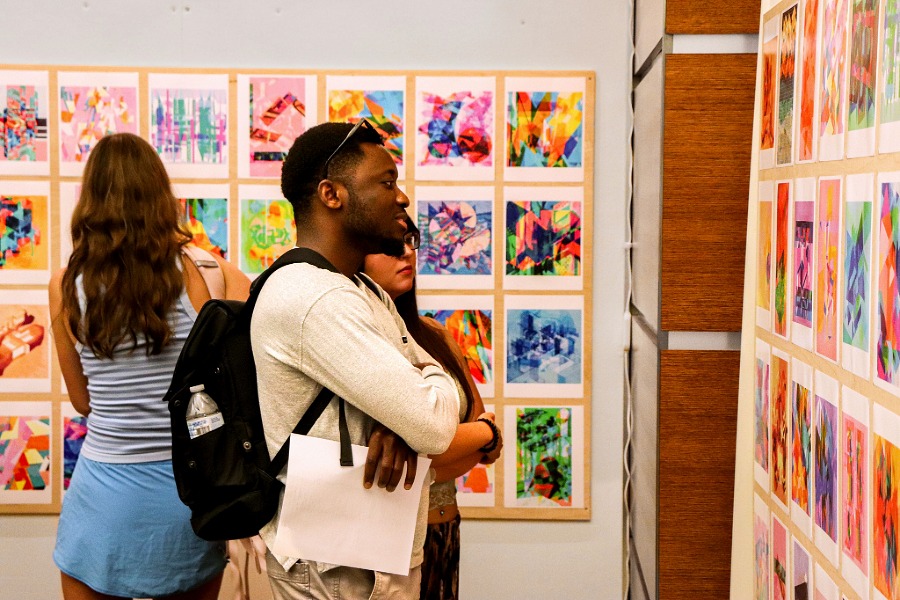
Gibbs College is pleased to present the exhibition 200 Digital Drawings by Professor Tiziana Proietti, currently on display in the Gould Hall Living Room.
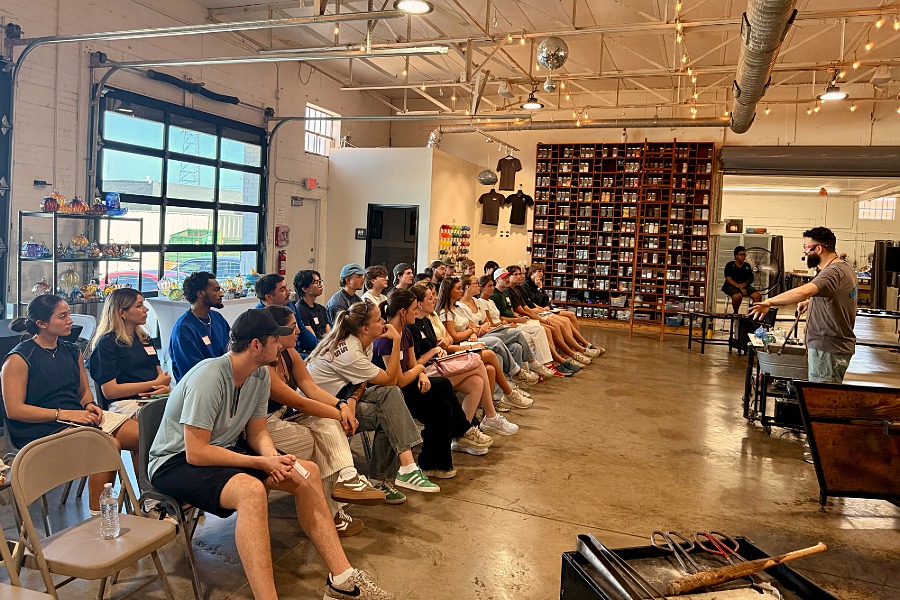
Gibbs College of Architecture Professors Amber Brown and Amy Leveno led 29 students to Dallas, Texas, in September for a learning experience as part of their Design 7 Studio course.
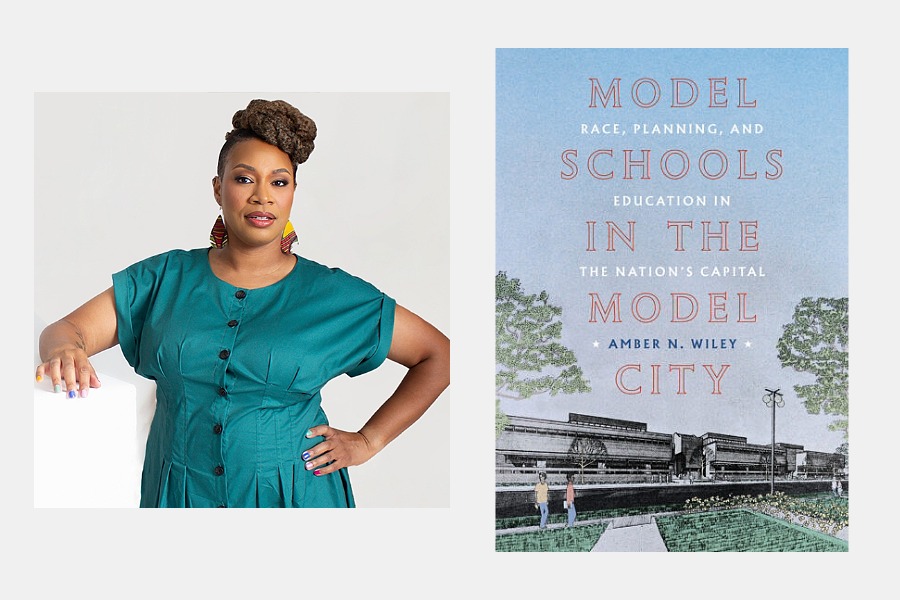
Christopher C. Gibbs College of Architecture professor and Institute for Quality Communities Director Dr. Amber N. Wiley’s book, Model Schools in the Model City: Race, Planning, and Education in the Nation’s Capital, has received two major honors from the Urban History Association.