Dr. Bryce Lowery, an associate professor in the Division of Regional + City Planning, is part of the University of Oklahoma Sewage Surveillance Team which recently received the Award for Excellence in Transdisciplinary, Convergent Research. This award was part of the 2022 Norman Campus Faculty Awards and Honors which were recognized during the Faculty Awards Luncheon on April 14th.
The University of Oklahoma Sewage Surveillance team is a team of eight researchers, including Dr. Lowery, at the University of Oklahoma who at first worked on wastewater surveillance for COVID-19 have been engaged in long-term surveillance of Oklahoma wastewater for several foodborne pathogens that cause gastrointestinal disease. This surveillance effort makes this team one of the few in the world to take part in long term, permanent surveillance.
When people are infected with a pathogen, they shed the pathogen in their waste before they begin to show symptoms. This means that sewage surveillance can predict an outbreak of a pathogen up to a week before a surge in reported cases. The OU Surveillance team originally used this in order to predict COVID-19 case surges, but there are now surveying sewage for the four most common foodborne pathogens in Oklahoma: Salmonella, Campylobacter, Norovirus, and Shiga toxin-producing E. coli (STEC). The team is able to see accurate infection rate data, even if people are not getting tested or showing severe symptoms.
If outbreaks are detected, the team will communicate with the Oklahoma City-County Health Department who will issue public health announcements instructing the public how to prevent infections and how to seek treatment for these pathogens as needed. This will give the health department advance time to prevent severe outbreaks of foodborne pathogens.
The Sewage Surveillance Team received the Award for Excellence in Transdisciplinary, Convergent Research because of the team’s efforts to protect the public health of Oklahomans as well as to foster transdisciplinary cooperation. Dr. John Harris, Director of the Division of Regional + City Planning, said, “The award recognizing Dr. Lowery and the Sewage Surveillance Team highlights not only the excellent work of several individual investigators, but also the best of the professions in Gibbs College where collaborators find transdisciplinary ways to solve practical community problems for the benefit of all.”
Gibbs College is pleased to present the exhibition 200 Digital Drawings by Professor Tiziana Proietti, currently on display in the Gould Hall Living Room.
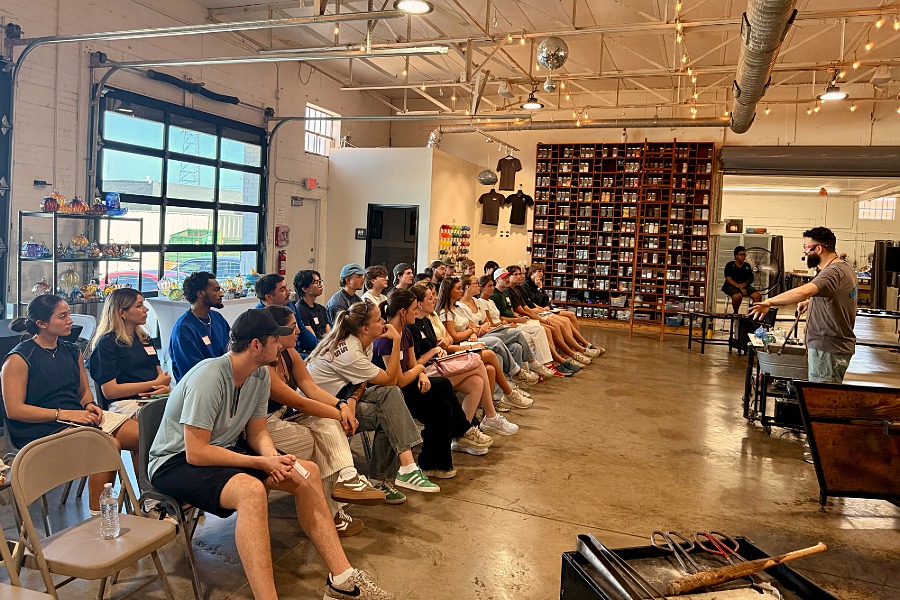
Gibbs College of Architecture Professors Amber Brown and Amy Leveno led 29 students to Dallas, Texas, in September for a learning experience as part of their Design 7 Studio course.
Christopher C. Gibbs College of Architecture professor and Institute for Quality Communities Director Dr. Amber N. Wiley’s book, Model Schools in the Model City: Race, Planning, and Education in the Nation’s Capital, has received two major honors from the Urban History Association.