The University of Oklahoma Christopher C. Gibbs College of Architecture Hall of Fame (GCA HOF) recognizes a select number of high-character individuals who have made a significant and lasting positive impact over time to Gibbs College (GCA), its students, staff, faculty, alumni, and/or to communities across the globe. The impact may have been, or continues to be, in the form of service and mentorship, sustained professional excellence, and/or advancement and financial support. Herb Greene is part of the 2023 Hall of Fame class.

Make a donation in honor of Herb Greene
Gifts will work to build the future of the Herb Greene Teaching Fellowship. This prestigious fellowship invites emerging designers and scholars for a two-year immersive experience in the Division of Architecture, promoting the cultivation of individual creative identity and fostering growth in teaching and research. Fellows are selected based on their unique approach to design and potential for contribution to the field, reflecting Greene’s own radically creative philosophy.

Herb Greene was born in Oneonta, New York in 1929. Greene began his architectural studies at Syracuse but transferred to the University of Oklahoma after learning of Bruce Goff’s work in 1948. Known for his skill as an artist and delineator, Greene produced many colored renderings for Goff over several years, including the drawings of the Bavinger House. After graduating in 1953, Greene worked in Houston and then in Los Angeles for John Lautner. He returned to OU to teach for six years (1956-62) as an associate professor, where he and his colleagues, including Bruce Goff and Mendel Glickman, developed the American School of architecture.

Herb Greene's Prairie House in 1961. Photo by Robert Alan Bowlby.
In 1962, Greene accepted a teaching position at the University of Kentucky, where he taught for 18 years. Among his most important works are: the Lyne Residence (1956; Houston, TX); the Joyce Residence and the Roosevelt Granite Quarry Office (1960; Snyder, OK); the Prairie House, labelled the “Prairie Chicken House” by Life magazine (1961; Norman, OK); the Cunningham Residence (1963; Oklahoma City, OK); Unitarian Church (1965; Lexington, KY); and the French Residence (1966; Versailles, KY).

Cunningham Residence by Herb Greene. Photo by Julius Shulman.
Throughout his life, in addition to being a practicing architect, Greene was also a prolific visual artist. Using mixed media, including photographs, he explores memory, experience and time. Greene is a celebrated artist and architect, known throughout the United States for his influence on American Architecture and has been recognized with exhibitions of his work. Greene’s influence on the curriculum and pedagogy at Gibbs College can still be seen today, as students are encouraged to respect, connect, be experimental, resourceful, and look beyond the accepted canon of Western architecture.
Gibbs College is pleased to present the exhibition 200 Digital Drawings by Professor Tiziana Proietti, currently on display in the Gould Hall Living Room.
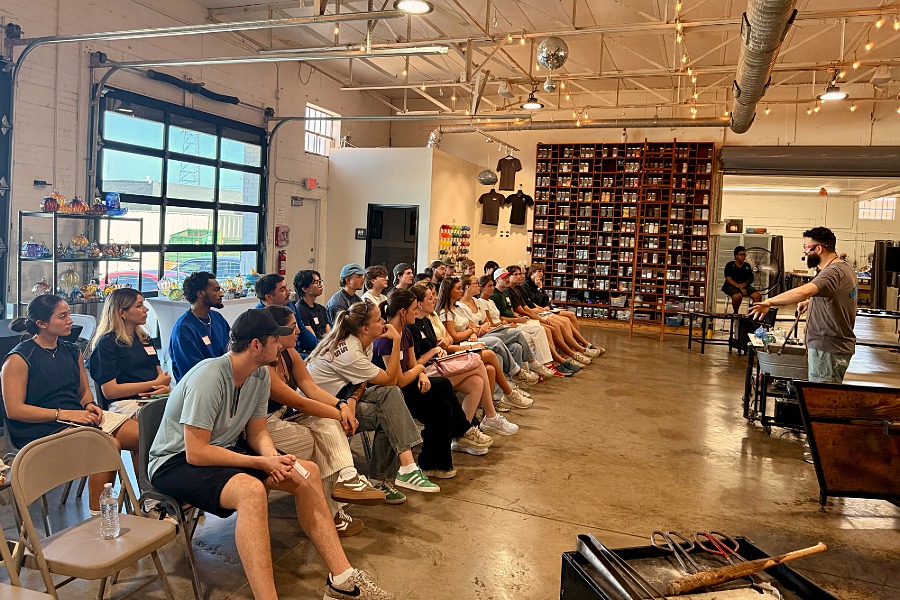
Gibbs College of Architecture Professors Amber Brown and Amy Leveno led 29 students to Dallas, Texas, in September for a learning experience as part of their Design 7 Studio course.
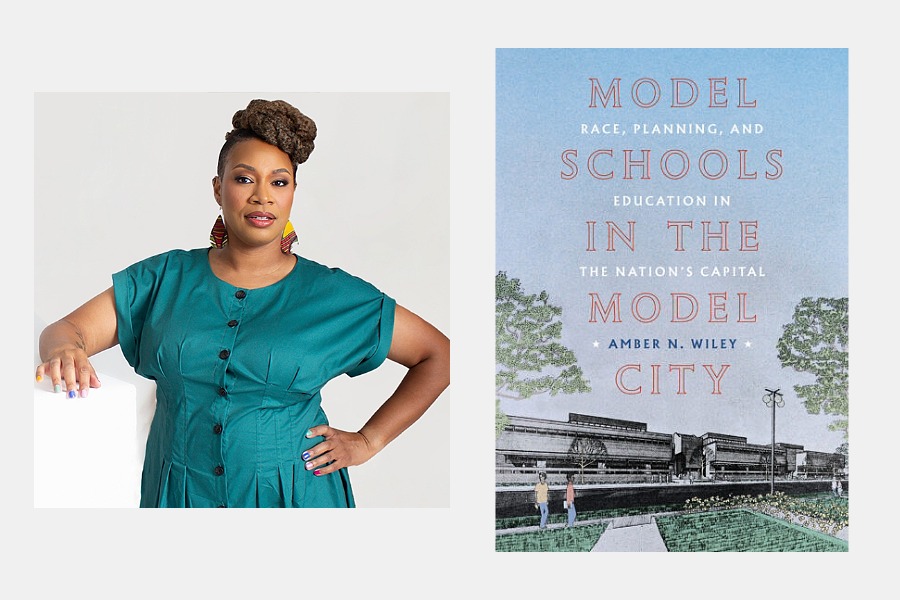
Christopher C. Gibbs College of Architecture professor and Institute for Quality Communities Director Dr. Amber N. Wiley’s book, Model Schools in the Model City: Race, Planning, and Education in the Nation’s Capital, has received two major honors from the Urban History Association.