Gibbs College of Architecture (GCA) alumnus Tony Wu has spent nearly two decades at Pelli Clarke & Partners, rising to Senior Associate and leading projects on an international scale. His recent work, a transit-oriented development in Yibin, China, earned national recognition in China and was featured on ArchDaily. The GCA Communications Team sat down with Tony to reflect on his path from the University of Oklahoma (OU) to the world stage.
Tony Wu graduated from OU in 2007 with dual degrees in Architecture and Mathematics. Originally from Taiwan, Tony moved to Edmond, Oklahoma, as a middle schooler and went on to spend six years at OU before launching a career that has taken him across the globe.
His path toward architecture began well before college. As a freshman in high school, Tony's woodworking teacher handed him a book on drawing floor plans and asked him to design a new woodshop. Little did he know that by the end of that summer, the 30-by-40-foot structure, complete with an upper-level apartment, had been built from his drawings.
"You start thinking you can be an architect one day," he recalls. "Little do you know what architecture is other than just a little shop."
Shortly after graduating from OU, Tony secured an opportunity to work in the Tokyo office of Pritzker Prize-winning architect Shigeru Ban, a formative three-month experience that helped position him for a role at Pelli Clarke & Partners, where he has worked for 18 years. He currently serves as an Senior Associate, managing large-scale international projects from his home base in Maryland.
Tony points to his fifth-year architecture studio at OU, led by Dr. Khosrow Bozorgi, as an experience that directly shaped his approach to design. Architecture school can be resource-intensive, and Tony found a practical workaround. Rather than purchasing materials for the large-scale models the studio required, he collected scrap pieces discarded by other students from the studio floor. The result was one of the largest models in the studio, built entirely from leftover materials.
"I didn't have money to build the giant models," he says plainly. It was an early demonstration of the resourcefulness that would serve him well throughout his career.
Video of the Kerman Studio project taught by Dr. Bozorgi.
The studio itself focused on a partially earthquake-damaged bazaar district in Kerman, Iran, asking students to think critically about public space, urban circulation, and cultural identity. Tony's assigned site sat at the periphery of the main planning axis, but rather than treating that as a limitation, he focused on its role as the primary entry point into the broader development. Recognizing that every visitor to the broader development would pass through his site first, he put pedestrian circulation at the center of his design thinking. That foundation was later reinforced during his graduate studies at Columbia University, where he engaged deeply with ideas around activating public space and “designing the void.”
Among Tony's most recognized projects is a large-scale transit-oriented development in Yibin, China, completed in roughly three years after the firm's proposal beat out several internationally prominent competitors. Tony served as project manager across the multi-phase effort, which includes a central park, retail pavilions, an art museum, civic buildings, and a network of elevated pedestrian infrastructure connecting a high-speed rail station to surrounding residential and office development.

Elevated walkways, greenery, and active pedestrian programming come together at the Yibin development, reflecting the commitment to pedestrian connectivity and public space. (Photo courtesy of Pelli Clarke & Partners)
The design draws inspiration from the natural landscape of the Yibin region, which is home to numerous species of bamboo. The team was drawn to the way most bamboo grows, not as individual plants, but as one connected system spreading outward from a shared root network. That idea carried into the project, with the central park functioning much like those roots, connecting the towers, pavilions, and surrounding neighborhoods into a single cohesive place.
The design also separates pedestrian and vehicular traffic throughout, allowing visitors to move from the rail platform through the park and into the broader district without crossing a single signalized intersection. The central park, approximately 60% open outdoor space, incorporates everyday programming such as studio space, tech facilities, and small retail rather than functioning as purely ornamental green space. "It's about making a statement that this is a place you want to live and work," Tony explains. "The park is not just a giant green space — it has a ballet studio, an IT lab, little convenience stores. It's your everyday thing."

Art museum featured among the High-Speed Rail development. (Photo courtesy of Pelli Clarke & Partners)
The art museum, which was constructed first, also served as a showroom for the entire development, housing a large-scale model of the project in its main gallery. It was there that President Xi Jinping visited ahead of the official groundbreaking, an endorsement that accelerated momentum across the project.
"You can only imagine," Tony says. "The president says this is a great project, and everybody is like, let's get this built." The project subsequently received a segment during China's national Lunar New Year broadcast, the country's most-watched television event, bringing the development to a national audience. It has since been featured on ArchDaily and continues to serve as a prominent example of the Tony’s people-centered approach to large-scale urban design.
Tony credits the project as a direct expression of the values he began developing at OU. "Designing for the people—I really walked away from the Kerman Studio with that."
Learn more about the Yibin TOD project on Pelli Clarke & Partners website.
Construction Industry Speaker Series welcomed Stephen Evans from the Oklahoma City National Memorial & Museum to give a lecture on better conversations and relationship building.
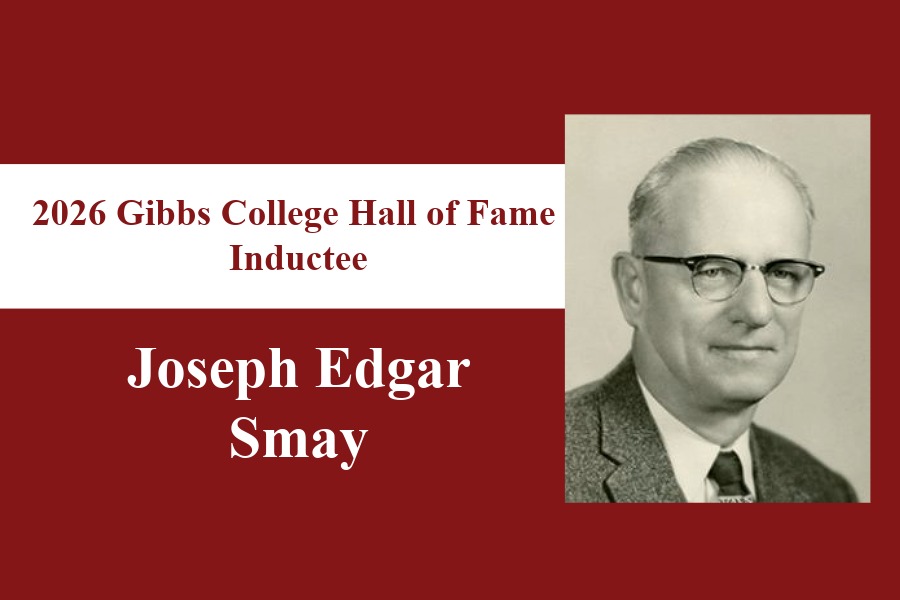
The University of Oklahoma Christopher C. Gibbs College of Architecture Hall of Fame recognizes a select number of high-character individuals who have made a significant and lasting positive impact on Gibbs College, its students, staff, faculty, alumni and/or to communities across the globe. The impact may have been, or continues to be, in the form of service and mentorship, sustained professional excellence, and/or advancement and financial support. Joseph Edgar Smay is part of the 2025 Hall of Fame class.
Christopher C. Gibbs College of Architecture congratulates three architecture students who were recognized in the 2026 AIA Dallas Student Design Awards.