NEWS


NORMAN, OKLA. – A team from the University of Oklahoma Gallogly College of Engineering has embarked on a pioneering partnership with scientists from the National Aeronautics and Space Administration, NASA, to advance research and technological development in advanced air mobility. This initiative aims to support NASA's efforts in integrating a range of new scalable traffic management operations, focusing on enhancing energy efficiency and real-time capabilities in collision avoidance, navigation, and control systems for advanced air mobility in complex environments.
Funded by a NASA EPSCoR grant, the research team comprises Mike Banad, Rockee Zhang, and Golnaz Habibi from OU and He Bai from Oklahoma State University. This project will use neuromorphic, or advanced brain-like technology, to improve the ways in which uncrewed aircraft systems (UAS) manage air traffic – focusing on improving their ability to sense and avoid obstacles, as well as their communication and navigation skills. This research aims to improve the safety of adding UAS for urban transportation into current air traffic systems.
Through communication with NASA and a visit to the Ames Research center, the team has aligned the project with the NASA NExCT program goals to establish functional requirements for air traffic management operations and to foster cooperative operating practices among diverse aircraft types. The collaboration underscores a shared commitment to developing innovative, AI-enabled, scalable and secure autonomous navigational solutions, improving the efficiency and safety of unmanned aerial vehicle operations and contribute to the program’s broader goal of advancing air mobility and traffic management technologies for future aerospace endeavors.
About the University of Oklahoma
Founded in 1890, the University of Oklahoma is a public research university located in Norman, Oklahoma. As the state’s flagship university, OU serves the educational, cultural, economic and health care needs of the state, region and nation. OU was named the state’s highest-ranking university in U.S. News & World Report’s most recent Best Colleges list. For more information about the university, visit ou.edu.
The University of Oklahoma has received a transformative gift from Jon and Shannon McCartney, which will name the McCartney Family Tunnel of Champions, the McCartney Family Gate of the Gaylord Family - Oklahoma Memorial Stadium and the McCartney Family Grand Lecture Hall in the Michael F. Price College of Business. The gift will also support the Inspiring Champions and the Athletic Director’s Discretionary Fund, in addition to establishing the McCartney DFW Career Trek program at Price College.
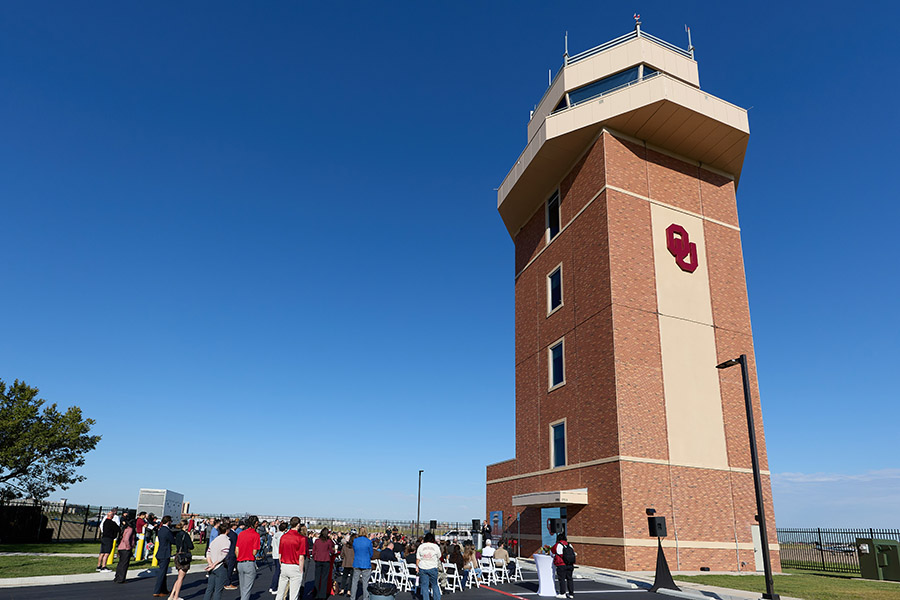
The University of Oklahoma today celebrated the opening of a new air traffic control tower at the OU Max Westheimer Airport. Standing 106 feet tall, more than double the current 52-foot facility, the new tower will modernize air traffic control operations and improve safety for pilots and students operating in the airspace.
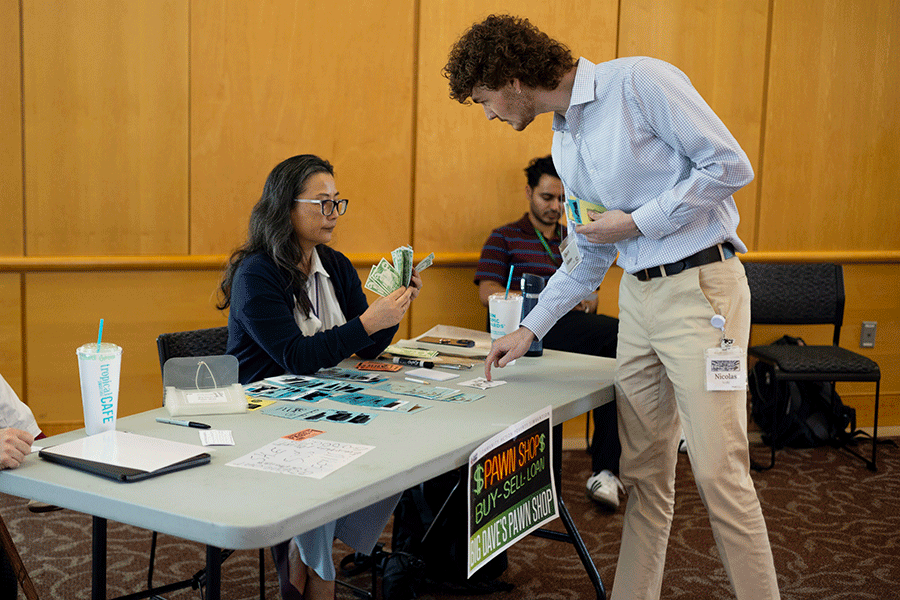
Do I buy groceries or pay the electric bill? Should I pawn some of my belongings to afford my prescription? My child is sick, so I will have to miss work to take care of him. Those are just a few of the difficult choices that OU-Tulsa health professional students confronted during the Community Access to Resources Experience. The role-playing activity challenged students to navigate the financial, family and other pressures that can affect a person’s health and ability to follow medical advice. Held annually during the SCM Institute orientation week, the experience is designed to generate understanding and build empathy.