NEWS

OKLAHOMA CITY, OKLA. – Pain-free movement is something that many of us take for granted. But for patients with peripheral artery disease, or PAD, merely walking a block or two can mean disabling leg pain — pain that often causes these patients to reduce their overall level of activity well below recommended amounts for a healthy lifestyle.
A researcher with the University of Oklahoma College of Medicine recently received funding from the National Institutes of Health National Institute on Aging — more than $2.4 million over five years — to study the efficacy of a new painless exercise protocol to treat the symptoms of PAD and ultimately increase patients overall physical activity. The research effort is led by Andrew Gardner, Ph.D., a professor in the cardiovascular section of the OU College of Medicine.
“Having PAD doesn't necessarily mean that patients are going to have a heart attack or stroke, but they are at higher risk,” Gardner said. “It's disabling. So, guess what? They do less walking because it hurts. And so, because they walk less, now they're totally inactive and that's a high-risk factor for cardiovascular disease to develop even further.”

Peripheral artery disease is when narrowed arteries reduce blood flow to the extremities which can cause pain, called claudication, in the legs. The pain is caused by ischemia or lack of oxygen due to the reduced blood flow to the muscles. This pain occurs during exercise of any kind, particularly walking, and is relieved by rest. However, one of the common treatment protocols for reducing claudication in PAD patients is, in fact, exercise.
Gardner explains that often these patients are prescribed exercise, typically walking, wherein they are instructed to walk until they are experiencing a moderate level of pain, stop and rest until the pain recedes and then repeat the process. They continue this until they have accomplished 20 to 30 minutes of walking, he says. Patients often see results after just a few months of following this regimen regularly.
But there are two main drawbacks to this method. Because the ischemia is happening, and the leg muscles are being deprived of oxygen, there can be muscle damage. And because the regimen does require the patient to walk to the point of moderate pain, those who would benefit most are less likely to adhere to the protocol, Gardner said.
To address these challenges, the research team will conduct a randomized controlled trial during which 100 patients – 20 per year for five years – will complete the program. Half of the participants, the control group, will follow the traditional ischemic exercise routine. The other half will be prescribed the non-ischemic, or pain-free, exercise plan.
Gardner explains it this way: This experimental group will be asked to walk slower and for shorter sessions – stopping before their leg muscles get ischemic and painful. A monitor on their calf during the walking sessions will measure the oxygen in the muscle.
For example, the control group may be walking at a leisurely two-miles-per-hour pace for perhaps four to five minutes when they reach moderate pain level and must stop for rest. Gardner’s experimental group will walk at a slower one-and-a-half miles per hour pace for merely a minute or two, stop to rest, then repeat.
“We're hypothesizing that, because we're eliminating, or at least decreasing, the pain, that there's going to be less inflammation and better microvascular circulation,” Gardner said.
After five years, they will compare the two groups with walking performance on a treadmill and measure their circulation along with any inflammation.
The value of this study is clear. It could change the whole approach of exercise training with PAD patients, says Gardner. Since it’s pain-free, they may like it better, which could cause better participation rates in these programs for PAD patients nationwide, he says.
“Because, as you can imagine, a lot of these patients have not exercised at all in their life and now they're 70 years old and they've got this problem, and now every time they walk, they hurt,” he says. Gardner hopes this pain-free exercise protocol could help change that dynamic for these patients. And he knows the value of exercise. His background is in exercise physiology, bringing more than 30 years of experience in the cardiovascular field.
But better participation rates aren’t the only thing Gardner hopes to achieve with this study.
“I'm very interested in physical activity throughout the day [for PAD patients],” he said. He plans to monitor patients’ daily activity levels both before and after study participation. The idea, says Gardner, is that if patients are seeing an improvement in walking without pain, that should translate into more activity throughout the day.
“So [study participants] are really becoming more active, which then has all sorts of benefits for them,” Gardner said.
About the research
Research reported in this press release is supported by the National Institute on Aging, a component of the National Institutes of Health, under the award number 1R01AG071778-01A1.
About the University of Oklahoma
Founded in 1890, the University of Oklahoma is a public research university located in Norman, Oklahoma. As the state’s flagship university, OU serves the educational, cultural, economic and health care needs of the state, region and nation. OU was named the state’s highest-ranking university in U.S. News & World Report’s most recent Best Colleges list. For more information about the university, visit ou.edu.
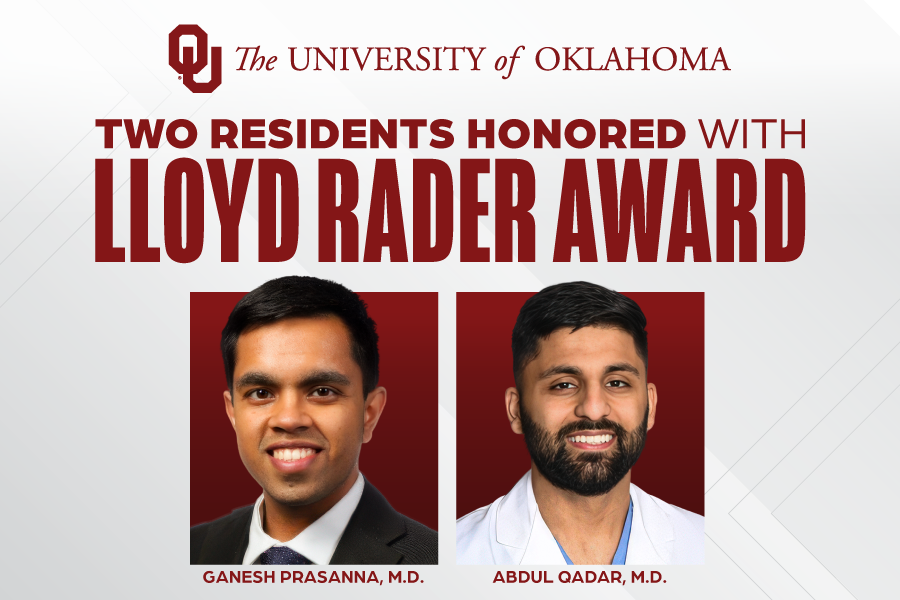
The University of Oklahoma College of Medicine has honored two residents with the Lloyd Rader Award, which recognizes outstanding clinical and research achievements in residency.
The University of Oklahoma will receive up to $220 million over five years from the U.S. Department of Commerce and the National Oceanic and Atmospheric Administration to continue the life-saving weather research led by the OU-NOAA Cooperative Institute for Severe and High-Impact Weather Research and Operations, extending a nearly 50-year partnership that has helped give Americans earlier, more accurate weather warnings
The OU Food Pantry won the annual Red River Food Fight, collecting 31,815.9 pounds of shelf-stable food and drinks to top UT Outpost’s 22,567 pounds. OU has won the competition four years in a row.