NEWS


OKLAHOMA CITY, OKLA. – Increasing degree completion to strengthen Oklahoma’s workforce pipeline in education, health care and STEM (science, technology, engineering, and math) fields continues to be the state system of higher education’s top priority. That was the message delivered by Chancellor Sean Burrage as he presented the Oklahoma State Regents for Higher Education’s 2025 legislative agenda and FY26 budget request to an audience of lawmakers, community leaders and educators at the University of Oklahoma Health Sciences campus on Dec. 17.
For FY26, the State Regents request an increase of $95 million, or 9.3% over the FY25 appropriation.
“Producing more college graduates to meet Oklahoma’s most pressing workforce needs is our primary goal,” Burrage said. “Our FY26 budget request for public higher education clearly demonstrates the state system’s commitment to expanding the labor force in critical occupations and incentivizing academic and operational innovations as outlined in our Blueprint 2030 strategic plan.”
The State Regents seek $9.3 million for FY26 to fund implementation of the Strong Readers Act provisions and expand concurrent enrollment.
Public higher education’s budget request also includes strategic investments that align with Oklahoma’s projected workforce demand in STEM and health care and focus on increasing adult degree completion. The State Regents request $42 million for critical workforce development initiatives, including funds to increase enrollment and graduation in STEM, nursing, and other health care disciplines and provide additional scholarships for adult students.
The State Regents also seek $43.7 million in FY26 to fund performance-based institutional allocations; strengthen college access and academic success services and FAFSA completion; expand student scholarships; fund innovations and efficiency initiatives; and enhance campus physical and cyber security. Additionally, the State Regents will advocate for institution-specific allocations of $403 million to meet campus needs, including system and structure maintenance projects, and fund strategic collaborations.
Expanding the Oklahoma Equal Opportunity Scholarship Act tax credit is also a priority for the State Regents in the upcoming legislative session. Authorizing the tax credit for donor contributions to fund need-based scholarships for students attending public colleges and universities will support efforts to increase Oklahoma’s college-educated workforce.
Another priority for the State Regents in the upcoming legislative session is refining the Oklahoma’s Promise scholarship to reduce administrative barriers to student access and participation. Strategies may include developing an appeal process to assist students facing unique circumstances and extending the application deadline to ensure no qualified student is excluded. Recognized by many as one of the top promise scholarship programs in the country, Oklahoma’s Promise is considered a national model that emphasizes both academic preparation and financial support for college. To learn more or to apply online, visit https://okpromise.org/.
About the University of Oklahoma
Founded in 1890, the University of Oklahoma is a public research university located in Norman, Oklahoma. As the state’s flagship university, OU serves the educational, cultural, economic and health care needs of the state, region and nation. For more information about the university, visit www.ou.edu.
The University of Oklahoma has received a transformative gift from Jon and Shannon McCartney, which will name the McCartney Family Tunnel of Champions, the McCartney Family Gate of the Gaylord Family - Oklahoma Memorial Stadium and the McCartney Family Grand Lecture Hall in the Michael F. Price College of Business. The gift will also support the Inspiring Champions and the Athletic Director’s Discretionary Fund, in addition to establishing the McCartney DFW Career Trek program at Price College.
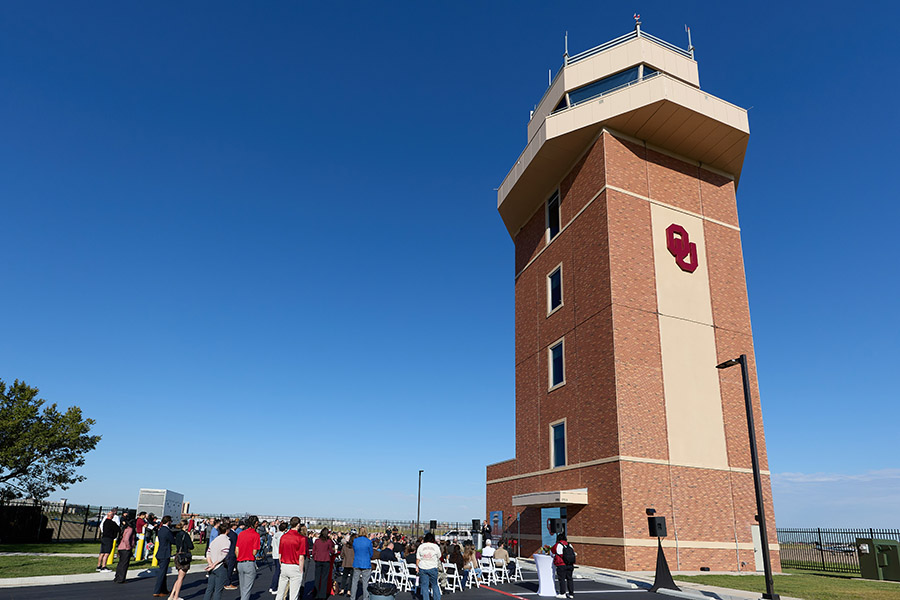
The University of Oklahoma today celebrated the opening of a new air traffic control tower at the OU Max Westheimer Airport. Standing 106 feet tall, more than double the current 52-foot facility, the new tower will modernize air traffic control operations and improve safety for pilots and students operating in the airspace.
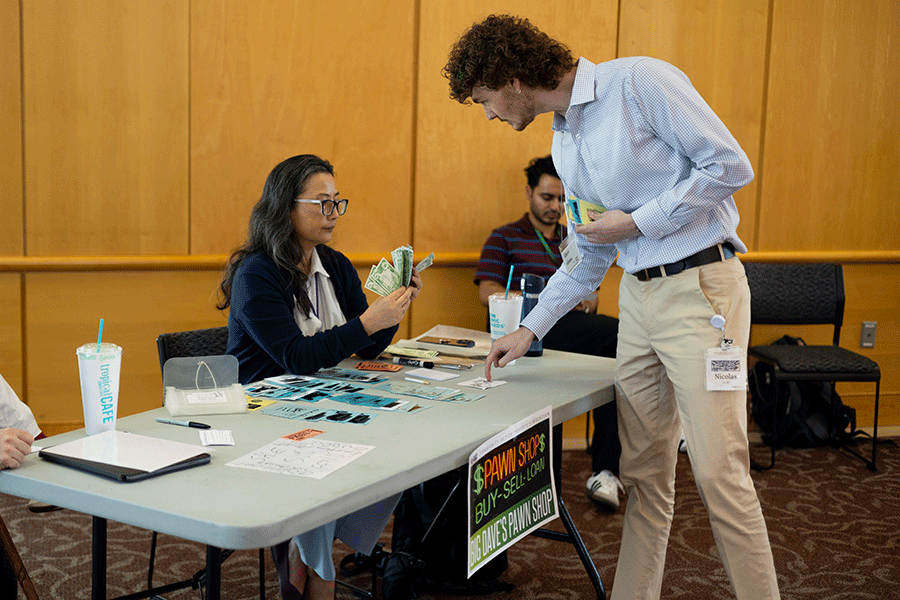
Do I buy groceries or pay the electric bill? Should I pawn some of my belongings to afford my prescription? My child is sick, so I will have to miss work to take care of him. Those are just a few of the difficult choices that OU-Tulsa health professional students confronted during the Community Access to Resources Experience. The role-playing activity challenged students to navigate the financial, family and other pressures that can affect a person’s health and ability to follow medical advice. Held annually during the SCM Institute orientation week, the experience is designed to generate understanding and build empathy.