NEWS


By
Annette Price
Date
NORMAN, OKLA. – The Cooperative Institute for Severe and High-Impact Weather Research and Operations (CIWRO) at the University of Oklahoma will receive federal funding totaling $4.5 million to advance NOAA’s next-generation water modeling of precipitation frequency as well as water availability.
The award is part of the U.S. Department of Commerce and NOAA’s announcement today of $22.78 million in funding to NOAA labs, programs, cooperative institutes and other research partners to advance research on a wide range of water-driven climate impacts. CIWRO’s work is in collaboration with the NOAA National Severe Storms Lab (NSSL) at the National Weather Center in Norman.
“Flash flooding events, as witnessed recently in western North Carolina from Hurricane Helene, are the greatest, most impactful short-fused weather events that we have in the United States. On average, more lives are lost and more damage is done with flooding and flash flooding than with any other severe weather event,” said Steven Martinaitis, a researcher who works within the storm-scale hydrometeorology group at CIWRO and NSSL. “Having more accurate rainfall data to help with the prediction of flooding will help mitigate the loss of life and property.”
The award will allow researchers working on NSSL's Multi-Radar Multi-Sensor (MRMS) system to improve real-time quantitative precipitation estimates used as inputs to NOAA's National Water Model (NWM), allowing meteorologists to improve precipitation estimation and its frequency through hydrological modeling.
“One of the biggest challenges with flooding is getting that precipitation estimation correct. We only have so much coverage with radar, and we have only so many ground observations. MRMS allows us to gather all this information and seamlessly blend it together to put together a more complete picture. One aspect of this funding is that it will allow us to build up our infrastructure to bring in even more observations, better utilize the observations and allow us to advance the science,” Martinaitis said.
In addition to flash flooding, the CIWRO precipitation research will help in the prediction of flooding near bodies of water and provide more accurate information for water resourcing.
“Integrating more data sets along with building new scientific advancements in areas of precipitation estimation can help with more accurate modeling for large-scale riverine flooding. Also, when we better understand how much water is there, various end users involved with water resourcing can understand how to better allocate water between the different entities, whether it's city, state, municipal, or tribal,” Martinaitis said.
CIWRO Director Greg McFarquhar said the cooperative institute’s continued collaboration with NOAA is vital to advancing safety through warnings of severe weather events.
“This project is critical for CIWRO’s overall effort to improve the understanding of multiple forms of severe and high-impact weather that have great societal importance. It is only through the availability of better data that we can know better the processes occurring so that we can translate that knowledge into improved models. Their output will ultimately save lives and property and reduce the economic impact of such events,” McFarquhar said.
Federal leaders echoed the importance of the $22.78 million in research funding.
“Thanks to President Biden’s historic Bipartisan Infrastructure Law, this investment will help boost NOAA’s efforts to address the rising threat of climate change — putting us on the path to becoming more climate resilient and giving future generations the information and resources needed to tackle the climate crisis,” said U.S. Secretary of Commerce Gina Raimondo.
In recent years, the increasing frequency and severity of coastal and inland flooding, extreme precipitation and other weather events have highlighted the urgent need for better prediction and resilience strategies. Rising sea levels, driven by climate change, are exacerbating these challenges and putting coastal communities at greater risk.
These funds from the Bipartisan Infrastructure Law will help communities prepare for a range of climate impacts and will directly benefit policymakers, emergency responders, researchers and the general public. The announcement is part of more than $6 billion being invested by NOAA in habitat restoration, weather forecasting, and community resilience to weather and climate events through the Bipartisan Infrastructure Law and Inflation Reduction Act.
“By integrating cutting-edge science and technology into prediction tools, we are working to equip communities to prepare for and respond to water-driven climate impacts on our path to becoming a climate-ready nation,” said NOAA Administrator Rick Spinrad, Ph.D. “These efforts enhance our nation’s resilience and underscore NOAA’s commitment to supporting sustainable and informed decision-making in the face of climate variability and change.”
Investigating the complex interactions between the ocean, atmosphere and land systems is key to creating more accurate forecasts. All the funded projects range from refining long-term water level predictions to better understanding natural climate patterns like the El Nino–Southern Oscillation to developing real-time flood risk prediction systems. Others focus on updating climate risk information to inform resilience strategies for communities as well as our nation’s infrastructure, including major bridges, power plants and ports.
About the University of Oklahoma
Founded in 1890, the University of Oklahoma is a public research university located in Norman, Oklahoma. As the state’s flagship university, OU serves the educational, cultural, economic and health care needs of the state, region and nation. For more information about the university, visit www.ou.edu.
The University of Oklahoma has received a transformative gift from Jon and Shannon McCartney, which will name the McCartney Family Tunnel of Champions, the McCartney Family Gate of the Gaylord Family - Oklahoma Memorial Stadium and the McCartney Family Grand Lecture Hall in the Michael F. Price College of Business. The gift will also support the Inspiring Champions and the Athletic Director’s Discretionary Fund, in addition to establishing the McCartney DFW Career Trek program at Price College.
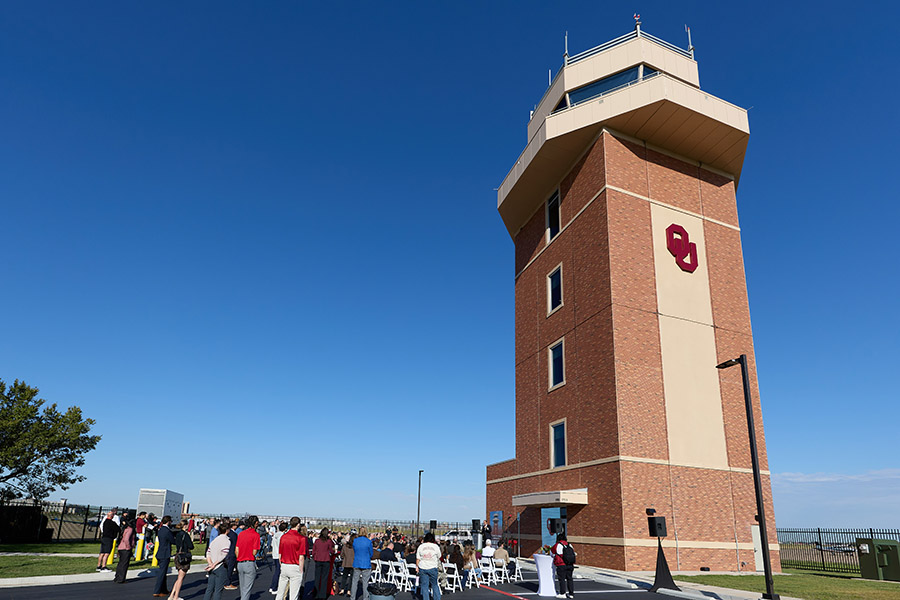
The University of Oklahoma today celebrated the opening of a new air traffic control tower at the OU Max Westheimer Airport. Standing 106 feet tall, more than double the current 52-foot facility, the new tower will modernize air traffic control operations and improve safety for pilots and students operating in the airspace.
Do I buy groceries or pay the electric bill? Should I pawn some of my belongings to afford my prescription? My child is sick, so I will have to miss work to take care of him. Those are just a few of the difficult choices that OU-Tulsa health professional students confronted during the Community Access to Resources Experience. The role-playing activity challenged students to navigate the financial, family and other pressures that can affect a person’s health and ability to follow medical advice. Held annually during the SCM Institute orientation week, the experience is designed to generate understanding and build empathy.