NEWS


NORMAN, OKLA. – Researchers from the University of Oklahoma are teaming up with colleagues from several other nations to focus on early childhood educators’ wellness and career satisfaction. The Happy Teacher Project, a research initiative of the OU Jeannine Rainbolt College of Education, has worked to address the urgent need across the state for recruiting, retaining and strengthening the early childhood education workforce. Now, they are looking beyond international borders to learn from and help other communities facing some of the same challenges. This new program is led by Kyong Ah Kwon, Ph.D., early childhood professor and principal investigator for OU’s Happy Teacher Project. Timothy G. Ford, Ph.D., and Wonkyung Jang, Ph.D., are co-principal investigators for the Happy Teacher Global Project.
“Our Happy Teacher Project team has studied educator well-being and been very successful in making broad impacts on early childhood practice and policy, and then we talk to others in the field and realize that different countries, even among industrialized nations, share some of the same issues,” said Kwon.
Kwon decided that these researchers from other countries and her team could learn a lot from each other, so, she formed a group of scholars to exchange ideas. Happy Teacher Project Oklahoma has interfaced with leading scholars from Singapore, Australia, Hong Kong, Finland and South Korea.
Representatives from two countries, Hong Kong and South Korea, have joined the cross-cultural research to replicate the Happy Teacher Project in their areas. Two others, Finland and Germany, are considering replicating some parts.
Recently, a group from South Korea, led by Jihyun Sung, Ph.D., a leading scholar and professor from Sungkyunkwan University in Seoul, visited Oklahoma and OU’s Happy Teacher Project team. Sung’s group was recently awarded a grant from the National Research Foundation of Korea and will soon begin work on their own early childhood educator well-being research project. Sung brought several graduate students along. The group heard from Happy Teacher Project researchers about holistic wellness for teachers and how to better structure environments to meet teachers’ needs. They also visited a Tulsa Educare, the Cherokee Nation Head Start program, Oklahoma City Educare and Pierce Early Education Center as their partner sites.
“Dr. Kwon introduced the Happy Teacher Project at a conference in Korea, and I realized it is beneficial for teachers’ working conditions and well-being,” Sung said. “That was my ‘a-ha moment’ when I decided I needed to study the same things in Korea.”
While still in its infancy, the Happy Teacher Global Project has established three early measures for moving forward. The international partners and those considering membership meet virtually on a monthly basis, they have organized symposiums for U.S.-based conferences, and they are in the beginning stages of a cross-cultural research study.
Kwon also admits to having more long-range goals. While the research being done is an important first step, ultimately, she and the group would like to have more influence on policymakers globally. This would truly make a difference in the lives of early childhood teachers. She also acknowledges how working with these international partners can allow her team to influence and learn from others.
“That's a big challenge, encouraging people to work together, which Happy Teacher Project does well. The long-term goal is to collaborate with many different areas to ensure teachers’ well-being is improved and to make a lasting difference for teachers and children.”
About the University of Oklahoma
Founded in 1890, the University of Oklahoma is a public research university located in Norman, Oklahoma. As the state’s flagship university, OU serves the educational, cultural, economic and health care needs of the state, region and nation. For more information about the university, visit www.ou.edu.
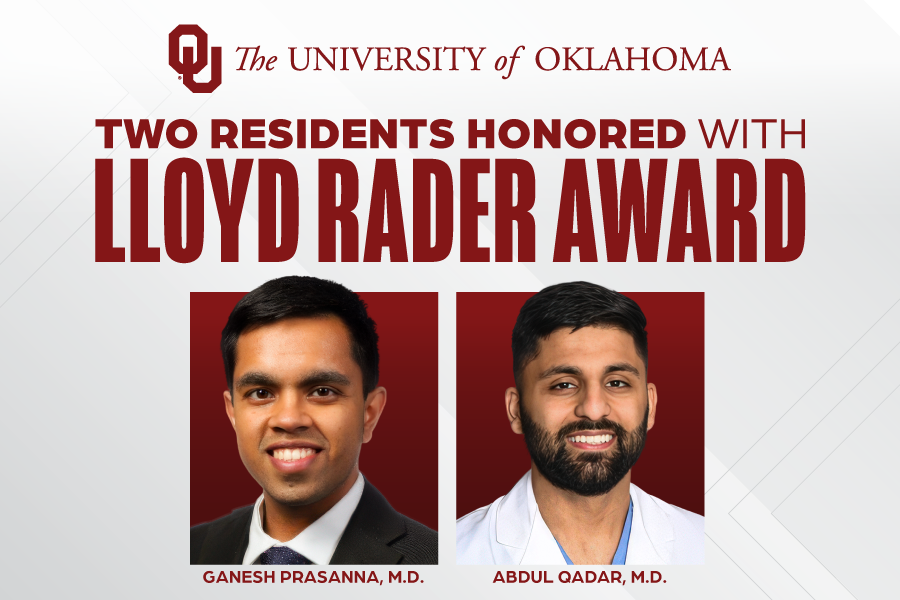
The University of Oklahoma College of Medicine has honored two residents with the Lloyd Rader Award, which recognizes outstanding clinical and research achievements in residency.
The University of Oklahoma will receive up to $220 million over five years from the U.S. Department of Commerce and the National Oceanic and Atmospheric Administration to continue the life-saving weather research led by the OU-NOAA Cooperative Institute for Severe and High-Impact Weather Research and Operations, extending a nearly 50-year partnership that has helped give Americans earlier, more accurate weather warnings
The OU Food Pantry won the annual Red River Food Fight, collecting 31,815.9 pounds of shelf-stable food and drinks to top UT Outpost’s 22,567 pounds. OU has won the competition four years in a row.