NEWS


NORMAN, OKLA. – Amanda Vicente-Santos, a post-doctoral researcher in the University of Oklahoma School of Biological Sciences, has won the Early Career Researcher Award from the journal Ecology Letters for her published research on stressors in bats.
“My research focuses on how human-caused disturbances, like climate change or deforestation, could potentially increase the prevalence of diseases that affect animal hosts and even humans,” she said. “These pathogens could not only cause a decrease in host populations but could change the risk of emerging infectious diseases.”
For the study published in Ecology Letters, Vicente-Santos reviewed 98 previous studies, looking at 891 data points across 71 host species and 78 types of parasites. She focused on three main types of stress that could impact the relationship between animal hosts and pathogens: resource limitations, environmental factors and pollution.
“External factors like land loss can cause the hosts to gather at a much denser rate, likely increasing pathogen strength and transmission. Likewise, pollution can dramatically impact the hosts’ ability to survive or reproduce because their body cannot effectively respond,” she said. “But there’s also a battle happening inside the animal hosts. If they’re under stress because of a lack of quality food, for example, they tend to get sick more easily because their defenses are low. In these cases, a host’s body is essentially a battleground between its immune system and the invading pathogen.”
While these interactions can all happen individually, there is a possibility of them occurring simultaneously. Using published literature and sample data, Vicente-Santos began investigating the host-pathogen interactions under both stressful and optimal conditions.
“We assessed the survival and reproduction rate of the animal hosts, while also examining the prevalence and intensity of pathogen infections,” she said. “We didn’t just want to know how many in the population got infected, we also wanted to see how many parasites were within each individual. That would tell us if the hosts were winning the internal battle against the pathogen.”
Vicente-Santos built theoretical models to predict how the disease dynamics changed under different stress scenarios. The models showed that infection rates peak under moderate stress. However, if the stress became too severe, the hosts would die off causing the pathogens to also die.
“Our goal was to show the implications for possible pathogen emergence and transmission on biodiversity, ecosystem stability, and animal and human health,” she said. “Our findings are significant, but more research is needed to fully understand and predict the impact of these scenarios.”
Vicente-Santos is a member of the Becker Lab at the University of Oklahoma, led by OU assistant professor Daniel Becker, and Verena, the Viral Emergence Research Initiative.
Learn more about the Ecology Letters Early Career Researcher Award.
About the project
“Host-pathogen interactions under pressure: A review and meta-analysis of stress-mediated effects on disease dynamics,” is published in Ecology Letters, DOI no. 10.1111/ele.14319.
About the University of Oklahoma
Founded in 1890, the University of Oklahoma is a public research university located in Norman, Oklahoma. As the state’s flagship university, OU serves the educational, cultural, economic and health care needs of the state, region and nation. For more information about the university, visit www.ou.edu.
Jensen Moore, Ph.D., an associate professor of public relations at the University of Oklahoma’s Gaylord College of Journalism and Mass Communication, has been elected to a three-year term on the Association for Education in Journalism and Mass Communication’s Standing Committee on Professional Freedom and Responsibility.
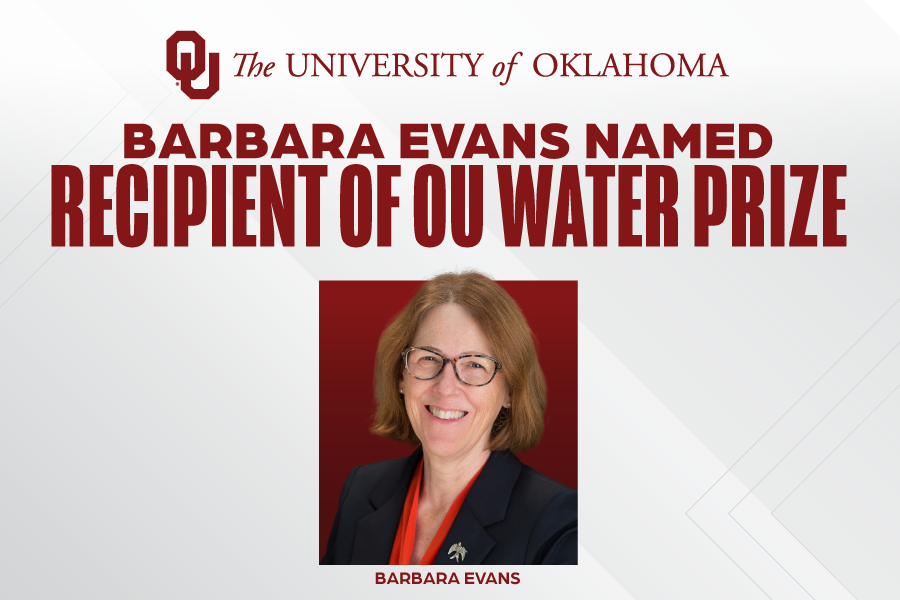
The OU Water Technologies for Emerging Regions (WaTER) Center has awarded Barbara Evans, a leader in public health engineering and urban sanitation, with the ninth International Water Prize. Her selection was announced at the 2026 OU WaTER Symoposium.
A newly funded study at the University of Oklahoma aims to increase prostate-specific antigen (PSA) screening among Black men in Oklahoma, who die from prostate cancer at rates two to four times higher than other racial groups.