NEWS


NORMAN, OKLA. – The Mewbourne College of Earth and Energy recognizes Brett Carpenter, associate professor and Willard L. Miller Chair in the School of Geosciences, as a recipient of the prestigious Brian E. and Sandra O’Brien Presidential Professorship.
Carpenter's research explores how fault structure and small-scale processes influence the broader behavior of faults and the Earth's crust. He is particularly focused on understanding how Earth materials behave under the shallow to mid-crustal conditions where many destructive earthquakes originate and propagate. His work supports improved forecasting of natural hazards and has critical applications in energy development and carbon sequestration.
Combining field-based structural observations from outcrops and boreholes with laboratory experiments, Carpenter investigates the mechanical, hydrologic, and acoustic properties of fault-related materials collected from around the world. His innovative approach enhances our understanding of the Earth’s dynamic systems and underscores the real-world impact of geoscience research.
The Brian E. and Sandra O’Brien Presidential Professorship honors faculty who demonstrate exceptional scholarly achievements and a strong commitment to teaching and research. Brett Carpenter exemplifies these qualities through his impactful teaching, research, and dedication to advancing the field of geosciences.
About the University of Oklahoma
Founded in 1890, the University of Oklahoma is a public research university located in Norman, Oklahoma. As the state’s flagship university, OU serves the educational, cultural, economic and health care needs of the state, region and nation. For more information about the university, visit www.ou.edu.
The University of Oklahoma has received a transformative gift from Jon and Shannon McCartney, which will name the McCartney Family Tunnel of Champions, the McCartney Family Gate of the Gaylord Family - Oklahoma Memorial Stadium and the McCartney Family Grand Lecture Hall in the Michael F. Price College of Business. The gift will also support the Inspiring Champions and the Athletic Director’s Discretionary Fund, in addition to establishing the McCartney DFW Career Trek program at Price College.
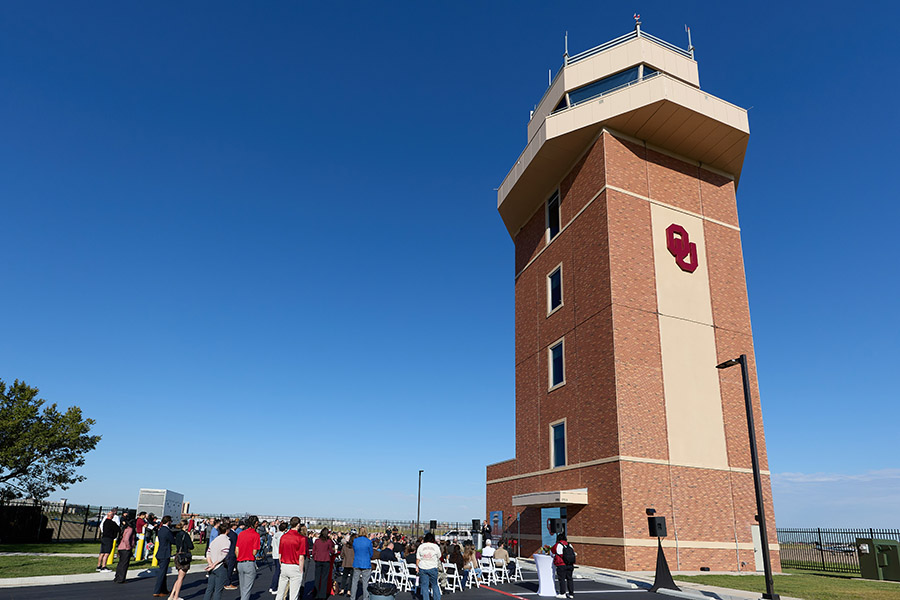
The University of Oklahoma today celebrated the opening of a new air traffic control tower at the OU Max Westheimer Airport. Standing 106 feet tall, more than double the current 52-foot facility, the new tower will modernize air traffic control operations and improve safety for pilots and students operating in the airspace.
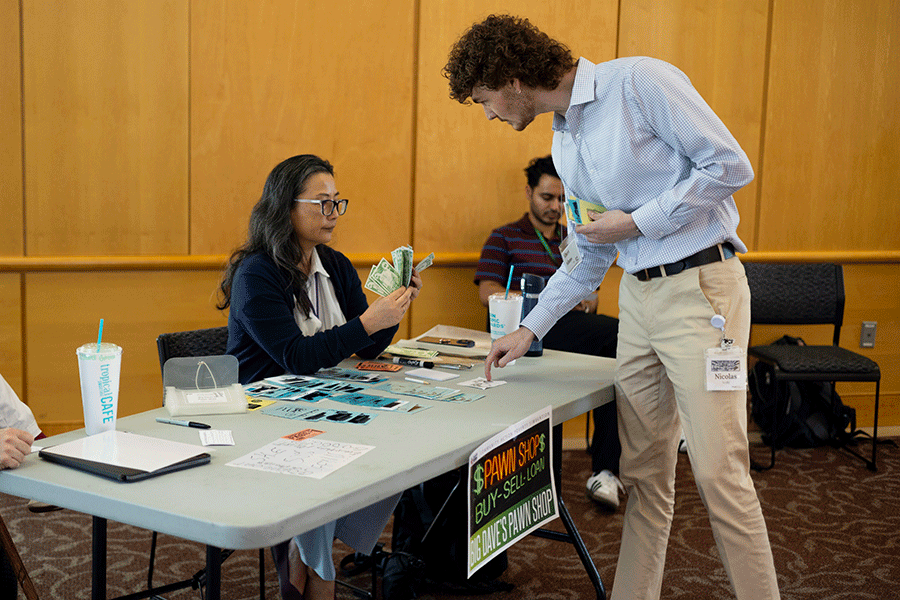
Do I buy groceries or pay the electric bill? Should I pawn some of my belongings to afford my prescription? My child is sick, so I will have to miss work to take care of him. Those are just a few of the difficult choices that OU-Tulsa health professional students confronted during the Community Access to Resources Experience. The role-playing activity challenged students to navigate the financial, family and other pressures that can affect a person’s health and ability to follow medical advice. Held annually during the SCM Institute orientation week, the experience is designed to generate understanding and build empathy.