NEWS


OKLAHOMA CITY – Amylin, a hormone that controls appetite and blood sugar by activating three different receptors in the brain, could be the basis for the next blockbuster obesity drugs. A University of Oklahoma study published today in the journal Science Signaling reveals a new understanding of how amylin receptors react upon being activated, an advancement that will be crucial to the field of drug development.
“This paper shows the new biochemical and pharmacological methods we developed that will enable the field, for the first time, to understand exactly what drugs in development do at each of the three amylin receptors,” said the paper’s senior author, Augen Pioszak, Ph.D., an associate professor of biochemistry and physiology at the University of Oklahoma College of Medicine. “Amylin receptors are very complicated, and each has very different and unique properties. What we have discovered has eluded researchers for many years, and we believe our findings will advance drug development.”
Amylin is secreted from the pancreas, along with insulin, after a person eats. Amylin receptors in the brain are in the same family as GLP-1 receptors, which are targeted by pioneering drugs like semaglutide (Ozempic and Wegovy).
“There has been a lot of interest in the pharmaceutical industry for developing new obesity drugs,” said Sandra Gostynska, a doctoral student in Pioszak’s lab who is the lead author of the paper and made the seminal findings. “What we have done is given the field new tools for understanding how a drug can affect amylin receptors.”
Their findings are two-fold:
Pharmaceutical companies are already developing drugs based on amylin. Pioszak said his lab’s research provides clarity for what occurs when a drug targets a complicated set of receptors.
“We believe our findings will further the study of drugs because what pharmaceutical and biotech companies want to know is what their drug does at each amylin receptor,” Pioszak said. “Now we have a method of answering those questions that were previously unanswerable.”
About the project
The paper, “Amylin receptor subunit interactions are modulated by agonists and determine signaling,” is published at https://www.science.org/doi/10.1126/scisignal.adt8127.
About the University of Oklahoma
Founded in 1890, the University of Oklahoma is a public research university with campuses in Norman, Oklahoma City and Tulsa. As the state’s flagship university, OU serves the educational, cultural, economic and health care needs of the state, region and nation. In Oklahoma City, OU Health Sciences is one of the nation’s few academic health centers with seven health profession colleges located on the same campus. OU Health Sciences serves approximately 4,000 students in more than 70 undergraduate and graduate degree programs spanning Oklahoma City and Tulsa and is the leading research institution in Oklahoma. For more information about OU Health Sciences, visit www.ouhsc.edu.
One in eight Oklahomans has type 2 diabetes, and an estimated one-third of the state’s adult population has undiagnosed prediabetes. University of Oklahoma researchers are developing a digital outreach program to help people understand their risk and connect with resources to help prevent the disease.
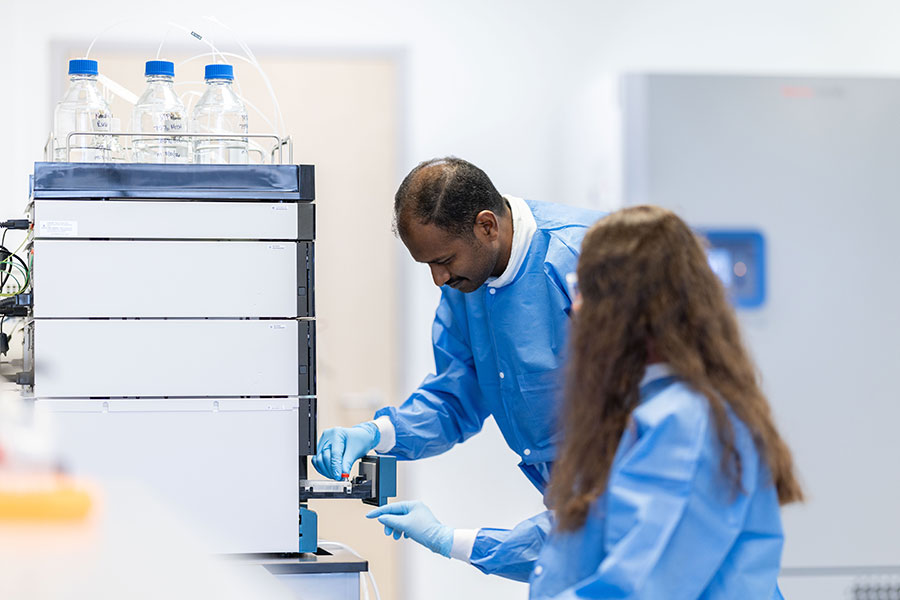
The Presbyterian Health Foundation has provided a grant for the University of Oklahoma College of Pharmacy to obtain its first liquid chromatography mass spectrometry equipment system. This acquisition expands the health campus’s ability to turn research into real-world impact.
Armed with a new five-year, $3.4 million grant from the National Institutes of Health, OU healthcare leaders are building the first chronic pain mHealth intervention app made with and for Native Americans.