NEWS


NORMAN, OKLA. – The University of Oklahoma College of Atmospheric and Geographic Sciences was well represented at both the American Geophysical Union and the American Meteorological Society annual meetings. Faculty, staff and student researchers presented on a wide range of topics at the two most significant annual meteorological conferences.
“These two meetings are premiere opportunities to showcase the breadth and depth of our research and to demonstrate new technologies to the international scientific community. They also provide unique networking opportunities and are important venues for the professional development of our faculty, staff and students. The week before the meetings, our office is buzzing with excitement of students making final arrangements and picking up their posters. Most of them return to campus reenergized, full of new ideas and often with best presentation awards,” said Petra Klein, Ph.D., interim dean of the college.
American Geophysical Union annual meeting
A great deal of the college’s international research was on display at AGU, with topics ranging from human health to ticks in Oklahoma City urban parks. Michael Wimberly, professor in the Department of Geography and Environmental Sustainability, presented on variations in microclimates and their effects on mosquito transmission of dengue and malaria in two urban Indian cities. Eric Bump, a graduate research assistant with Wimberly’s EcoGRAPH lab, also presented malaria-related research, giving a poster presentation on projecting malaria transmission and the role of humidity in climate change-driven disease models.
Other topics included AI for weather and Earths systems, aerosol transportation, urban heat islands and wind energy development.
In addition to the talks and poster presentations from the College, the AGU-TV film highlighting the OU-led Consortium for Advanced Data Assimilation Research and Education was broadcast for the first time. The $6.6M NOAA-funded consortium, called CADRE, is led by the School of Meteorology professor Xuguang Wang, Ph.D.
American Meteorological Society annual meeting
Presentations on the uses of artificial intelligence in meteorology were prevalent during the AMS Annual Meeting. Aaron Hill, Ph.D., professor in the School of Meteorology, gave a presentation on using machine learning techniques to derive severe weather forecasts from global weather predictions and a poster presentation on efforts to generate probabilistic forecasts of excessive rainfall using machine learning. Amy McGovern, Ph.D., professor in the School of Meteorology and the School of Computer Science, gave an update on the OU-led National Science Foundation AI Institute for Research and Trustworthy AI in Weather, Climate and Coastal Oceanography (AI2ES), of which she is the director.
Other topics included wildfires and precipitation event anomalies, observations of tornadoes and supercells conducted with the Horus radar, the Oklahoma Hydronet and new methods of determining snow accumulations. Wang received the Jagadish Shukla Earth System Predictability Prize, and also presented about CADRE.
Pam Heinselman, Ph.D., NOAA National Severe Storms Laboratory deputy director for science and School of Meteorology affiliate faculty, was honored as an AMS Fellow, and School of Meteorology students Gabriel Cenker, Roy Patrick Galang and Maximus Sasser received AMS scholarships.
On Tuesday, Jan. 14, the college hosted its OU AMS Reception at the World War II Museum. This annual event connects faculty, staff, students and research with innovation partners from the federal and private sectors.
To learn more about research in the College of Atmospheric and Geographic Sciences, visit ou.edu/ags/research.
About the University of Oklahoma
Founded in 1890, the University of Oklahoma is a public research university located in Norman, Oklahoma. As the state’s flagship university, OU serves the educational, cultural, economic and health care needs of the state, region and nation. For more information about the university, visit www.ou.edu.
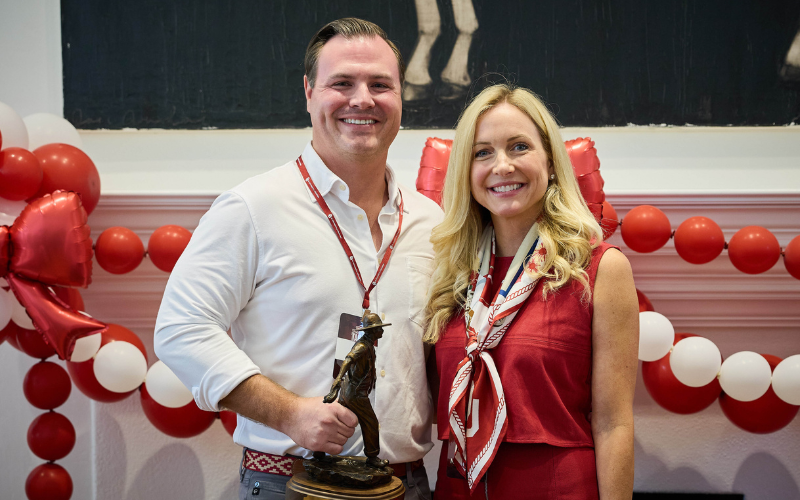
The University of Oklahoma has received a transformative gift from Jon and Shannon McCartney, which will name the McCartney Family Tunnel of Champions, the McCartney Family Gate of the Gaylord Family - Oklahoma Memorial Stadium and the McCartney Family Grand Lecture Hall in the Michael F. Price College of Business. The gift will also support the Inspiring Champions and the Athletic Director’s Discretionary Fund, in addition to establishing the McCartney DFW Career Trek program at Price College.
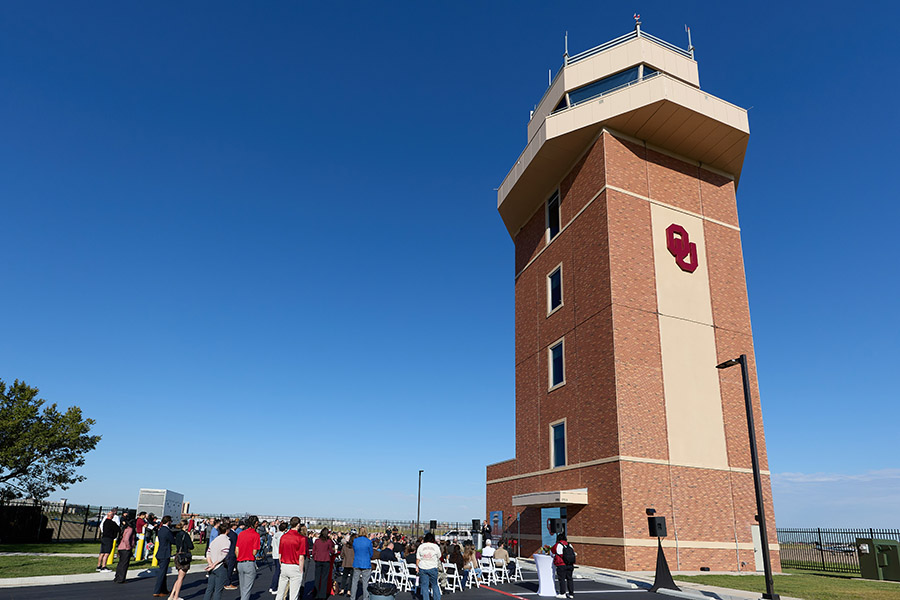
The University of Oklahoma today celebrated the opening of a new air traffic control tower at the OU Max Westheimer Airport. Standing 106 feet tall, more than double the current 52-foot facility, the new tower will modernize air traffic control operations and improve safety for pilots and students operating in the airspace.
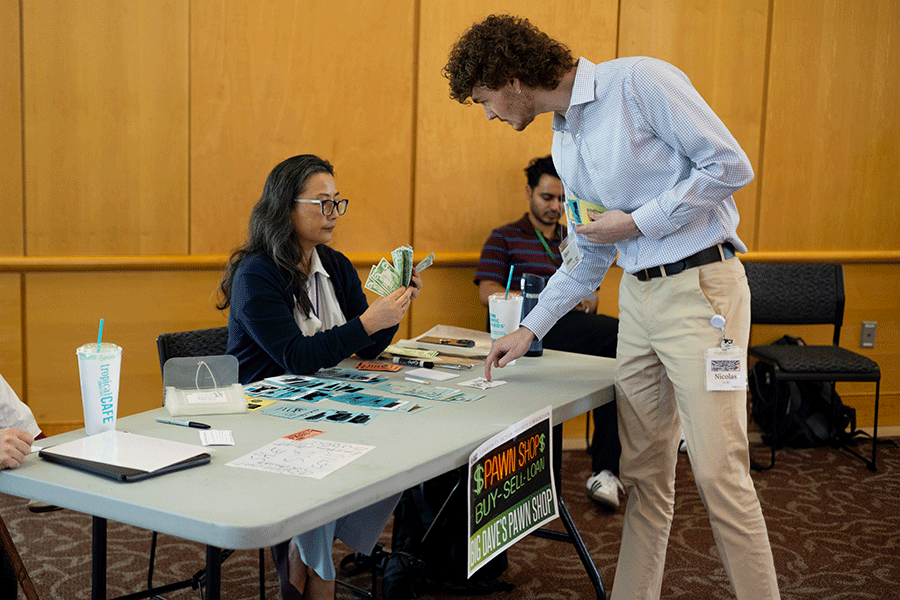
Do I buy groceries or pay the electric bill? Should I pawn some of my belongings to afford my prescription? My child is sick, so I will have to miss work to take care of him. Those are just a few of the difficult choices that OU-Tulsa health professional students confronted during the Community Access to Resources Experience. The role-playing activity challenged students to navigate the financial, family and other pressures that can affect a person’s health and ability to follow medical advice. Held annually during the SCM Institute orientation week, the experience is designed to generate understanding and build empathy.