NEWS


NORMAN, OKLA. – The University of Oklahoma has named Heather Bedle, Ph.D., as the inaugural director of its Sustainable Energy Systems program, a multidisciplinary program designed to equip students with the knowledge needed to address the challenges of a dynamic energy landscape.
Bedle, an expert in advanced data science and machine learning applications in seismic analysis, will lead the new program that combines fundamental coursework with flexible elective options, allowing students to specialize in areas of interest. The program integrates perspectives from a range of disciplines, including engineering, Earth sciences, social sciences, business, humanities, data science, education, law and journalism.
“We are pleased to have Dr. Heather Bedle serve as the inaugural director of OU’s Sustainable Energy Systems program,” said André-Denis Wright, Ph.D., senior vice president and provost. “Her vision, background and passion for seeking innovative solutions across traditional disciplinary boundaries are aligned perfectly with the core principles of the Sustainable Energy Systems program.”
John Antonio, Ph.D., dean of the Mewbourne College of Earth and Energy and chair of the campus-wide Sustainable Energy Systems Steering Committee, says Bedle has a broad and interdisciplinary background of proven leadership and success in sustainable energy systems. “Dr. Bedle has a passion for inspiring the next generation of energy professionals and researchers. She is committed to research and innovative approaches that speak to multiple perspectives in addressing pressing environmental and energy challenges by bridging disciplinary gaps between Earth sciences and social sciences,” he said.
Bedle’s research focuses on enhancing imaging techniques for the Earth’s subsurface. Her work spans a range of geological applications, including identifying hard-to-detect fault systems and gas hydrate accumulations to improving reservoir characterization for carbon capture and geothermal energy projects to exploring the socio-environmental dynamics related to climate and energy challenges.
“I’m excited to serve as the inaugural director of our Sustainable Energy Systems Program,” Bedle said. “This program was designed to transcend traditional academic divisions, recognizing that energy challenges require integrated and transdisciplinary thinking. By valuing and igniting curiosity in both the technical and human dimensions of energy, we’re preparing students to address complex problems with the comprehensive understanding they need.”
Bedle joined OU in 2018 and holds the Lissa and Cy Wagner Professorship, as well as the Edith Kinney Gaylord Presidential Professorship. She earned a master’s degree and a Ph.D. from Northwestern University and a bachelor’s degree from Wake Forest University. Before joining OU, Bedle spent over 12 years working in the defense and energy sectors.
The Sustainable Energy Systems academic programs combine fundamental core coursework with flexible elective options, allowing students to specialize in areas of interest. Current curricula options include both undergraduate and graduate certificate programs that can be embedded within virtually any degree program on campus. The new Williams Office Suite for Sustainable Energy will serve as the hub for the program, which includes administrative and communal space, faculty and post-doc offices and space to accommodate up to 15 graduate students performing collaborative, multidisciplinary research. For more information, visit https://www.ou.edu/mcee/ses.
About the University of Oklahoma
Founded in 1890, the University of Oklahoma is a public research university located in Norman, Oklahoma. As the state’s flagship university, OU serves the educational, cultural, economic and health care needs of the state, region and nation. For more information about the university, visit www.ou.edu.
The University of Oklahoma has received a transformative gift from Jon and Shannon McCartney, which will name the McCartney Family Tunnel of Champions, the McCartney Family Gate of the Gaylord Family - Oklahoma Memorial Stadium and the McCartney Family Grand Lecture Hall in the Michael F. Price College of Business. The gift will also support the Inspiring Champions and the Athletic Director’s Discretionary Fund, in addition to establishing the McCartney DFW Career Trek program at Price College.
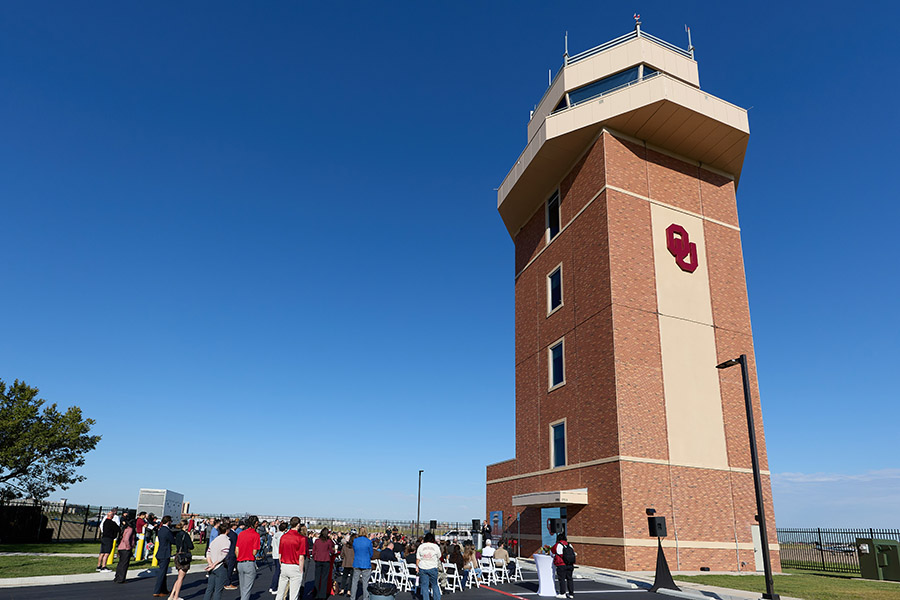
The University of Oklahoma today celebrated the opening of a new air traffic control tower at the OU Max Westheimer Airport. Standing 106 feet tall, more than double the current 52-foot facility, the new tower will modernize air traffic control operations and improve safety for pilots and students operating in the airspace.
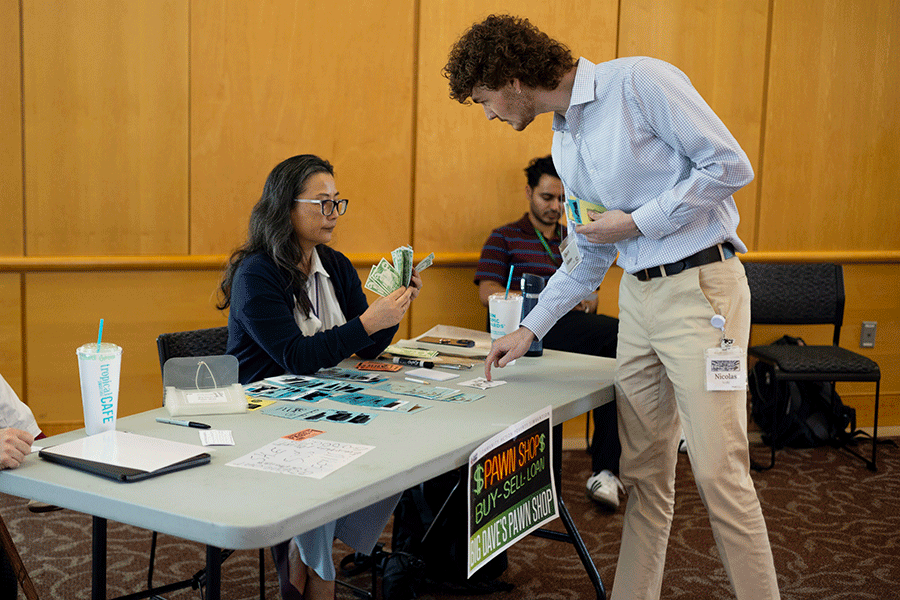
Do I buy groceries or pay the electric bill? Should I pawn some of my belongings to afford my prescription? My child is sick, so I will have to miss work to take care of him. Those are just a few of the difficult choices that OU-Tulsa health professional students confronted during the Community Access to Resources Experience. The role-playing activity challenged students to navigate the financial, family and other pressures that can affect a person’s health and ability to follow medical advice. Held annually during the SCM Institute orientation week, the experience is designed to generate understanding and build empathy.