NEWS


NORMAN, OKLA. – Sixteen students in the Christopher C. Gibbs College of Architecture at the University of Oklahoma are gaining hands-on experience while working on a community project in northeast Oklahoma City. Taught by instructor LaTasha Timberlake, the students are developing architectural recommendations for the adaptive reuse of the former Marcus Garvey School, a 1927 building abandoned since 2014.
Timberlake, an instructor in the Division of Planning, Landscape Architecture and Design at OU, leads a practicum course focused on preservation and culturally responsive design strategies. The course emphasizes balancing progress with preservation, particularly in under-resourced and marginalized communities.
“The main goal of this class is to provide students with the opportunity to apply what they’ve learned in a real-world setting,” Timberlake said. “We emphasize the reuse of community assets and the importance of cultural preservation while ensuring our projects are inclusive and accessible to everyone.”
The class has spent the semester conducting research, fieldwork and community engagement to develop proposals for transforming Marcus Garvey School. Their findings and recommendations will be presented in a formal presentation to community members and developers.
The Marcus Garvey School, originally built as Harmony Public School in 1927, later became Martin Luther King Jr. Elementary in the 1970s before being renamed for publisher and activist Marcus Garvey in 2003. After being abandoned in 2014, the school was transferred to the Oklahoma City Urban Renewal Authority. It has since been purchased by developers Norman Seaberg and Annita Bridges of One Red Oak LLC, who are working to redevelop the space into affordable housing.
Once complete, the 25,079-square-foot building will be renovated into The Harmony Marcus Garvey Apartments, featuring 20 new apartment units within the historic structure and an additional 20 units in three newly constructed buildings. The former school auditorium will be transformed into a common area and fitness center, and a new two-story community building will provide educational programs and small business support for residents.
Celina Quiros, a senior majoring in environmental design, says that working on the project has given her valuable insights into what can be achieved when someone recognizes a site's worth and acts to preserve and develop it for future generations.
“Before starting this project, I was already leaning toward a career in historic preservation and adaptive reuse to revitalize community sites with mixed-use developments and affordable housing with a focus on sustaining culture and addressing housing shortages. Working with my classmates on the Harmony Marcus Garvey site reinforced my passion for making this type of project my career focus,” Quiros said.
Through their work on this project, students are engaging in critical conversations about Oklahoma City’s affordable housing crisis and the need for sustainable community development. The course also explores broader urban planning issues, such as the integration of technology and native landscaping into neighborhood design.
“On our site visit, students visited with residents and considered essential design elements that impact daily life,” Timberlake said. “They noticed the absence of sidewalks, which led to discussions about historical infrastructure decisions and how they shape communities today. This project is about more than just architecture – it’s about fostering ecosystems where people can thrive for generations.”
Timberlake, whose family has lived in northeast Oklahoma City for four generations, has long been an advocate for community revitalization. She sees this course as an opportunity to educate future architects while empowering communities to envision a better future.
“This work is personal to me,” she said. “We’re not just designing buildings – we’re shaping the way people live, interact and build their futures. It is crucial that we embrace the Oklahoma spirit by integrating native plants, sustainable materials and forward-thinking technology into our designs.”
For more information about the course and community engagement initiatives at the University of Oklahoma, visit ou.edu/communityengagement.

About the University of Oklahoma
Founded in 1890, the University of Oklahoma is a public research university located in Norman, Oklahoma. As the state’s flagship university, OU serves the educational, cultural, economic and health care needs of the state, region and nation. For more information about the university, visit www.ou.edu.
From strengthening severe-weather preparedness to advancing national security, MITRE and the University of Oklahoma (OU) are joining forces to tackle some of the nation’s most critical challenges.
Jensen Moore, Ph.D., an associate professor of public relations at the University of Oklahoma’s Gaylord College of Journalism and Mass Communication, has been elected to a three-year term on the Association for Education in Journalism and Mass Communication’s Standing Committee on Professional Freedom and Responsibility.
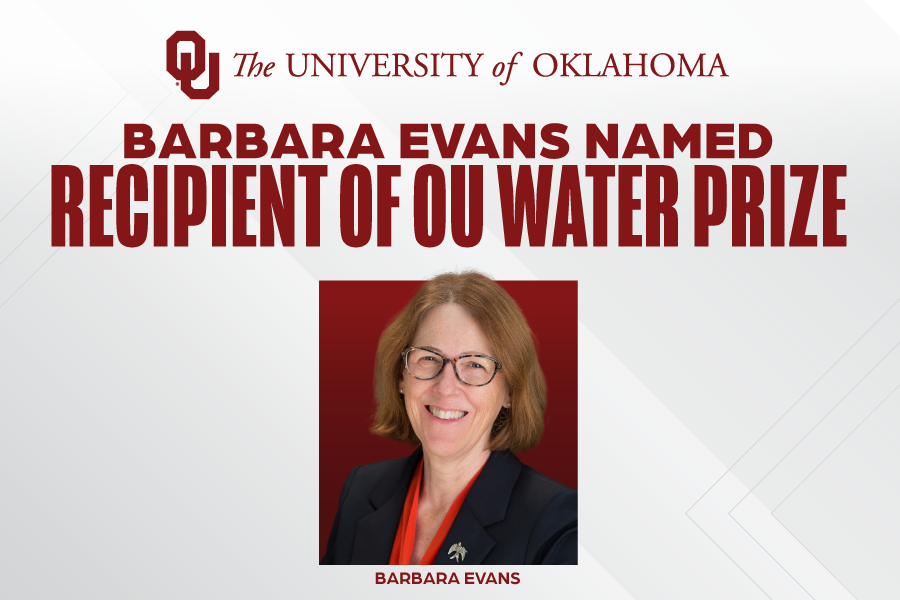
The OU Water Technologies for Emerging Regions (WaTER) Center has awarded Barbara Evans, a leader in public health engineering and urban sanitation, with the ninth International Water Prize. Her selection was announced at the 2026 OU WaTER Symoposium.