NEWS


NORMAN, OKLA. – Researchers from the University of Oklahoma have made significant breakthroughs in a promising technology for efficient energy conversion and chemical processing. Two recent studies involving protonic ceramic electrochemical cells, called PCECs, address significant challenges in electrochemical manufacturing and efficiency. These innovations are a crucial step toward reliable and affordable solutions for hydrogen production and clean energy storage.
The studies, published in the prestigious Nature family of scientific journals, were led by Hanping Ding, Ph.D., an assistant professor in the School of Aerospace and Mechanical Engineering at the University of Oklahoma.
PCECs have traditionally struggled to maintain performance under the extreme conditions required for commercial use. In a study featured in Nature Synthesis, Ding and his colleagues reported a new approach that eliminates the need for cerium-based materials, which are prone to breakdown under high steam and heat. Instead, the team engineered a method to manufacture pure barium zirconate-based electrolytes that remain stable at record-low operating temperatures, a development that allows the system to run efficiently under intense electrochemical conditions.

A second study, published in Nature Communications, tackled another crucial component: the oxygen electrode. Led by Ding’s team and graduate student Shuanglin Zheng, the researchers developed a new ultra-porous nano-architecture electrode with triple phase conductivity, meaning it can transport electrons, oxygen ions and protons, which dramatically improves electrolysis kinetics. This design allows cells to perform better under heavy use and highlights the critical role of optimizing electrode microstructure to balance surface activity and durability. This development marks a critical step toward realizing efficient, reversible, and high-performance PCECs for both hydrogen production and electricity generation.
“These findings represent significant advancements in the field of high-temperature steam electrolysis,” said Ding. “By addressing key challenges in electrolyte processing and electrode design, we are unlocking the full potential of PCECs for sustainable energy applications.”
The dual breakthroughs represent a meaningful step toward broader deployment of PCECs in hydrogen production, power generation and chemical manufacturing. In addition to improving core performance, Ding’s research offers insights relevant to other technologies, such as alkaline fuel cells, water electrolyzers and biosensors.
Together, the findings underscore OU’s expanding role in energy innovation, particularly in developing next-generation systems that aim to reduce emissions and transition global infrastructure toward more sustainable energy sources.
About the projects
“Sintering protonic zirconante cells with enhanced electrolysis stability and Faradaic efficiency” is published in Nature Synthesis at https://www.nature.com/articles/s44160-025-00765-z
“Enhancing Surface Activity and Durability in Triple Conducting Electrode for Protonic Ceramic Electrochemical Cells” is published in Nature Communications at https://www.nature.com/articles/s41467-025-59477-9
About the University of Oklahoma
Founded in 1890, the University of Oklahoma is a public research university located in Norman, Oklahoma. As the state’s flagship university, OU serves the educational, cultural, economic and health care needs of the state, region and nation. For more information about the university, visit www.ou.edu.
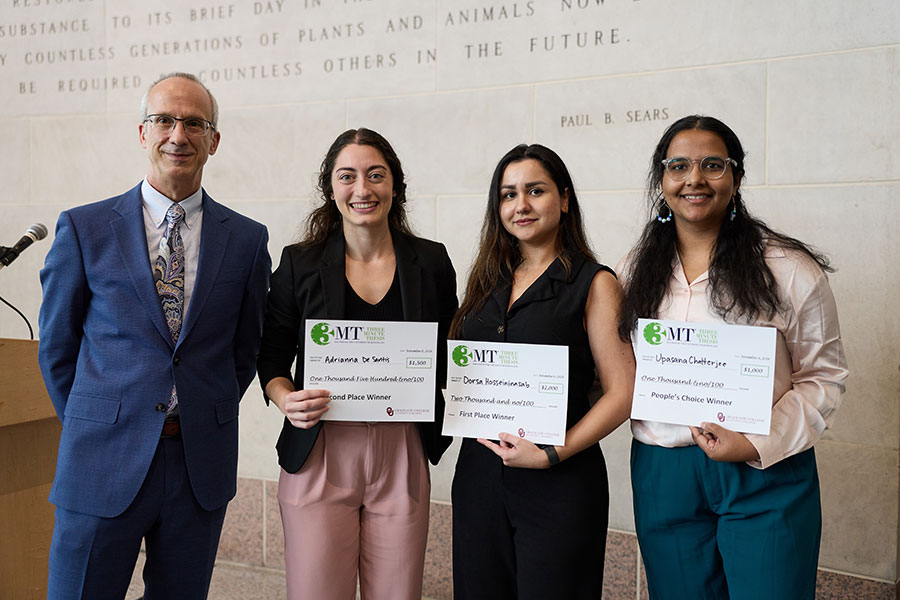
Three University of Oklahoma graduate students earned top honors in the 2026 Three Minute Thesis (3MT) competition, an annual event that challenges students to explain their research to a general audience in 3 minutes.
Researchers at the OU Health Harold Hamm Diabetes Center are investigating diabetes from numerous angles, including how the disease affects other organs, what factors contribute to its development and complications, and how new approaches to prevention and treatment could improve health.
A new five-year, $3 million grant from the National Cancer Institute will enable researchers at OU’s TSET Health Promotion Research Center (HPRC) to scale up a smartphone-based mHealth solution that uses targeted and tailored messages to motivate smokers to kick the habit.