NEWS


OKLAHOMA CITY – Ana J. Chucair-Elliott, Ph.D., an assistant professor of ophthalmology at the University of Oklahoma College of Medicine and research member of Dean McGee Eye Institute, has been funded by the BrightFocus Foundation to investigate how aging, diet and inflammation contribute to retinal pigment epithelium (RPE) degeneration, a deterioration of the layer of cells in the back of the eye.
BrightFocus has awarded Chucair-Elliott a three-year, $409,500 grant from its Macular Degeneration Research program. Failure of the RPE is a key feature of age-related macular degeneration, which is the leading cause of vision loss in Americans 65 and older. In addition to the grant, Chucair-Elliott received BrightFocus’ 2025 Elizabeth Anderson Award for Macular Degeneration Research.
“As a biomedical science researcher, my goal is to provide mechanistic knowledge that leads us to the discovery of targets for therapies to restore and preserve vision,” Chucair-Elliott said. “This is not just a scientific curiosity to me. Having my own grandmother suffer the challenges of progressive central vision loss due to age-related macular degeneration made this research topic personal. I witnessed how this social, active, independent loved one experienced the struggles of anxiety, depression and inevitable life changes that come from losing connection with the world as others see it. This personal perspective has fueled my enthusiasm and research.”
In this study, Chucair-Elliott aims to learn how certain immune cells in the eye (called macrophages) contribute to damage in a layer of the retina (RPE) as people age or eat an unhealthy diet, two key risk factors for age-related macular degeneration.
“We want to find out if eating a high-fat, high-carbohydrate diet causes helpful immune cells in the aging eye to become harmful, which could disrupt how genes work in the retina,” she said. “Right now, there are gaps in our understanding of how these changes lead to vision problems like age-related macular degeneration. We hope our findings will help guide new treatments to keep the retina healthy as we age. One key goal is to identify specific cell targets that could be used to stop or reverse harmful aging in the retina and reduce the risk of age-related macular degeneration.”
BrightFocus is currently funding 49 active macular degeneration research grants worldwide, an investment of nearly $16 million in studies aimed at improving early detection and diagnosis, advancing treatment options, and uncovering the root causes of disease onset. These grants are highly competitive and awarded following a rigorous review process led by expert scientific advisory committees of leading researchers in the field.
“This year’s grant recipients represent some of the boldest, most promising investigators in vision and brain health research,” said BrightFocus President and CEO Stacy Pagos Haller. “Their groundbreaking work brings hope to millions around the world with these debilitating conditions.”
About the University of Oklahoma
Founded in 1890, the University of Oklahoma is a public research university with campuses in Norman, Oklahoma City and Tulsa. As the state’s flagship university, OU serves the educational, cultural, economic and health care needs of the state, region and nation. In Oklahoma City, OU Health Sciences is one of the nation’s few academic health centers with seven health profession colleges located on the same campus. OU Health Sciences serves approximately 4,000 students in more than 70 undergraduate and graduate degree programs spanning Oklahoma City and Tulsa and is the leading research institution in Oklahoma. For more information about OU Health Sciences, visit www.ouhsc.edu.
The University of Oklahoma has received a transformative gift from Jon and Shannon McCartney, which will name the McCartney Family Tunnel of Champions, the McCartney Family Gate of the Gaylord Family - Oklahoma Memorial Stadium and the McCartney Family Grand Lecture Hall in the Michael F. Price College of Business. The gift will also support the Inspiring Champions and the Athletic Director’s Discretionary Fund, in addition to establishing the McCartney DFW Career Trek program at Price College.
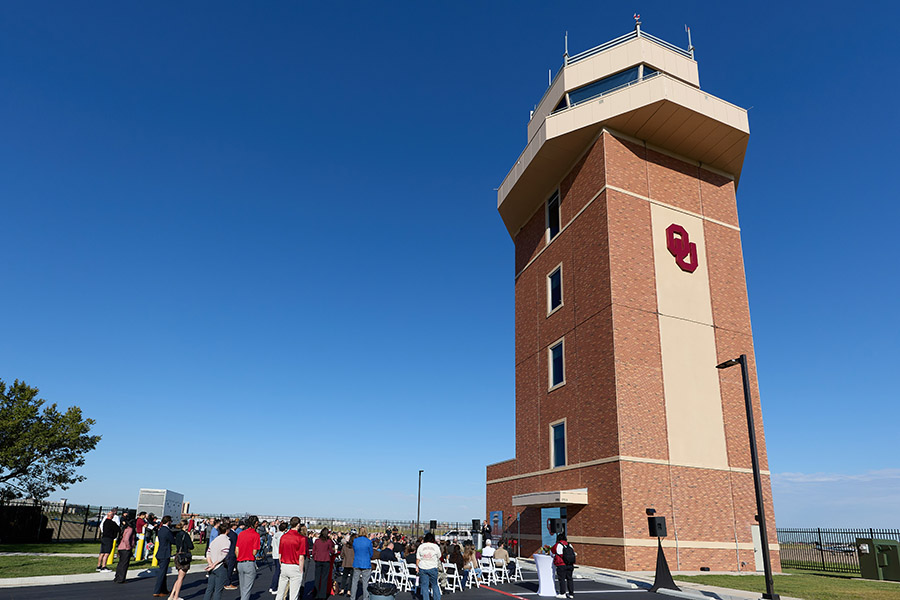
The University of Oklahoma today celebrated the opening of a new air traffic control tower at the OU Max Westheimer Airport. Standing 106 feet tall, more than double the current 52-foot facility, the new tower will modernize air traffic control operations and improve safety for pilots and students operating in the airspace.
Do I buy groceries or pay the electric bill? Should I pawn some of my belongings to afford my prescription? My child is sick, so I will have to miss work to take care of him. Those are just a few of the difficult choices that OU-Tulsa health professional students confronted during the Community Access to Resources Experience. The role-playing activity challenged students to navigate the financial, family and other pressures that can affect a person’s health and ability to follow medical advice. Held annually during the SCM Institute orientation week, the experience is designed to generate understanding and build empathy.