NEWS


OKLAHOMA CITY – In a study published Wednesday in the Proceedings of the National Academy of Sciences (PNAS), University of Oklahoma researchers detail their discoveries about why the brain tumor glioblastoma is so aggressive. Their findings center on ZIP4, a protein that transports zinc throughout the body and sets off a cascade of events that drive tumor growth.
About half of all malignant brain tumors are glioblastomas, the deadliest form of brain cancer with a median survival rate of 14 months.
“Surgery for glioblastoma is very challenging, and patients almost always experience a relapse,” said the study’s senior author, Min Li, Ph.D., a professor of medicine, surgery and cell biology at the University of Oklahoma College of Medicine. “By better understanding why these brain tumors are so aggressive, we hope to open up paths for new treatments.”
Under normal conditions, ZIP4 plays a positive role, transporting and maintaining the right amount of zinc for good health. However, when brain cancer is present, ZIP4 takes on a different role. In the case of glioblastoma, it triggers a series of events:
“Everything starts with the fact that ZIP4 is overexpressed in glioblastoma,” Li said. “That triggers all these downstream events that help the tumor to grow.”
Li’s research team also tested a small-molecule inhibitor to target ZIP4 and TREM1. The inhibitor attached to both proteins, stopping their actions and slowing tumor growth. “This tells us that ZIP4 and TREM1 may be promising therapeutic targets,” he said.
Neurosurgeon, OU College of Medicine Executive Dean and study co-author Ian Dunn, M.D., said the findings are an encouraging step toward combating the aggressive cancer.
“These results are really exciting in such a debilitating cancer. The hope and promise is to translate these findings to novel treatment approaches to improve the lives of our patients,” said Dunn, who has been treating patients with brain tumors for over 20 years.
This is one of Li’s first major publications on glioblastoma, but ZIP4 has been a focus of his pancreatic cancer research for many years. He discovered that overexpression of ZIP4 causes pancreatic cancer cells to be more resistant to chemotherapy and prompts tumor cells to transform themselves so they can stealthily travel to the body’s other organs. In addition, he found that ZIP4 plays a role in the onset of cachexia, a muscle-wasting condition that affects the majority of patients with pancreatic cancer.
OU College of Medicine professor and internal medicine physician Michael Bronze, M.D., a co-author of many of Li’s studies, said that in the future, ZIP4 may open doors to improved treatment of several types of cancer.
“One amazing aspect of this research is identifying the role of ZIP4 in glioblastoma progression considering previous findings of the overexpression of ZIP4 in studies on pancreatic cancer progression and the associated weight loss seen in pancreatic cancer patients,” Bronze said. “One hope is that common pathways among several tumors may translate into new treatments or preventive strategies that affect several different tumor types. Novel approaches like this could make a profound difference in cancer treatment strategies.”
About the Project
The paper, “A zinc transporter drives glioblastoma progression via extracellular vesicles–reprogrammed microglial plasticity,” can be found at https://www.pnas.org/doi/10.1073/pnas.2427073122. Other OU authors include Kar-Ming Fung, M.D., Ph.D., Chao Xu, Ph.D., James Battiste, M.D., Michael Bronze, M.D., and Courtney Houchen, M.D. Co-senior author Webster Cavenee, Ph.D., is from the University of California at San Diego. Additional authors are from several institutions in China.
About the University of Oklahoma
Founded in 1890, the University of Oklahoma is a public research university with campuses in Norman, Oklahoma City and Tulsa. As the state’s flagship university, OU serves the educational, cultural, economic and health care needs of the state, region and nation. In Oklahoma City, OU Health Sciences is one of the nation’s few academic health centers with seven health profession colleges located on the same campus. OU Health Sciences serves approximately 4,000 students in more than 70 undergraduate and graduate degree programs spanning Oklahoma City and Tulsa and is the leading research institution in Oklahoma. For more information about OU Health Sciences, visit www.ouhsc.edu.
The University of Oklahoma has received a transformative gift from Jon and Shannon McCartney, which will name the McCartney Family Tunnel of Champions, the McCartney Family Gate of the Gaylord Family - Oklahoma Memorial Stadium and the McCartney Family Grand Lecture Hall in the Michael F. Price College of Business. The gift will also support the Inspiring Champions and the Athletic Director’s Discretionary Fund, in addition to establishing the McCartney DFW Career Trek program at Price College.
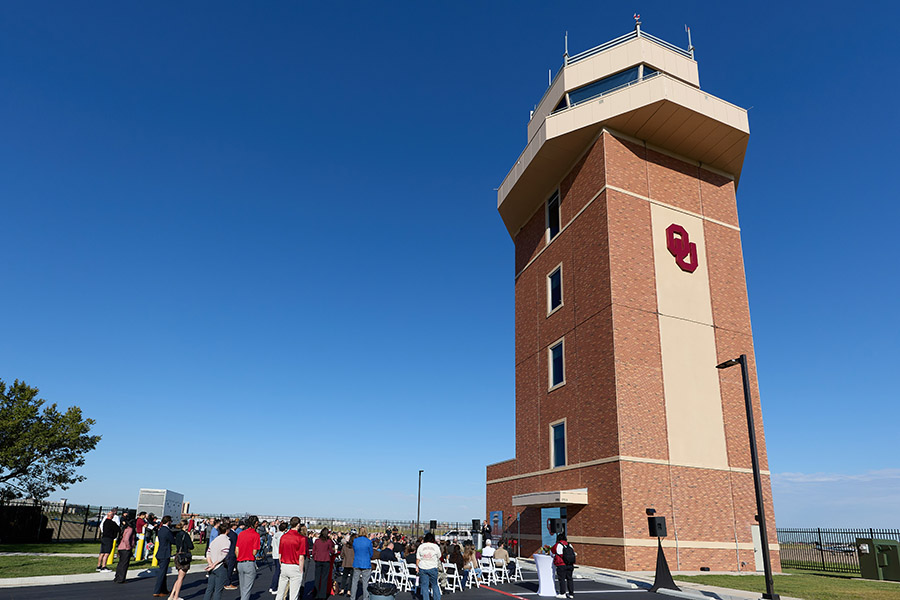
The University of Oklahoma today celebrated the opening of a new air traffic control tower at the OU Max Westheimer Airport. Standing 106 feet tall, more than double the current 52-foot facility, the new tower will modernize air traffic control operations and improve safety for pilots and students operating in the airspace.
Do I buy groceries or pay the electric bill? Should I pawn some of my belongings to afford my prescription? My child is sick, so I will have to miss work to take care of him. Those are just a few of the difficult choices that OU-Tulsa health professional students confronted during the Community Access to Resources Experience. The role-playing activity challenged students to navigate the financial, family and other pressures that can affect a person’s health and ability to follow medical advice. Held annually during the SCM Institute orientation week, the experience is designed to generate understanding and build empathy.