NEWS


NORMAN, OKLA. – From concert halls in New York and Seoul to city buses in Braga, Portugal, the music of University of Oklahoma professor Konstantinos Karathanasis, Ph.D., has reached audiences in unexpected places. His electroacoustic compositions – works that blend live performance with digital soundscapes – have been featured at international festivals, broadcast on European radio and even shared through public transit initiatives abroad.
For Karathanasis, who joined the OU School of Music in 2006, the global reach highlights the significance of a discipline often overlooked in traditional research discussions. His work exists at the intersection of art and science, where acoustics meet technology and where mythology, psychology and cultural traditions can be transformed into sound.
“People often think of research as belonging only to labs and formulas,” he said. “But music has always been closely linked with mathematics, with acoustics, with technology. Electroacoustic composition simply pushes that connection forward into new and unexplored territory.”
From Greece to Oklahoma
Raised in Athens, Greece, Karathanasis began his musical life as a classically trained pianist under the guidance of his great-grandmother, a piano teacher. His first exposure to electronic music came as a shock. In one college course, he listened to a pioneering 1948 composition built entirely from recordings of train engines. At the time, he rejected the idea outright: “This is not music,” he thought.
Yet curiosity soon turned into respect – and then passion. By experimenting with early digital sound environments, Karathanasis discovered that computers could create soundscapes no traditional instrument could replicate. That realization launched a career that has since taken him around the world, where his work has been honored for its originality.
Karathanasis’s works begin with unexpected sources: locomotive engines, ancient myths or fragments of Renaissance music. One example is Medusa in Somno (The Sleeping Medusa), a piece for cello and live electronics that blends real-time processing with mythological inspiration. Drawing from Greek mythology and contemporary stories of gender-based violence, the work illustrates how music can carry both timeless and timely themes, he said.
Most recently, Karathanasis’s interpretation of Medusa was accepted for performance at the Sound and Music Computing Conference in Graz, Austria – recognized as one of Europe’s leading gatherings for electroacoustic music.
“The purpose of electroacoustic music is not to entertain in the traditional sense,” Karathanasis said. “It is to explore timbre, to push the boundaries of what music can be and to invite listeners to consider sound itself as a source of meaning.”
While his compositions reach audiences worldwide, some of Karathanasis’s most rewarding work happens closer to home. Inside Catlett Music Center on the OU-Norman campus, he oversees the university’s computer music studio, a facility that provides students access to professional-grade microphones, software and recording spaces that would otherwise be out of reach.
Throughout his career at OU, Karathanasis has secured over $216,000 in grant funding, much of which has been directed toward building and updating the computer music studio. Major awards, including a $34,000 grant for recording studio equipment and a $22,000 grant for concert hall loudspeakers, have strengthened OU’s ability to support student creativity and research in electroacoustic music.
Though small, the studio has achieved impressive results. OU students have had their very first electroacoustic works accepted into prestigious international festivals, including the New York City Electroacoustic Music Festival. Competing against established professionals, OU students have gained recognition for their creativity – an achievement Karathanasis describes as “a tremendous success.”
“Composition is not a sprint; it’s a marathon,” he tells his students. “You improve with each piece you write. If you compose because the music speaks to you, others will eventually recognize its value too.”
Current Projects
Nearly 20 years into his OU career, Karathanasis continues to push forward. He is preparing his first solo album, scheduled for worldwide release in 2026 with PARMA Recordings, a New Hampshire-based audio production company that will distribute his music through both physical and digital platforms. He is also working on a new fixed-media piece, created entirely from recordings of OU School of Music ensembles during the school’s centennial year.
“I want to capture the incredible variety of sounds our school produces – from percussion and jazz to Carnatic and Native American music,” he said. Carnatic music is the classical music of Southern India, characterized by its complex melodies and rhythms. “The idea is to weave those voices together into something that reflects our collective musical culture.”
Earlier this year, Karathanasis presented Inner sOUndscapes, a free concert series curated by Karathanasis each semester. This year’s event highlighted music for saxophone and electronics, showcasing new electroacoustic works by students, faculty and guest artists.
Looking back, Karathanasis is amazed at the way his field has grown. What began with tape recorders and early computers now incorporates artificial intelligence, software synthesis and multimedia collaborations. And while the aesthetics may differ, the core remains the same: experimenting with technology to discover new sonic possibilities.
“Sometimes the computer surprises you with sounds you could never imagine,” he said. “In those moments, it feels like Columbus setting out to find India and discovering the Americas. That’s the spirit of this music – exploration.”
The Weitzenhoffer Family College of Fine Arts produces over 400 concerts, recitals, dramas, musicals, operas and dance performances each year. Learn more at ou.edu/finearts.
About the University of Oklahoma
Founded in 1890, the University of Oklahoma is a public research university located in Norman, Oklahoma. As the state’s flagship university, OU serves the educational, cultural, economic and health care needs of the state, region and nation. For more information about the university, visit www.ou.edu.
The University of Oklahoma has received a transformative gift from Jon and Shannon McCartney, which will name the McCartney Family Tunnel of Champions, the McCartney Family Gate of the Gaylord Family - Oklahoma Memorial Stadium and the McCartney Family Grand Lecture Hall in the Michael F. Price College of Business. The gift will also support the Inspiring Champions and the Athletic Director’s Discretionary Fund, in addition to establishing the McCartney DFW Career Trek program at Price College.
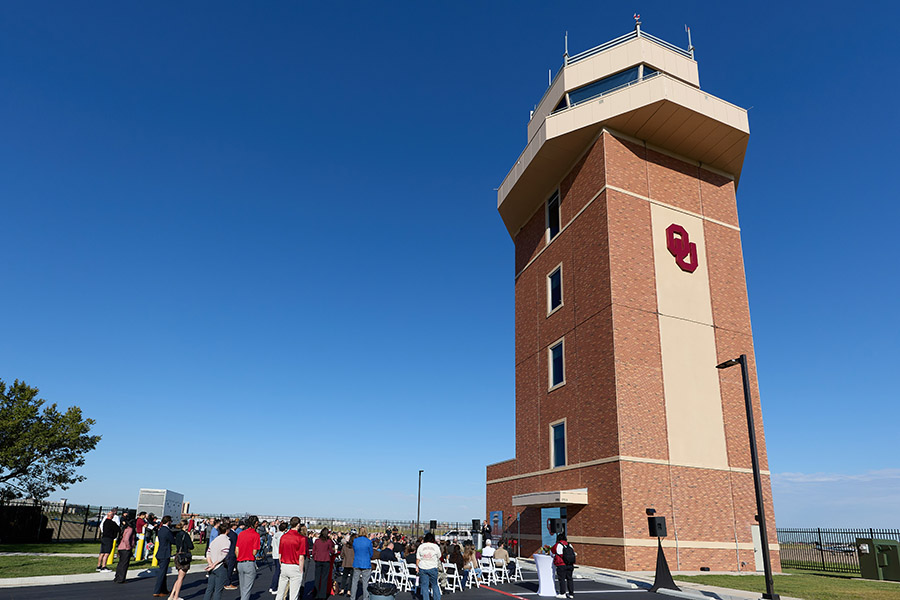
The University of Oklahoma today celebrated the opening of a new air traffic control tower at the OU Max Westheimer Airport. Standing 106 feet tall, more than double the current 52-foot facility, the new tower will modernize air traffic control operations and improve safety for pilots and students operating in the airspace.
Do I buy groceries or pay the electric bill? Should I pawn some of my belongings to afford my prescription? My child is sick, so I will have to miss work to take care of him. Those are just a few of the difficult choices that OU-Tulsa health professional students confronted during the Community Access to Resources Experience. The role-playing activity challenged students to navigate the financial, family and other pressures that can affect a person’s health and ability to follow medical advice. Held annually during the SCM Institute orientation week, the experience is designed to generate understanding and build empathy.