NEWS


OKLAHOMA CITY – To combat power outages and extreme weather events, a team led by University of Oklahoma researchers has helped launch a project utilizing electric school buses as a backup energy resource. Their work is both providing energy resilience and health solutions in Shawnee, Okla., and establishing a replicable model that can be adopted by cities across the U.S.
The OU Hudson College of Public Health is guiding the initiative, known as Recharge-OK, in partnership with Shawnee Public Schools and Oklahoma Gas & Electric (OG&E), with additional support from research teams at OU’s Norman campus and Oklahoma State University.
The project also engages key community partners, including the Association of Central Oklahoma Governments, the Indian Nations Council of Governments, the City of Oklahoma City and Gordon Cooper Technology Center, as well as industry partners IC Bus and InCharge Energy.
After an initial planning phase, researchers launched their pilot phase last October with support from a $1 million grant from the National Science Foundation’s Civic Innovation Challenge (CIVIC).
A key project feature is vehicle-to-grid integration (V2G), allowing Shawnee Public School’s electric buses to both receive power from and send power to the local grid. Hongwan Li, one of the lead researchers, said that the vehicles were not originally designed to support this bidirectional charging.
“When the buses are parked in the parking lot, they can act as distributed energy storage units,” said Li, who is an assistant professor in the Hudson College of Public Health. “We did some research and development to retrofit these electric school buses so that they are V2G capable.”
The researchers will implement the bidirectional charging stations this summer when buses aren’t in use, examining how well the vehicles and grid store and transfer power. Li said she would like to see it possibly expanded to daily use during the next school year.
Through this V2G approach, the team aims to combat power disruption in Shawnee, transforming existing infrastructure to provide electricity to schools, hospitals and other important services at times of need. Eventually, they want to work with other communities to incorporate additional school districts into the project.
“We can also partner with departments to integrate the V2G assets into regional emergency response planning,” Li said.
Along with achieving the project’s technical objectives – such as designing an optimal charging system and long-term bus schedule plan – the researchers have community-oriented goals. A major one is air quality: by adopting electric buses as an energy resilience strategy, future community partners can also reduce greenhouse gas emissions around their schools and bus depots.
Another goal is increasing STEM interest in future generations. Thanks to a partnership with Shawnee High School, the researchers will help launch a program in the spring that teaches students about V2G technology through mentorship, interactive activities and other experiences.

That partnership is just one of many ways that local and regional collaborators have been essential to the project’s success. For example, OG&E’s expertise helped make Shawnee’s V2G integration a reality, while Li noted that Shawnee Public Schools was proactive in introducing electric school buses well before its leadership picked OU Hudson College of Public Health for this initiative.
“We pretty much have all the project designed to be co-developed across partners,” she said.
Li added that community input is a valuable part of this project, and that this year the team will use workshops to learn what kinds of project data that residents want to see collected on public dashboards. Before that, the team plans to hold a kickoff event this spring at Shawnee High School to engage students, teachers and community members about the work being done in their city.
That work could eventually be used to support cities across the U.S. after power outages.
“Long term, we want this to become a replicable national model for community-centered energy resilience,” Li said.
About the research
“Enhancing Oklahoma Community Energy Resilience and Disaster Preparedness Through Electric School Bus Integration into Local Grids” is funded by a $1,000,000 grant from the National Science Foundation, Award No. 2527318.
About the University of Oklahoma
Founded in 1890, the University of Oklahoma is a public research university located in Norman, Oklahoma. As the state’s flagship university, OU serves the educational, cultural, economic and health care needs of the state, region and nation. For more information about the university, visit www.ou.edu.
The University of Oklahoma has received a transformative gift from Jon and Shannon McCartney, which will name the McCartney Family Tunnel of Champions, the McCartney Family Gate of the Gaylord Family - Oklahoma Memorial Stadium and the McCartney Family Grand Lecture Hall in the Michael F. Price College of Business. The gift will also support the Inspiring Champions and the Athletic Director’s Discretionary Fund, in addition to establishing the McCartney DFW Career Trek program at Price College.
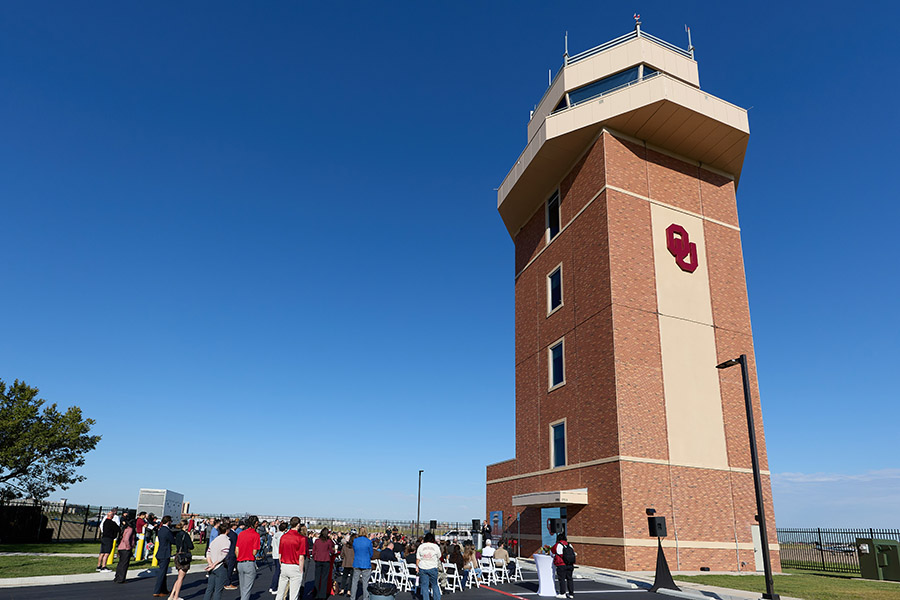
The University of Oklahoma today celebrated the opening of a new air traffic control tower at the OU Max Westheimer Airport. Standing 106 feet tall, more than double the current 52-foot facility, the new tower will modernize air traffic control operations and improve safety for pilots and students operating in the airspace.
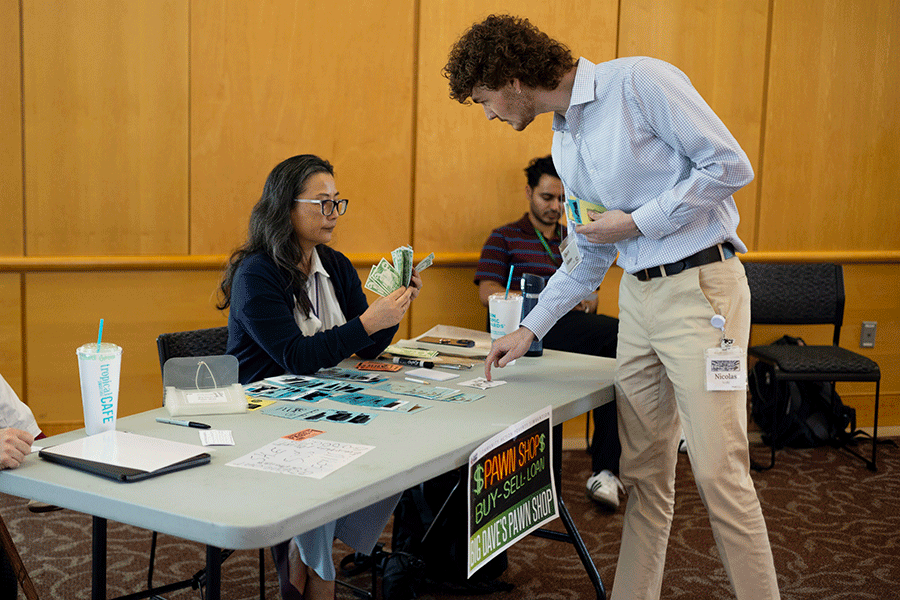
Do I buy groceries or pay the electric bill? Should I pawn some of my belongings to afford my prescription? My child is sick, so I will have to miss work to take care of him. Those are just a few of the difficult choices that OU-Tulsa health professional students confronted during the Community Access to Resources Experience. The role-playing activity challenged students to navigate the financial, family and other pressures that can affect a person’s health and ability to follow medical advice. Held annually during the SCM Institute orientation week, the experience is designed to generate understanding and build empathy.