NEWS


NORMAN, Okla. – More than 500,000 visitors are expected to visit Oklahoma City for the Summer Olympics in 2028, as the city hosts the canoe slalom and softball competitions. Though the events will only last a combined two weeks, graduate students at the University of Oklahoma have put together a vision for how the Olympics can best support residents, including well after the games have ended.
Vanessa Morrison is a professor of practice in the Division of Planning, Landscape Architecture & Design (PLAD) in OU’s Christopher C. Gibbs College of Architecture. Each academic year, she leads a studio course for graduate-level urban planning students to gain real-world project experiences. Her 2025-26 course focused on how the upcoming Olympics can support community members in northeast Oklahoma City, a part of the larger Ward 7 where both Olympic venues are located.
As an urban planner, Morrison recognizes how crucial the Olympics can be in producing investment and long-term benefits for residents across the city, especially in its historically Black northeast area.
“I challenged my students to think about, ‘How do you steward and include community members in making sure that incoming opportunities are accessible to everyone, especially those who live in surrounding neighborhoods?’” she said.
John Harris, Ph.D., director of PLAD, emphasized the productive value of courses in the division.
“We believe strongly that our program should have a positive impact on communities across Oklahoma. Our Master's of Regional and City Planning courses regularly take on projects like this to give students a chance to work in real-world ways alongside community members. We are so grateful that we have great faculty like Vanessa Morrison to help train our students.”
Morrison tasked the class to create planning recommendations and actionable strategies that explored how the Olympics can leave a lasting impact for those neighborhoods. Students not only conducted research about past Olympics and the existing northeast area, but also interacted with local and national planning experts, residents, other community stakeholders, Olympic decision makers, business owners and elected officials. Oklahoma City Council Ward 7, USA Softball and the Oklahoma Black Alumni Coalition are among the groups that engaged with the course.
They also went directly to the community. Students took a tour of Devon Park and Riversport Adventure Park to understand the scale of the project and hear from Olympic stakeholders. They also held an engagement session for locals to share their thoughts on how the Olympics could best serve their neighborhoods.

“The engagement process is so important because it helps us build proximity to the real lived experiences that people are navigating every day in their neighborhoods,” Morrison said. “It helps to build trust and makes our recommendations stronger because we're able to connect strategies with the very people who do life in these areas every day.”
Students landed on four main topics for their recommendations: mobility and access, community benefits, cultural preservation and outreach and engagement. Following the spring semester, Morrison finalized the action guide and distributed it to stakeholders and local decision makers. Those strategies are available for the public to view online.
In addition to community engagement and communication, the course helped the students develop various other career skills. For example, Morrison highlighted how critical it is for aspiring urban planners to work to understand historic and present-day spatial and cultural contexts, and to be able to translate these insights across different sectors of planning. She also emphasized that students were able to gain critical perspectives from national experts and neighborhood leaders representing a diverse range of backgrounds.
“There are multiple interpretations of how people experience a community space,” Morrison said. “As urban planners, we're tasked with building consensus across different ideas, lived experiences, priorities, histories and spatial contexts. Our role is to translate those perspectives into actionable strategies that strengthen communities, expand opportunities and address the challenges that may hold them back.”

About the University of Oklahoma
Founded in 1890, the University of Oklahoma is a public research university located in Norman, Oklahoma. As the state’s flagship university, OU serves the educational, cultural, economic and health care needs of the state, region and nation. For more information about the university, visit www.ou.edu.
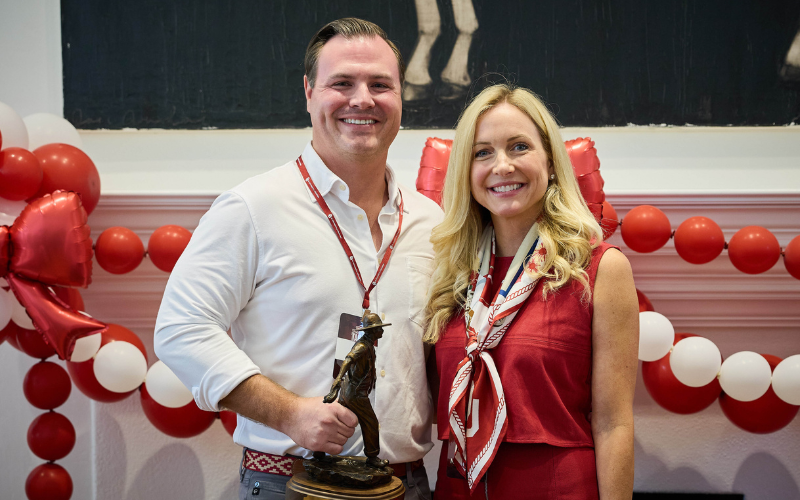
The University of Oklahoma has received a transformative gift from Jon and Shannon McCartney, which will name the McCartney Family Tunnel of Champions, the McCartney Family Gate of the Gaylord Family - Oklahoma Memorial Stadium and the McCartney Family Grand Lecture Hall in the Michael F. Price College of Business. The gift will also support the Inspiring Champions and the Athletic Director’s Discretionary Fund, in addition to establishing the McCartney DFW Career Trek program at Price College.
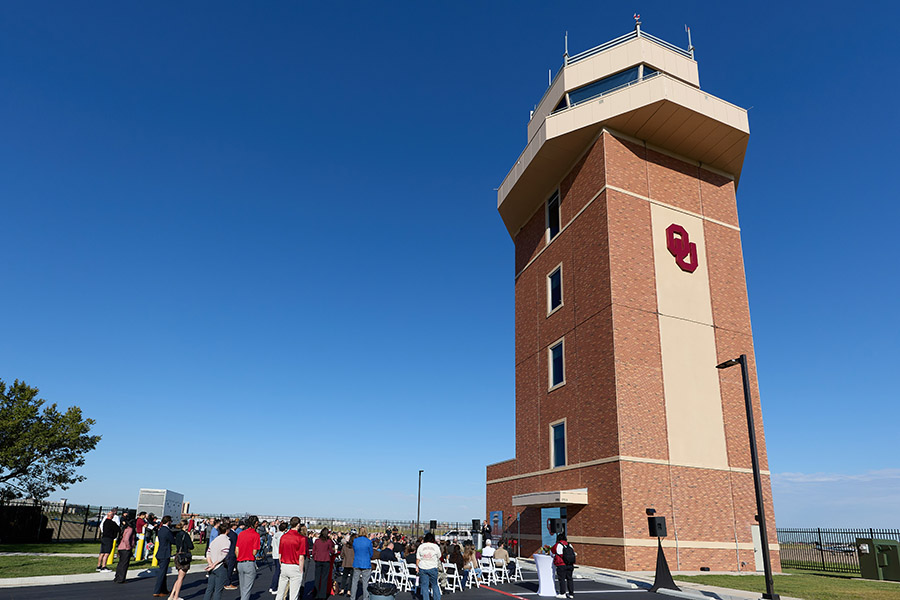
The University of Oklahoma today celebrated the opening of a new air traffic control tower at the OU Max Westheimer Airport. Standing 106 feet tall, more than double the current 52-foot facility, the new tower will modernize air traffic control operations and improve safety for pilots and students operating in the airspace.
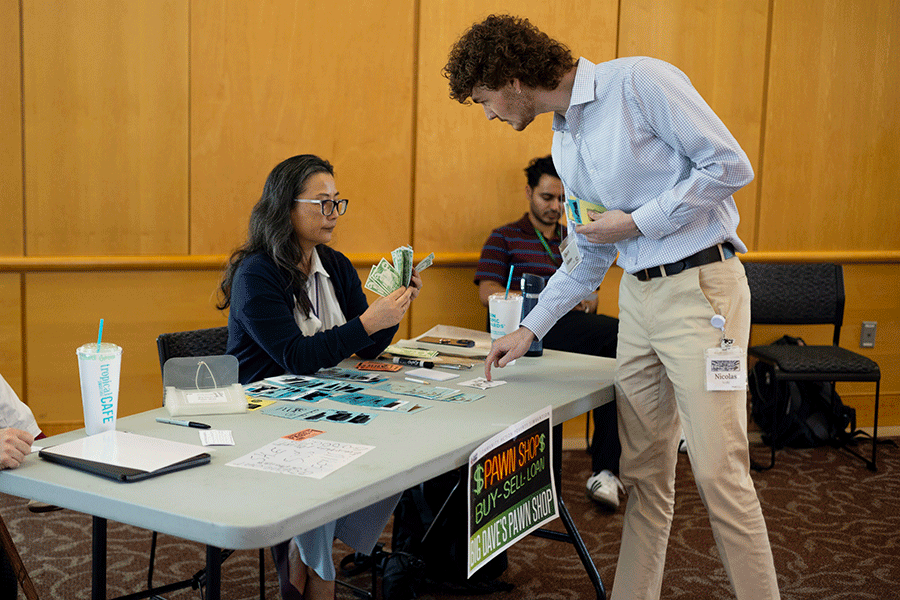
Do I buy groceries or pay the electric bill? Should I pawn some of my belongings to afford my prescription? My child is sick, so I will have to miss work to take care of him. Those are just a few of the difficult choices that OU-Tulsa health professional students confronted during the Community Access to Resources Experience. The role-playing activity challenged students to navigate the financial, family and other pressures that can affect a person’s health and ability to follow medical advice. Held annually during the SCM Institute orientation week, the experience is designed to generate understanding and build empathy.