NEWS


NORMAN, Okla. — The University of Oklahoma has received an $11.5 million award from the National Institutes of Health to establish the Oklahoma Center of ImmunoEngineering, a new research center designed to accelerate the study and treatment of diseases rooted in the immune system.
The five-year Phase I award, funded through NIH’s Centers of Biomedical Research Excellence program, will build a statewide immunoengineering research network and establish two specialized research cores at OU. The center is led by principal investigators Wei Chen, Ph.D., and Chongle Pan, Ph.D.
Immunoengineering applies engineering tools and principles to analyze and manipulate the immune system — dialing its activity up or down depending on the disease. For cancer or viral infection, the goal is to amplify the immune response. For autoimmune diseases, the goal is to suppress them. The field generates significant volumes of data, and making sense of that data is increasingly where new discoveries are made.
To support those discoveries, the center will house two research cores that operate in close coordination: the Immunomodulation Technology Core, which supports experimental laboratory work, and the Omics Data Science Core, which provides the computational tools and expertise to design experiments, manage large-scale data collection and interpret results.
“Immunology, immunotherapy, and data science are among the most exciting and transformative fields in modern biomedical research,” said Chen, director, Stephenson Chair, and professor in the Peggy and Charles Stephenson School of Biomedical Engineering. “Their convergence in immunoengineering is creating unprecedented opportunities to advance human health. As a cancer researcher, I have benefited greatly using immunology and immunotherapy, as well as omics data analysis to advance a novel therapy for the treatment of late-stage cancer patients. The Oklahoma Center of ImmunoEngineering will provide a unique platform that integrates immunomodulation technologies with omics data science, empowering researchers across Oklahoma to drive discoveries and translate them into improved patient outcomes. To the best of our knowledge, this is the first such center in the nation.”
Co-PI Chongle Pan will lead the data science side of the center. His work anchors the Omics Data Science Core, which will develop new computational tools and analytical methods to help researchers across Oklahoma harness the full potential of their immunoengineering data.
“Engineering the immune system requires a predictive understanding of the immune system. By bringing together data science, artificial intelligence, and predictive models, this core will help researchers across Oklahoma turn complex immune data into discoveries that can guide better treatments,” said Pan, professor of Computer Science and Biomedical Engineering.
OCIE has selected four early-career faculty as research project leaders, each paired with two experienced mentors drawn from OU's Norman and Health Sciences campuses:
Beyond the four research projects, OCIE will offer monthly seminars, research roundtables, training workshops and an annual symposium. The center will also fund pilot and team-science projects aimed at connecting basic, translational and clinical researchers.
Oklahoma is one of the states served by NIH's Institutional Development Award program, which works to build research capacity in states that have historically received lower levels of federal research funding.
About the University of Oklahoma
Founded in 1890, the University of Oklahoma is a public research university located in Norman, Oklahoma. As the state’s flagship university, OU serves the educational, cultural, economic and health care needs of the state, region and nation. For more information about the university, visit www.ou.edu.
The University of Oklahoma has received a transformative gift from Jon and Shannon McCartney, which will name the McCartney Family Tunnel of Champions, the McCartney Family Gate of the Gaylord Family - Oklahoma Memorial Stadium and the McCartney Family Grand Lecture Hall in the Michael F. Price College of Business. The gift will also support the Inspiring Champions and the Athletic Director’s Discretionary Fund, in addition to establishing the McCartney DFW Career Trek program at Price College.
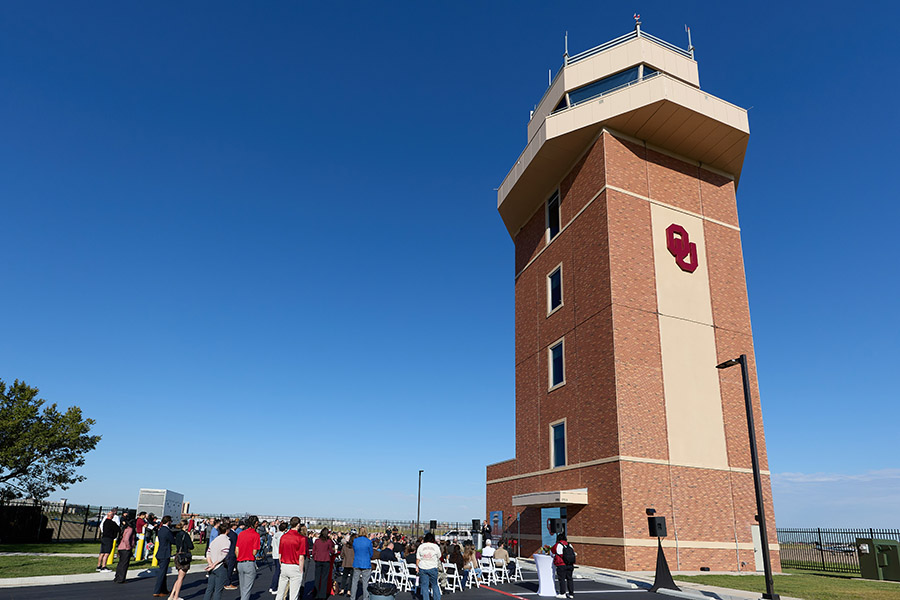
The University of Oklahoma today celebrated the opening of a new air traffic control tower at the OU Max Westheimer Airport. Standing 106 feet tall, more than double the current 52-foot facility, the new tower will modernize air traffic control operations and improve safety for pilots and students operating in the airspace.
Do I buy groceries or pay the electric bill? Should I pawn some of my belongings to afford my prescription? My child is sick, so I will have to miss work to take care of him. Those are just a few of the difficult choices that OU-Tulsa health professional students confronted during the Community Access to Resources Experience. The role-playing activity challenged students to navigate the financial, family and other pressures that can affect a person’s health and ability to follow medical advice. Held annually during the SCM Institute orientation week, the experience is designed to generate understanding and build empathy.