NEWS


OKLAHOMA CITY – For the millions of people living with lupus – a chronic autoimmune disease that can damage the kidneys, brain and other vital organs – treatment options remain limited and often come with serious side effects. A $1.7 million grant from the National Institutes of Health will allow a University of Oklahoma researcher to continue investigating a protein that may help explain why the disease develops and how it might be treated more precisely.
Carol Webb, Ph.D., a professor at the OU College of Medicine, has spent her career studying the protein ARID3a. Her research has shown that people with lupus have higher numbers of B cells (a type of immune cell) containing ARID3a than healthy individuals, and patients with more of these cells tend to have more active and severe disease. In mouse research models, increasing ARID3a in B cells caused the animals to produce harmful antibodies that attacked their own tissues, similar to what is observed in lupus.
“Lupus is a complicated disease in which the immune system turns against the body and can damage organs such as the kidneys and brain, making it especially challenging to study and treat,” Webb said. “We believe these B cells may eventually help us detect disease earlier and guide the development of more effective, targeted therapies.”
In lupus, the immune system attacks the body by mistake. Normally, young B cells – the immune cells that make antibodies – must pass an important “safety check” to make sure they do not target healthy tissue. Webb’s research suggests that ARID3a may disrupt that safety system.
Her team found that in healthy people, these young B cells do not contain ARID3a. But in people with lupus, some of these young B cells do contain the protein. This finding suggests that ARID3a may allow harmful cells to slip past the body’s natural protections.
With the new NIH funding, the researchers will focus on three main goals: identifying the genes directly controlled by ARID3a, understanding how the protein helps B cells break normal safety rules, and testing whether blocking ARID3a in mice can reduce lupus symptoms.
If the studies are successful, ARID3a could become both a warning sign of disease activity and a possible target for new treatments. Instead of suppressing the entire immune system, which is how many current lupus drugs work, future therapies might more precisely target the pathways that cause harm.
“In the past 60 years, the Food and Drug Administration has approved only three drugs for lupus,” Webb said. “We really need a more effective treatment.”
About the project
Research reported in this news release was supported by the National Institute of Allergy and Infectious Diseases, a component of the National Institutes of Health, under award number R01AI189437. The content is solely the responsibility of the authors and does not necessarily represent the official views of the National Institutes of Health.
Webb also received a bridge grant from Presbyterian Health Foundation in Oklahoma City that contributed to her earning the NIH grant.
About the University of Oklahoma
Founded in 1890, the University of Oklahoma is a public research university with campuses in Norman, Oklahoma City and Tulsa. As the state’s flagship university, OU serves the educational, cultural, economic and health care needs of the state, region and nation. In Oklahoma City, the OU Health Campus is one of the nation’s few academic health centers with seven health profession colleges located on the same campus. The OU Health Campus serves approximately 4,000 students in more than 70 undergraduate and graduate degree programs spanning Oklahoma City and Tulsa and is the leading research institution in Oklahoma. For more information about the OU Health Campus, visit www.ouhsc.edu.
The University of Oklahoma has received a transformative gift from Jon and Shannon McCartney, which will name the McCartney Family Tunnel of Champions, the McCartney Family Gate of the Gaylord Family - Oklahoma Memorial Stadium and the McCartney Family Grand Lecture Hall in the Michael F. Price College of Business. The gift will also support the Inspiring Champions and the Athletic Director’s Discretionary Fund, in addition to establishing the McCartney DFW Career Trek program at Price College.
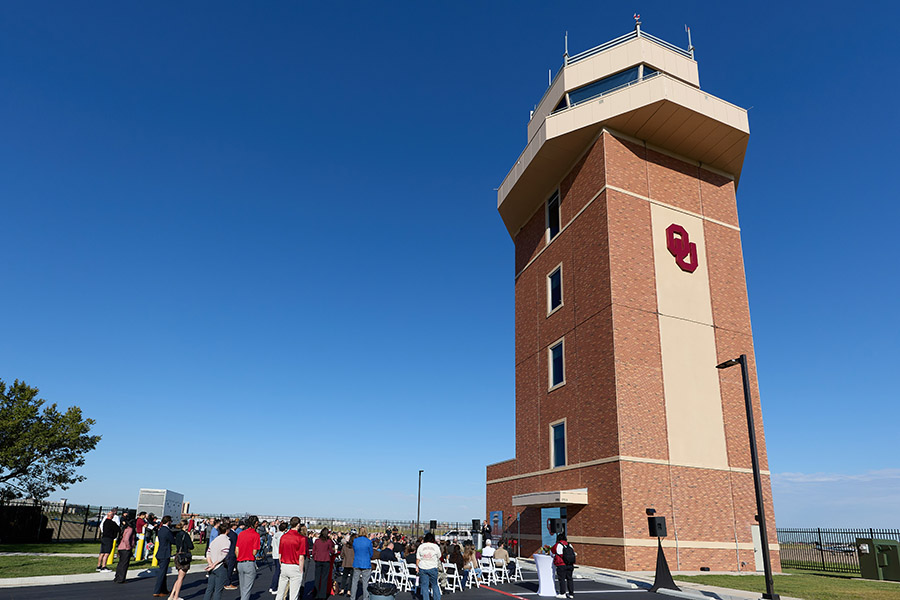
The University of Oklahoma today celebrated the opening of a new air traffic control tower at the OU Max Westheimer Airport. Standing 106 feet tall, more than double the current 52-foot facility, the new tower will modernize air traffic control operations and improve safety for pilots and students operating in the airspace.
Do I buy groceries or pay the electric bill? Should I pawn some of my belongings to afford my prescription? My child is sick, so I will have to miss work to take care of him. Those are just a few of the difficult choices that OU-Tulsa health professional students confronted during the Community Access to Resources Experience. The role-playing activity challenged students to navigate the financial, family and other pressures that can affect a person’s health and ability to follow medical advice. Held annually during the SCM Institute orientation week, the experience is designed to generate understanding and build empathy.