NEWS


OKLAHOMA CITY – Patients with ultra-high-risk multiple myeloma, an aggressive form of blood cancer, often respond poorly to standard treatments, including bone marrow transplant. A University of Oklahoma physician-researcher recently received $2.9 million in funding from the National Cancer Institute to study whether RedHill Biopharma’s drug opaganib, given after CAR T-cell therapy, can help the immune cells fight cancer more effectively.
CAR (chimeric antigen receptor) T-cell therapy takes a patient’s immune cells, genetically modifies them so they can recognize and attack cancer cells, and then returns them to the patient. Researchers believe that opaganib can help the modified immune cells stay active and continue attacking myeloma for longer.
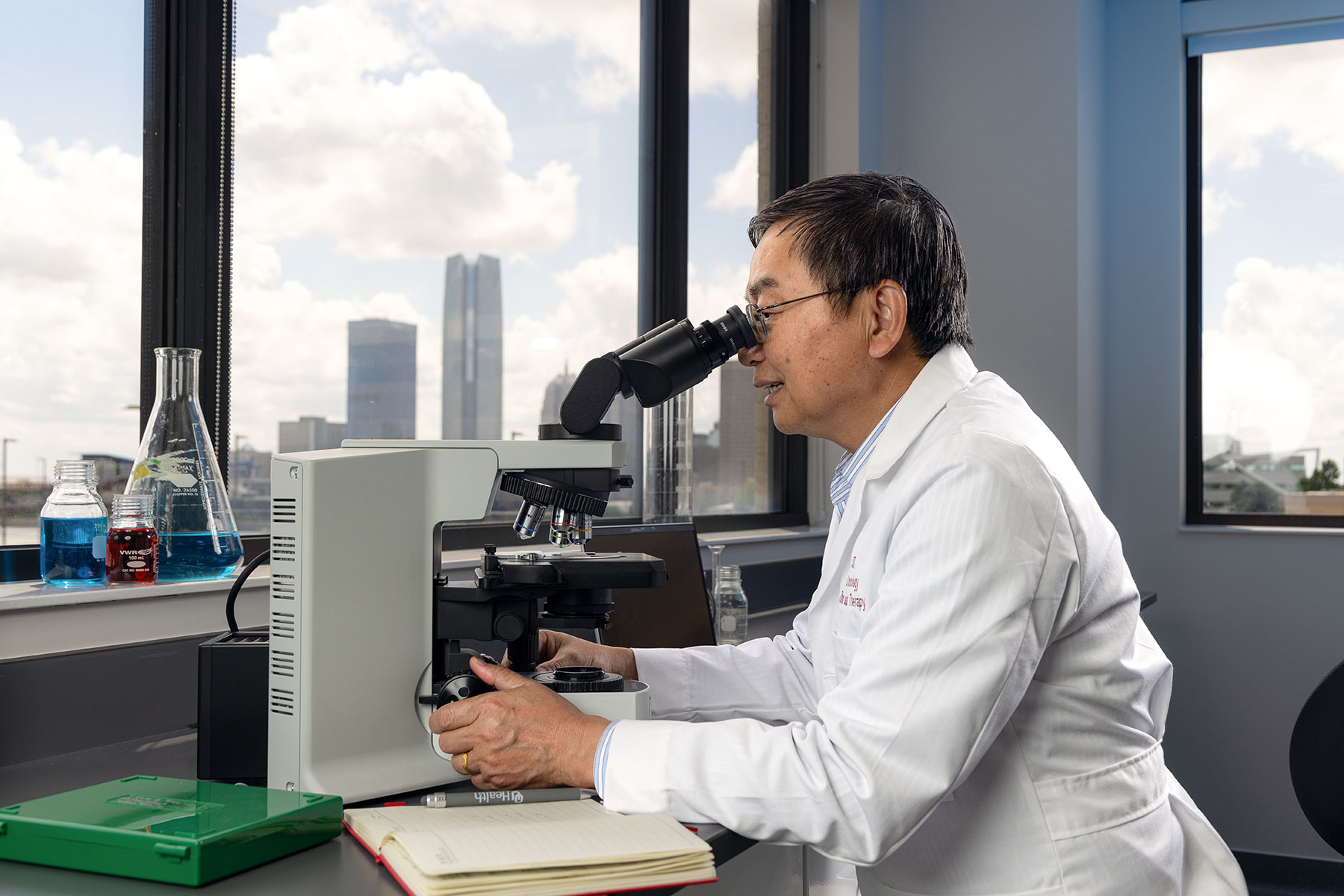
The five-year grant will fund two phases of clinical trials. The Phase 1b trial will enroll up to 18 patients to evaluate the safety of the treatment combination and determine the appropriate dosage of opaganib. A subsequent Phase 2 trial will enroll up to 21 additional patients to look for early evidence of effectiveness. The grant was awarded to Yubin Kang, M.D., OU Health hematologist-oncologist, division chief of Hematology, Bone Marrow Transplant and Cellular Therapy at OU Health Stephenson Cancer Center, and a professor at the OU College of Medicine.
“We need to find a novel, more effective treatment for patients with ultra-high-risk multiple myeloma because they continue to have poor outcomes despite current treatments,” Kang said. “I’m excited to see whether combining CAR T-cell therapy with opaganib can improve the care and outcomes for this population of patients.”
Kang conducted preclinical studies on CAR T-cell therapy and opaganib for the past decade at Duke University, prior to coming to OU earlier this year. Opaganib works by blocking a protein called SK2, which appears to act as a kind of brake on the immune system’s cancer-fighting T cells. When SK2 was absent or blocked in mice, T cells multiplied more effectively and became better at killing myeloma cells. When he combined opaganib with CAR T-cell therapy in mice, the results were very promising: The tumor was much better controlled, for a longer period of time.
“Those studies led to this new grant and the opportunity to test the combination of CAR T-cell therapy and opaganib in humans,” Kang said.
For patients with ultra-high-risk multiple myeloma, cancer often returns despite treatment, including bone marrow transplantation. CAR T-cell therapy is already an option for some patients whose cancer has returned. Kang hopes the clinical trials will provide evidence that adding opaganib to CAR T-cell therapy can produce longer-lasting responses and improve outcomes for these high-risk patients.
This study also marks a first for OU and the state: The CAR T cells will be manufactured on campus rather than being sent to a commercial manufacturer, a move that should save both time and money.
“Currently, we have to send a patient’s T cells to an out-of-state company, which takes four to six weeks to genetically engineer them,” Kang said, “and the cost is nearly half a million dollars. We believe that we can manufacture them on site in six to nine days for less than $100,000. In addition, the infrastructure we build here can potentially be used for many other studies in the future.”
The clinical trials will be conducted in partnership with RedHill Biopharma, which will provide opaganib, and Miltenyi Biotec, which developed the CAR construct. Miltenyi Biotec is enabling clinical translation by producing GMP-grade lentiviral vector for CAR T manufacturing on the CliniMACs Prodigy.
Dr. Mark Levitt, chief scientific officer at RedHill Biopharma, said: “Opaganib has shown promise in preclinical studies as a potential combination therapy in a number of oncology and other indications. Prior preclinical and clinical work has shown that through a reduction of cancer cell survival proteins like c-Myc and Mc1-1, opaganib can potentially play a role in the treatment of multiple myeloma. We congratulate Dr. Kang and OU on this grant, which has the potential to be an important step to determine, through clinical trials, whether these preclinical findings can turn into reality.”
About the project
Research reported in this press release is supported by the National Cancer Institute of the National Institutes of Health under award No. R01CA293516-01A1.
About the University of Oklahoma
Founded in 1890, the University of Oklahoma is a public research university with campuses in Norman, Oklahoma City and Tulsa. As the state’s flagship university, OU serves the educational, cultural, economic and healthcare needs of the state, region and nation. In Oklahoma City, the Harold Hamm Health Campus is one of the nation’s few academic health centers with seven health profession colleges located on the same campus. The Harold Hamm Health Campus serves approximately 4,000 students in more than 70 undergraduate and graduate degree programs spanning Oklahoma City and Tulsa and is the leading research institution in Oklahoma. For more information about the Harold Hamm Health Campus, visit www.ouhsc.edu.
A University of Oklahoma physician-researcher recently received $2.9 million in funding from the National Cancer Institute to study whether RedHill Biopharma’s drug opaganib, given after CAR T-cell therapy, can help the immune cells fight cancer more effectively.
A protein called Miro1 found at elevated levels in the skeletal muscle of people with type 2 diabetes may contribute to insulin resistance, potentially making it a target for future treatments that help the body regulate blood sugar, according to a study published today in Nature Communications.
Plane spotters who photograph aircraft at the University of Oklahoma’s Max Westheimer Airport will bring their photography into its lobby this November as part of a growing program showcasing Oklahoma artists.