719
Total Awards in FY24
$183
Million in Sponsored Awards in FY24
$286
Million in Expenditures in FY24*
*Reported to the NSF HERD Survey; Includes Norman programs in Tulsa
A 12-year field experiment at the University of Oklahoma has revealed that warming's effect on soil carbon storage depends critically on precipitation. Understanding what controls whether soils gain or lose carbon has broad implications for the carbon cycle and beyond.
The University of Oklahoma and Oak Ridge National Laboratory, in partnership with the Air Force Sustainment Center, Air Force Research Laboratory and the Oklahoma City Air Logistics Complex, will launch Phase II of a groundbreaking additive manufacturing research program to revolutionize how the military maintains and modernizes legacy weapon systems.
With funding from NASA, Steven Cavallo is leading a global study of how small disturbances in the polar tropopause, a region roughly 30,000 feet above Earth’s surface, eventually grow into massive winter storms impacting millions.
Researchers at the University of Oklahoma have developed new hybrid materials that challenge conventional thinking about how light-emitting compounds work and could advance the field of fast radiation detection.
In the longest-running field warming experiment of its kind, researchers have documented dramatic shifts in high-elevation mountain meadows, revealing that changes in climate alter not only the plants we can see above ground, but the invisible world of fungi and microbes in the soil below.
In a study published in the journal Communications Engineering, Chongle Pan, an OU professor of computer science and biomedical engineering, and Penghua Wang, a doctoral student in data science and analytics, detail a machine learning model that dramatically accelerates the manufacturing timeline of monoclonal antibodies.
Scott Salesky, a researcher with the University of Oklahoma, has been awarded funding from the U.S. Department of Defense (DoD) to study how clouds above the sea surface are created and changed by factors such as airborne particles and atmospheric instability.
Jessica Blanchard, Ph.D., senior research scientist at the University of Oklahoma's Center for Applied Social Research, is a key collaborator on a competitive grant from the National Institutes of Health to advance tribally defined approaches to genomic research.
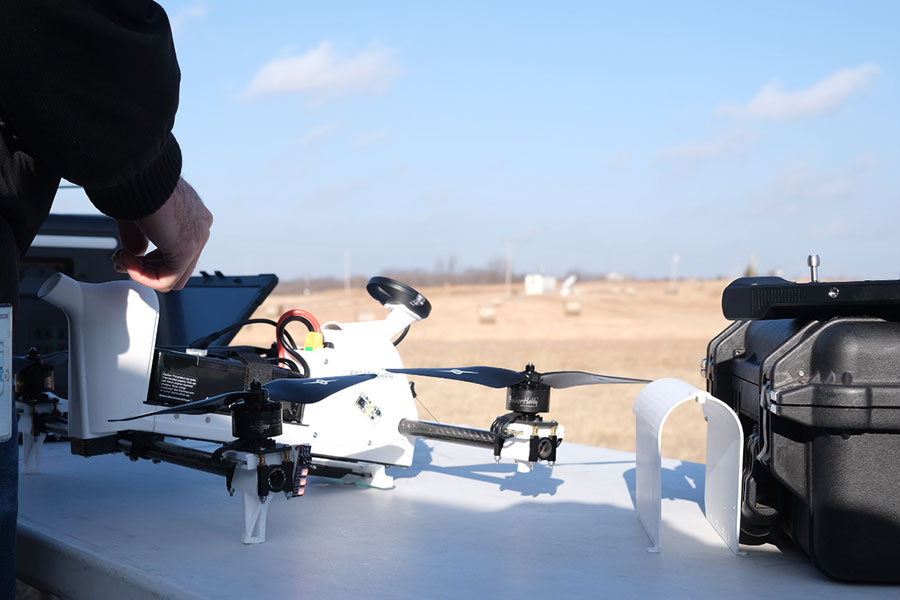
The 3D Mesonet project aims to make advancements in gathering spatiotemporal atmospheric data in the United States, allowing scientists to better predict short-term, high-impact weather, like thunderstorms, severe winds and winter precipitation.
Greg McFarquhar, director of the Cooperative Institute for Severe and High-Impact Weather Research (CIWRO) and Operations and a researcher at the University of Oklahoma, has been awarded funding from the U.S. Department of Defense (DoD) to compile and analyze cloud property measurements from around the world.