

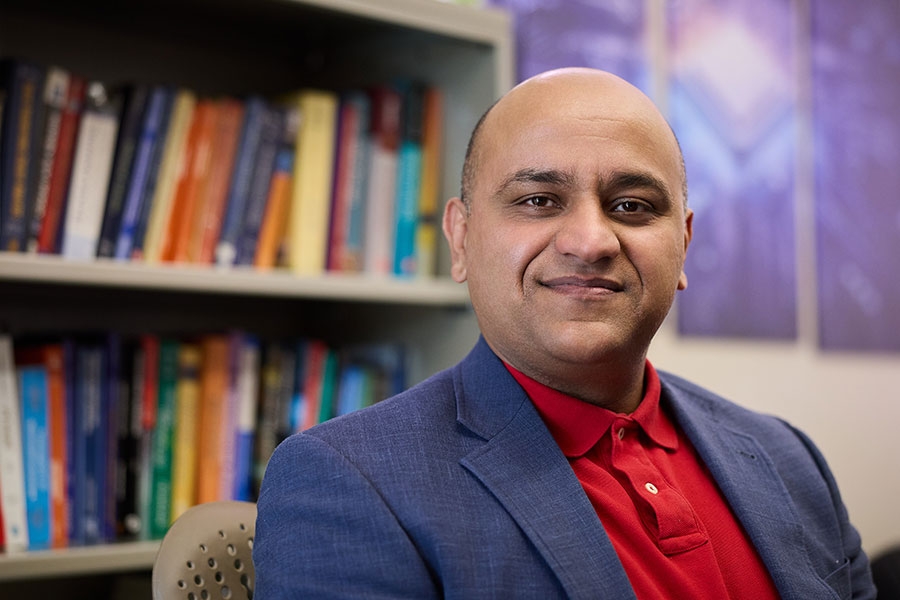
Mike Banad, a researcher with the University of Oklahoma, has been awarded funding from the U.S. Department of Defense (DoD) to pursue the development of advanced materials that could shape the future of energy-efficient electronics and photonics. His project uses inverse design techniques that aim to accelerate their creation and develop a systematic framework for future materials engineering that targets specific, desired properties.

Dr. Amy McGovern is a Lloyd G. and Joyce Austin Presidential Professor in the School of Computer Science at the University of Oklahoma and in the School of Meteorology at the University of Oklahoma. Dr. McGovern received her PhD in Computer Science from the University of Massachusetts Amherst in 2002 and was a senior postdoctoral research associate at the University of Massachusetts until joining the University of Oklahoma in January 2005. She received her MS from the University of Massachusetts Amherst (1998) and her BS (honors) from Carnegie Mellon University (1996).

Dr. Daniel J. Becker is an Associate Professor of Biology at the University of Oklahoma, with a Ph.D. from the University of Georgia and a B.A. from Bard College. His research focuses on understanding the ecological and evolutionary factors that drive infectious disease dynamics in wildlife hosts and cross-species transmission. Combining spatiotemporal field studies, machine learning, immunology, and theoretical models, Dr. Becker's work aims to predict how pathogens spread and how environmental changes affect disease transmission. He specializes in zoonotic pathogens, particularly in bats and birds, exploring topics like the impact of anthropogenic diet shifts, agricultural land use, and migration on disease risk. His interdisciplinary approach generates field-testable predictions to inform disease surveillance and management. Dr. Becker's work has been widely published in prestigious journals such as Trends in Ecology & Evolution, Molecular Ecology, and Proceedings of the Royal Society B, contributing significant insights into wildlife-pathogen interactions and disease ecology.

Dr. Dimitrios Diochnos is an associate professor in the School of Computer Science at the University of Oklahoma (OU). Prior to joining OU, he worked as a Hobby postdoctoral research fellow at the Department of Computer Science of the University of Virginia. Earlier he held a research associate position at the University of Edinburgh. He received his PhD degree from the Department of Mathematics, Statistics, and Computer Science at the University of Illinois at Chicago. He received his MS degree from the Department of Mathematics at the University of Athens, Greece. He received his BS degree from the Department of Informatics and Telecommunications at the University of Athens, Greece. The main focus of his research is on the mathematical foundations of machine learning. He is also interested in artificial intelligence at large and in particular in applications of knowledge-based systems to automated reasoning. His work has appeared in top conferences such as NeurIPS, ALT, and FUN, or top journals such as Information Processing Letters and Journal of Symbolic Computation. He has served as a member of the program committee in major artificial intelligence venues such as NeurIPS, AAAI, and IJCAI. He has also served as a reviewer in top venues such as SODA, ICALP, and AAMAS, or top journals such as SIAM Journal on Discrete Mathematics, Discrete Applied Mathematics, and Annals of Mathematics and Artificial Intelligence. Since 2012 he has served as the publicity chair for the biennial International Symposium on Artificial Intelligence and Mathematics (ISAIM). He is also a co-editor on a special issue of the Annals of Mathematics and Artificial Intelligence journal, devoted to ISAIM 2018. Finally, he has also served as a member of the international scientific committee for the International Olympiad in Informatics in 2004.

Dr. Heather Bedle is the Lissa and Cy Wagner Associate Professor of Geosciences and holds the Edith Kinney Gaylord Presidential Professorship at the University of Oklahoma. She earned her Ph.D. (2008) and M.S. (2005) in Earth and Planetary Sciences from Northwestern University, and her B.S. (1999) in Physics from Wake Forest University. Dr. Bedle's research combines geosciences, data science, and environmental sciences, utilizing advanced seismic reflection methods and machine learning to improve multi-attribute seismic analysis and reservoir characterization for geothermal and carbon capture applications. She also explores seismic identification of gas hydrates and the interactions between environmental dynamics and society. Dr. Bedle teaches a range of courses, including 3D Seismic Interpretation, Machine Learning for Geoscientists, and Python for Geoscientists. Her published work spans high-resolution imaging of continental tectonics, seismic facies classification using machine learning, and the application of multi-attribute analysis in paleoreef reservoir characterization.

Dr. Javier A. Jo is the Ted and Cuba Webb Presidential Professor and Director of the NIH-P20 COBRE Oklahoma Center of Medical Imaging for Translational Cancer Research at the University of Oklahoma. He received his B.S. in Electrical Engineering from Pontificia Universidad Católica del Peru and his M.S. in Electrical Engineering (Signal and Image Processing) and Ph.D. in Biomedical Engineering (Physiological Modeling) from the University of Southern California. Dr. Jo’s research focuses on biophotonics, developing innovative optical sensing and imaging technologies to study pathophysiological mechanisms and improve the clinical management of major human diseases. His work integrates both optical spectroscopy/imaging instrumentation and computational tools for noninvasive tissue characterization, addressing critical unmet needs in biomedical research and clinical practice. Dr. Jo has secured over $8 million in research funding from agencies such as the NIH, AHA, and CPRIT. He teaches courses in biomedical instrumentation, signal/image processing, and statistics, and serves as a Topical Editor for OSA Optics Letters and as a standing member of the NIH Clinical Translational Imaging Science Study Section.

Dr. Matthew L. Jensen is the W.P. Wood Presidential Professor of Management Information Systems at the University of Oklahoma and Co-Director of the Center for Applied Social Research. He earned his Ph.D. from the University of Arizona in 2007. Dr. Jensen’s research focuses on computer-aided decision-making, human-computer interaction, and online credibility assessment, exploring how individuals evaluate information in mediated and AI-assisted environments. His work has been published in top-tier journals like MIS Quarterly, Information Systems Research, and Journal of MIS, as well as interdisciplinary outlets such as Communication Research and Journal of Computer-Mediated Communication. Dr. Jensen has secured over $9.7 million in research funding from agencies such as the National Science Foundation and the Air Force Office of Scientific Research, supporting his investigations into knowledge transfer, deception detection, and the evaluation of online information.

Dr. Naveen Kumar is an Associate Professor in the Management Information Systems division at the Price College of Business, University of Oklahoma, with expertise in data science and information systems. He holds a Ph.D. from the University of Washington and previously worked as a data science researcher at Intel Corporation for over nine years. His research focuses on large language models and AI techniques for big data applications. Dr. Kumar brings real-world experience into his classroom, using application-oriented teaching to connect theory with industry-based scenarios, and he actively supports students in securing internships and jobs. He has contributed to university service and the academic community, chairing conferences and reviewing top journals. His leadership in data science has involved collaborations with organizations like FedEx and the Air Force, and he has received notable awards, including the Microsoft Azure Research Award. His research has been funded by entities such as the FedEx Institute of Technology and FedEx Corporation.

René Peralta studied architecture at the New School of Architecture in San Diego and the Architectural Association in London, England. He has a Master of Science in Planning with an emphasis in History and Theory from the University of Oklahoma. René has been a professor in the Department of Architecture and Urban Design at UCLA, a Professor of Urban Design at the University of Washington in St. Louis, and, from 2012-2014, was Director of the Master of Science in Architecture with an emphasis in Landscape + Urbanism at Woodbury University in San Diego. Previously, he served as the inaugural Herb Greene Teaching Fellow at the University of Oklahoma (2019-2021).

Dr. Samuel J. Huskey is a Professor of Classics and Letters at the University of Oklahoma, specializing in Latin poetry, textual criticism, palaeography, neo-Latin, and medieval Latin. He holds a particular interest in the allusive techniques of Augustan poets, especially Ovid, and has published extensively on Ovid's Tristia. Recently, his research has focused on a 15th-century manuscript of Lucan's De bello civili, using digital techniques to uncover lost texts and publishing transcriptions of previously unpublished marginalia. Dr. Huskey is also a co-translator of Boccaccio's minor Latin works for the Harvard University Press I Tatti Renaissance Library. He directs the Digital Latin Library, a collaborative project funded by the Andrew W. Mellon Foundation. In addition to his research, Dr. Huskey enjoys teaching courses on Classical mythology, Greek and Latin literature, and advanced Latin grammar and rhetoric. He served as department chair from 2009 to 2019 and is actively involved in academic advising and university service, including roles with the Classical Association of the Middle West and South and the Society for Classical Studies.

Dr. Talayeh Razzaghi is an Associate Professor at the University of Oklahoma, specializing in data-driven analytical, machine learning, and AI-based models with applications in healthcare, cyber-physical systems, and smart manufacturing. She holds a Ph.D. in Industrial Engineering from the University of Central Florida, an M.S. in Industrial and Systems Engineering from Sharif University of Technology, and a B.S. in Applied Mathematics from the University of Tehran. Dr. Razzaghi’s research focuses on developing robust supervised learning techniques for high-dimensional, imperfect data and addressing challenges such as class imbalance, missing values, and outliers. Her work emphasizes personalized predictive modeling in medical diagnosis and health disparities, particularly in cancer and women's health outcomes. She has received multiple awards for excellence in research, including the University of Oklahoma’s VPRP Award, and serves on several editorial and professional boards, including as Associate Editor for Energy Systems. Dr. Razzaghi's extensive contributions also include leadership roles in the Institute of Industrial and Systems Engineers (IISE) and INFORMS.

Dr. Banad is an Associate Professor in the School of Electrical and Computer Engineering and an affiliated faculty member in the Materials Science and Engineering Program at the University of Oklahoma. Prior to joining OU, he was a researcher at Harvard University, a faculty at Southern University in Louisiana, and a research and development engineer at Samsung Electronics. His research includes emerging machine learning applications and the hardware implementation of energy-efficient neuromorphic computing based on emerging materials, devices, and sensors. Dr. Banad is a director of a new research laboratory, “Neuromorphic Intelligent Computing Systems (NICS)” that focuses on emerging techniques for reliable, energy-efficient, and high-performance neuromorphic engineering across the full stack of materials, devices, circuits, systems, algorithms, and applications.
