Looking to make a difference in K-12 education and school libraries? The University of Oklahoma’s Master of Library and Information Studies degree—the only ALA-accredited program in Oklahoma—is the perfect way to ignite your career.
At the University of Oklahoma, School of Library and Information Studies, candidates pursuing school librarianship are prepared for their career through a robust curriculum, active application of their learning, and cross-department collaborations that provide authentic learning by working with pre-service teachers. The core courses inform a strong theoretical framework and foundation, and the required electives help students focus their skills for their invaluable work in school libraries.
School libraries are the heart of the school, and the work of School Librarians is impactful for all learners. Five roles, as outlined in the National School Library Standards for Learners, School Librarians, and School Libraries (AASL, 2018), each with different responsibilities, provide the roadmap to best practice. Through coursework and authentic application of concepts, students develop skills to fulfill the five roles as outlined by AASL.
If you have questions about the School Librarianship focus of the MLIS program, general certification questions, or careers in school librarianship, we are here to help!

Graduates of the SLIS program stand out! Candidates develop a deep philosophical foundation couched in the unique work of school librarians. Through focused elective courses, SLIS students learn about collection development in school libraries and how to ensure the library has a balanced collection where all students are represented; they discover different literacies and strategies to effectively reach learners in a variety of ways; they gain an understanding of the developmental needs of children and young adults and how information resources and services for each age group meet a wide range of needs; and students are immersed in the roles and responsibilities required to effectively manage a school library reflecting best practice. SLIS graduates recognize the vital role that administrators play in the school library program and work in tandem as a team in developing student-centered library programs.

As a graduate of the SLIS program I felt confident and prepared for my career as a school librarian. My course program at SLIS provided an incredible foundation of knowledge and balanced the theory with practical applications in a school library. As a district library director, my experience in hiring OU SLIS graduates has been outstanding. I am confident in their abilities and know they are prepared to jump into a K12 library and immediately make an impact with their learners.

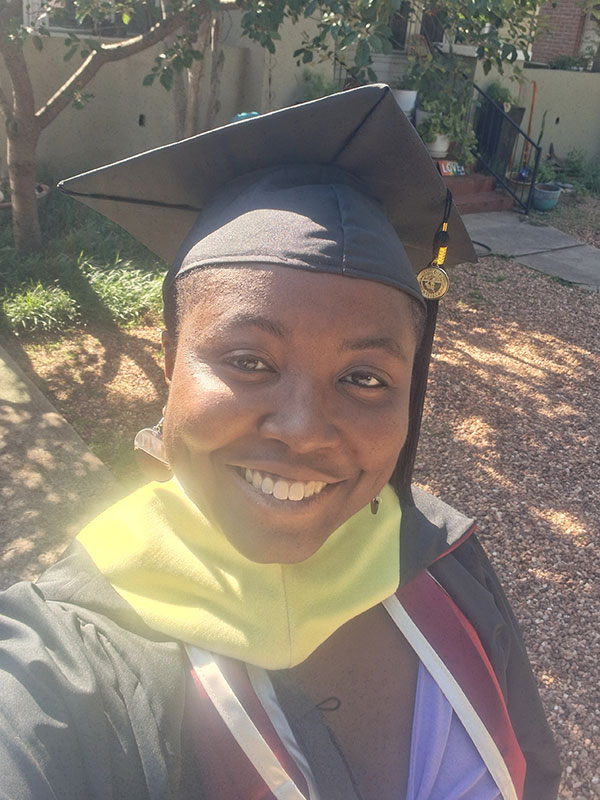
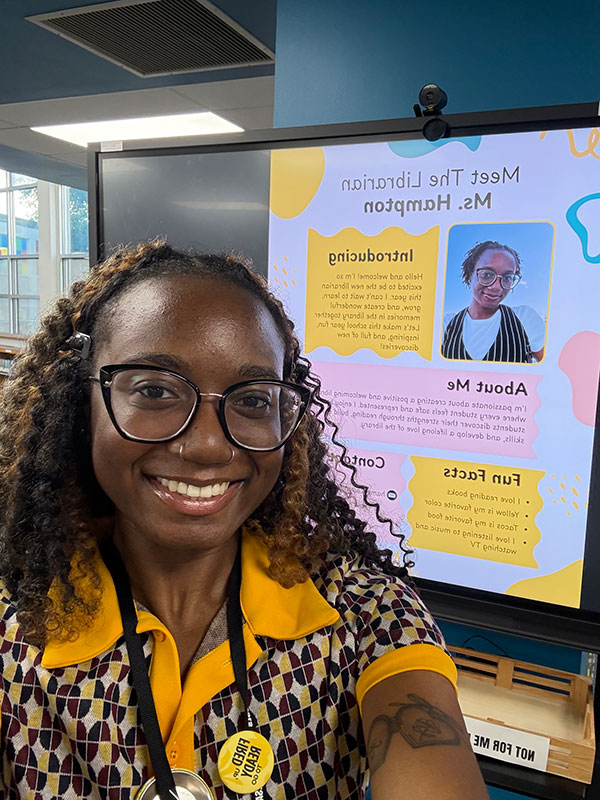
MLIS Student Kari Hampton is in her final semester of library school, and as she reflects on her journey, she is proud of how far she’s come. In June of this past summer, she attended the ALA conference in Chicago and had a great time exploring the city, resources, and sessions. She plans to stay involved with ALA and participate in any conferences she can. She was hired as a school librarian at Hawthorne Elementary School in Tulsa! They had been without a librarian for the past year, so it was a blessing that she was hired.
MLIS Student Kari Hampton is in her final semester of library school, and as she reflects on her journey, she is proud of how far she’s come. In June of this past summer, she attended the ALA conference in Chicago and had a great time exploring the city, resources, and sessions. She plans to stay involved with ALA and participate in any conferences she can. She was hired as a school librarian at Hawthorne Elementary School in Tulsa! They had been without a librarian for the past year, so it was a blessing that she was hired.
LIS is developing a new strategic plan representing all programs – Museum Studies, Master of Library and Information Studies, Bachelor of Information Studies, Bachelor of Science and Information Technology, Doctorate of Information Studies, and graduate certificates - and we want to hear from you. Whether you are a student, alumni, employer, or community partner, your feedback will help guide our priorities and future direction.

School Librarians provide essential instruction for learners, other educators, and stakeholders in a variety of literacies, including print, digital, information, media, and news. They are uniquely positioned to teach all learners in a school.
School librarians build relationships with the learning community and recognize the diverse needs of users. As a leader, they are committed to the profession by gaining knowledge of the profession and working with stakeholders and local and global group to develop high quality library programs.
School Librarians are at forefront of the evolving information landscape and provide all members of the school community with the expertise and instruction necessary to navigate these changes.
School Librarians are a vital member of the instructional team, modeling best practice in instructional strategies, collaboration and coteaching beside classroom teachers, and suppporting learners as they become critical thinkers.
School Librarians ensure access to resources that meet a variety of needs with a strong mission and vision for the school library, strategic planning, and effective policies. The school Librarian manages the budget, personnel, and the library physical and virtual spaces.

OU SLIS supports rolling admissions, so now is the perfect time to start your application! Steps include completing an application, a statement of purpose and goals, an updated resume or CV, and three (3) letters of recommendation. Click the button below to find out more about the admissions process.

According to the American Association of School Librarian (ala.org):
“Today's school librarian works with both students and teachers to facilitate access to information in a wide variety of formats, instruct students and teachers how to acquire, evaluate and use information and the technology needed in this process, and introduces children and young adults to literature and other resources to broaden their horizons. As a collaborator, change agent, and leader, the school librarian develops, promotes and implements a program that will help prepare students to be effective users of ideas and information, a lifelong skill.”
The University of Oklahoma School of Library and Information Studies (OU SLIS) is the only American Library Association-accredited master's degree in Oklahoma offering a comprehensive degree program through coursework and practical experience (ala.org). The MLIS degree requires a minimum of 36 hours of completed coursework. To be awarded the MLIS, students must do one of the following end of program assessments in their final semester: complete a written thesis or prepare an eportfolio.
Below is the OU list of core courses for those seeking a career in a k-12 school librarianship.
NOTE the following for students electing the school librarianship focus:
It is strongly recommended that you take the six general core courses listed above BEFORE taking your end of program assessment.
Please consult your advisor for the one course from the options listed below that best meets your educational goals:


For students who hold a standard teaching certificate, the university may recommend them to the Oklahoma State Department of Education for certification. Requirements may vary depending on the candidate's education, background, and experience. The process is outlined below:
Upon completion of the degree and required school librarianship certification exam, students should apply to add the certificate area through the State Department of Education single sign-on portal.
At the appropriate time (Single Sign On account set up, completed the degree, and required exams), the student should contact the SLIS office to request a recommendation.
In consultation with the College of Education certification representative, a transcript review will confirm the degree and certification recommendation.
The SLIS office will send a recommendation for certification to the College of Education certification representative for an electronic approval through the Oklahoma State Department of Education.
Information about the traditional path for Oklahoma Teacher Certification is available at: http://sde.ok.gov/sde/traditional-path-oklahoma-teacher-certification
Because school library media certification is an advanced certification (to be added on to a standard teaching certificate), candidates completing the SLIS certification program typically hold a standard teaching certificate and need to take one more exam, the OSAT, for the content area of school library media. Information on this test can be found at: http://www.ceoe.nesinc.com
Students who hold the MLIS degree with a focus on school librarianship may be considered for a non-traditional (alternative) credential by applying for Alternative Certification through the Oklahoma State Department of Education (OSDE). Note that most students pursuing alternative certification are asked to complete additional coursework. For most, this includes a pedagogical practices course and a classroom management course. School Library Administration 5283 meets the required pedagogical practices, and the classroom management requirement may be met with a course from the College of Education.
Students requiring additional coursework for certification should work with the School Librarianship Faculty Lead (Dr. Edwards). Special permission to enroll in College of Education courses is obtained through Dr. Edwards.
Upon completing the MLIS program to continue with certification students will need to:
At the appropriate time (Single Sign On account set up, completed the degree, and required exams), the student should contact the SLIS office to request a recommendation.
In consultation with the College of Education certification representative, a transcript review will confirm the degree and certification recommendation.
See OSDE Alternative Certification for additional information at: http://sde.ok.gov/sde/oklahoma-alternative-placement-program-teacher-certification
If you have a question for OSDE, you may contact the Director of Instructional Materials & Library:
Jason Stephenson,Director of Secondary English Language Arts & Library Media
Phone: 405-522-3628
Email: jason.stephenson@sde.ok.gov
Visit the OSDE Teacher Certification website: http://sde.ok.gov/sde/teacher-certification
Students applying for School Librarian Certification outside to Oklahoma must consult the State Department of Education in the state for which they seek certification.

Oklahoma Academic Standards Information Literacy
American Association of School Librarians*
National School Library Standards for Learners, School Librarians, and School Libraries
*The following Learner, Librarian and School Library Frameworks are excerpted from the National School Library Standards for Learners, School Librarians, and School Libraries by the American Association of School Librarians, a division of the American Library Association, copyright © 2018 American Library Association. Used with permission. The documents are permissible to use, reproduce, and distribute for private, non-commercial, and educational purposes only for use by Oklahoma educators, librarians, and citizens. Any usage or permission question can be directed to aaslstandards@ala.org. Visit standards.aasl.org for additional resources.

The career of a school librarian is an exciting opportunity to impact all learners of the school. School librarianship graduates are prepared for work in K-12 school libraries, steeped in theory and practical applications. Oklahoma school libraries follow standards for accreditation of Oklahoma Schools, specifically, Standard VII. Oklahoma Standard VII provides guidelines and requirements - for elementary, middle, and secondary schools - for the collection, staffing and staff responsibilities, physical space, expenditures, and evaluation of the overall program. The standard supports the work of the School Librarian and the school library as a whole.
As a vital member of the instructional team, School Librarians are master educators knowledgeable of information literacy standards seamlessly integrated with classroom curriculum. The librarian is armed with knowledge of information literacy while the classroom teacher brings the content area expertise. Collaborating and coteaching, the team develops and delivers instruction grounded in strong instructional design principles. For more information about the Oklahoma Academic Standards, visit the Oklahoma State Department of Education.
School librarianship candidates in the OU SLIS Master of Library and Information Studies program, complete a program that has the ALA/AASL/CAEP School Librarian Preparation and the National School Library Standards for Learners, School Librarians, and School Libraries embedded throughout the curriculum. Having these standards integrated into coursework and academic experiences, candidates deepen their understanding of application and best practice in the workplace.
Graduates and practitioners working in school libraries are active professionals participating in professional organizations. Many find that being a part of a professional organization provides opportunities for networking, leadership, and professional development. School librarians are unique in that a broad scope of professional associations may be applicable to their work. Individuals decide which are best-suited to support their work. The Oklahoma Library Association and the Oklahoma School Librarians division provide professional experiences to strengthen one's skill set, learn about new trends, and give back to the profession through leadership and participation. At the national level, many OU alumni are active members and hold offices in the American Library Association, the American Association of School Librarians, the Young Adult Library Services Association, and the Association for Library Service to Children. Other related organizations are the Oklahoma Society for Technology in Education and International Society for Technology in Education.
Graduates, keep in touch with SLIS! Share your news, jobs, awards, career advancements and more. Let us celebrate with you!
References
American Association of School Librarians, A. A. (2018). National School Library Standards for Learners, School Librarians, and School Libraries. American Library Association.