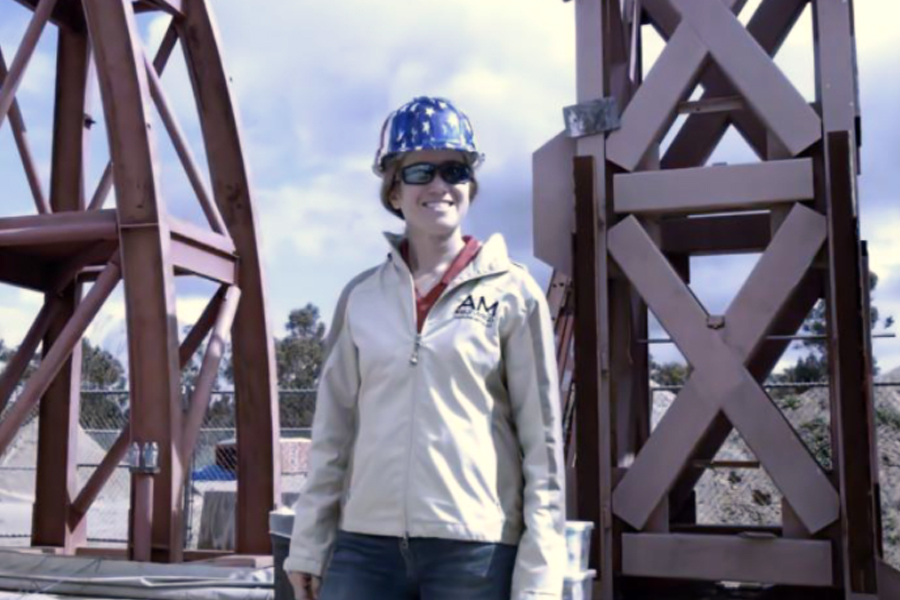
Amy Cerato, helical pile researcher and CEES associate professor conducted tests at the University of California-San Diego on the world's largest shake table.
The CEES Geotechnical Engineering program has two primary missions: provide quality education at both the undergraduate and graduate levels, and develop and maintain strong research programs of regional and national significance in the areas of geotechnical engineering and geomechanics.
These programs are designed to provide students with fundamental understanding of the behavior of geologic media, of structures constructed on or using these geologic media and of the contributions of geologic media to environmental problems and solutions. The topics studied relate to static and dynamic behavior of soils; soil-structure interaction; constitutive modeling; unsaturated soil mechanics; large and small scale laboratory evaluations of soil properties; foundation engineering; the influence of physicochemical properties on mechanical behavior of soils and in situ testing and centrifuge modeling of static and dynamic behavior of soils, including pollutant transport processes. The program strongly encourages interaction between the various disciplines of soil mechanics, geomechanics and environmental engineering. The program emphasizes both analytical/numerical and experimental methods that aid in the advancement of modeling, analysis and design.
Both thesis and course-work only options are available for obtaining the MS degree. The course-work only option requires 32 semester credit hours. The thesis option requires completion of 30 semester credit hours, with five hours devoted to thesis research and one hour to a course on technical communications. The thesis option includes a final defense.
The doctoral program, which is tailored to the specific interests of the student, focuses on expanding professional knowledge in the fundamental concepts of geotechnical engineering. The student is expected to produce a research dissertation of professional significance that could be the basis of two or more papers published in refereed journals. The doctoral degree requires a minimum of 48 hours of post-graduate coursework and 41 hours of dissertation research. Thirty hours of CEES courses and 12 hours outside of CEES are required. One hour must be devoted to technical communications.

New RA and TA Graduate positions available - APPLY TODAY!
Faculty research interests cover a broad spectrum of geotechnical and geo-environmental engineering. Current research areas include constitutive modeling, soil-structure interaction, consolidation, behavior of shallow and deep foundations, laboratory and in-situ testing of soils, bridge approach settlement, resilient modulus, soil stabilization and soil aggregate pavement materials, dispersive and swelling clays, pore collapse in unconsolidated and poorly consolidated reservoir rocks, ground surface subsidence and mine collapse, pavement dynamics including vehicle-guideway interaction and non-destructive testing, slope stability, seepage flow through porous media, soil liquefaction, application of numerical methods to complex geotechnical engineering, rock mechanics and mining problems, static and seismic design of landfills, applications of geosynthetics in geotechnical and transportation engineering, physico-chemical behavior of soils governing the migration of pollutants through soils, centrifuge modeling and soil behavior including saturated and unsaturated soils.

The University of Oklahoma's Geotechnical Engineering Program has six faculty who teach and perform research in various avenues of unsaturated soil mechanics, foundation engineering, constitutive modeling, geosynthetic applications, rock mechanics, clay mineralogy, engineering geology & pavement design.