Building on the conversations about the future of design pedagogy that were started during the March 2020 “Schools of Thought” conference, the Gibbs College of Architecture at the University of Oklahoma is hosting a series of webinar conversations that explore how to adapt to our changing world, or better yet, how to rebuild it as a better world.
About the session
The purpose of the “Safer During COVID-19″ panel is to bring to the fore our current best practices and advice on how to make interior/enclosed spaces safer. We hope to discuss which principles, techniques and technologies can assist with retrofits and what considerations should apply for new builds. One of the areas we’re highlighting is the tendency for buildings to be difficult to adapt to the bare requirements for safety in the time of COVID, largely due to how their air-handling systems were designed, and most often due to the prevalence of inoperable windows.
Thursday, July 9, 2020
4:00 – 5:30 p.m. EST
Lee Fithian, University of Oklahoma
Lee has over 17 years of commercial and governmental practice experience, including serving as former Director of Sustainable Design at the Benham Companies. Within the State of Oklahoma, she helped found the Oklahoma Sustainability Network and the State Chapter of the US Green Building Council. Lee currently serves as Chair of the Committee on the Environment for the AIA Central Oklahoma Chapter. Lee’s research and teaching efforts focus on the application of biological and ecological models to architectural design. She builds connections between interdisciplinary research and architectural design to conserve and regenerate air and water in urban and suburban environments.
Kristina Leach, University of Oklahoma
Kristina Leach is a theorist, strategist and historian of architectural design. Her academic work explores the interplay between technology, culture and architecture’s design medium. She uses the insights from this work to create user-focused strategies in the civic, corporate and academic worlds.
Douglas L. Watts, RJC Engineers
Doug has over 35 years of experience in both architecture and engineering. He is involved in investigations and assessments of existing building envelopes, management of envelope retrofits, and envelope design consultations with architects for new construction projects. Having worked in prestigious engineering and architectural firms, as a university lecturer and a researcher, and as a building envelope specialist for the City of Vancouver, Doug joined RJC in 2002, and was made Principal in 2011.
The Summer Schools of Thought Series is led by Stephanie Pilat, Angela Person and Tony Cricchio.
Gibbs College is pleased to present the exhibition 200 Digital Drawings by Professor Tiziana Proietti, currently on display in the Gould Hall Living Room.
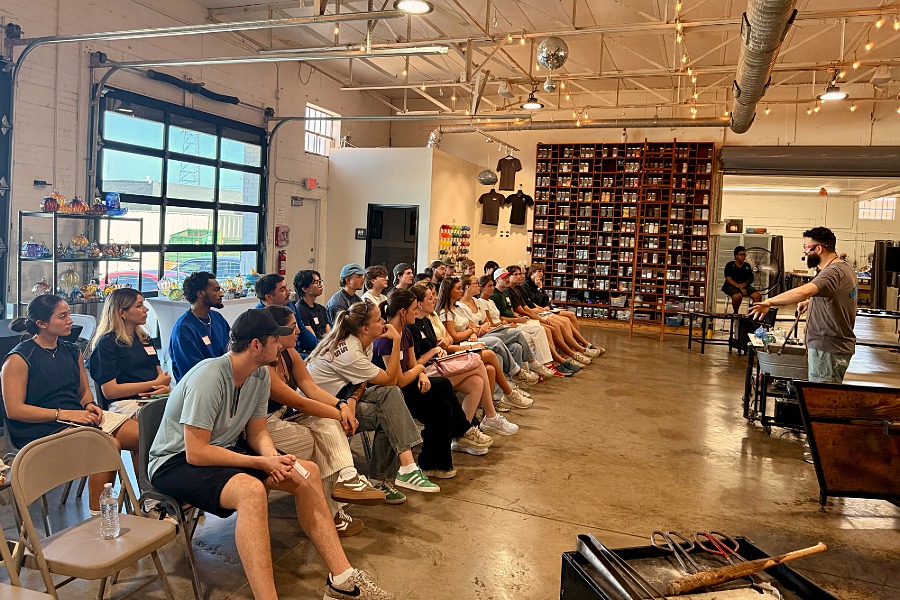
Gibbs College of Architecture Professors Amber Brown and Amy Leveno led 29 students to Dallas, Texas, in September for a learning experience as part of their Design 7 Studio course.
Christopher C. Gibbs College of Architecture professor and Institute for Quality Communities Director Dr. Amber N. Wiley’s book, Model Schools in the Model City: Race, Planning, and Education in the Nation’s Capital, has received two major honors from the Urban History Association.