GCA Communications Intern Kali Curtis (K) sat down with Brent Wall (W) a landscape architecture alumnus and adjunct professor here at Gibbs! We sat down with Brent Wall to learn about his experiences as a landscape architect and how he got into the field. He is the Studio Director of the Landscape Architecture + Urban Design (LAUD) Studio, a full-service architecture practice in Oklahoma City. Read on for highlights or click the link below to access the full podcast.
K: Hello everyone, welcome to the Gibbs Spotlight. My name is Kali Curtis and I’m a communications intern at the Gibbs College of Architecture. Today we are talking to Brent wall, a landscape architecture alumnus and adjunct professor at Gibbs College. He is currently the director of the landscape architecture and urban design studio in Midtown Oklahoma City. So, can you tell me a bit about yourself?
W: Sure, I’m a native Oklahoman. I grew up in Oklahoma City. My joke lately is that I was born in the hospital that’s about a mile from my house, so I haven’t gone very far. So, I’m an original Midtowner in Oklahoma City. I’ve been married for 13 years, my wife and I have a 10-year-old daughter, we live in a super old house that takes a lot of care and upkeep. We love to travel and love to work around the house, obviously I like to garden and build things. And I’ve learned recently that I don’t idle very well. Some people can really kind of take it easy and not get antsy, and I’ve learned that I’m not that kind of person. I kind of stay busy. I always have something, something going on. Usually, a lot of balls in the air. And for some reason, that seems to make me happy.
K: Thank you so much. Yeah, I’m kind of the same way. I always like to be doing something.
W: Yeah, I’m sure it drives people crazy. You know, I’ve learned that I can really turn things off pretty easily when I need to. But when I don’t want to do that, I have to kind of stay busy. Obviously, I’m a landscape architect. That’s kind of what I do, and not who I am, you know. Parts of what my experience of life and things have contributed to that. But I’ve become really aware that when you go to parties, when you get older, it’s like the first question is “what do you do?” And I’ve really tried to stop doing that and try to find out who somebody is apart from their occupation. So, I love that that’s your first question. Because you’re trying to find out who the person is, not necessarily how that relates to their profession, you know?
K: Yes, definitely. Because I mean, we know that you’re a landscape architect, but we also would like to start off knowing a bit about the person, not just about the career. So, can you tell me about LAUD studio and your role there as the director?
W: Yeah, LAUD studio is a full-service kind of generalist architecture practice. We’re located in Midtown. We currently have four architects working on staff. Jessica Lerner has been with us the longest, she’s a Gibbs College of Architecture graduate. Fotis Kousiakis also graduated from OU. We have Hannah Moll, she’s a graduate from Arkansas. And then we’ve added Carl, to our staff who is an Oklahoma [State] graduate. So, we have a real kind of mix of educational backgrounds and schools in the studio. And then we also have two part-time employees. Katie Huskerson is our studio coordinator. She helps everybody on a daily basis do things and then Traci Brannon is our business manager. So, we’re doing a lot of public work, which would be streetscapes and Parks and Recreation type work, things that are development driven, restaurants, and quite a bit of residential work as well. So, we just have a real broad mix of project types that come in the door.
I’m the director of the practice, but we’re also a very collaborative group. We kind of have a deal that we work very closely together. We have project managers, but oftentimes a lot of the staff winds up kind of cross pollinating and working on projects together, which is really nice. So, I’ve tried really, really hard to create a collaborative environment where all the good ideas are the ones that kind of rise to the top. I’m kind of a stickler for just making sure that all of the work that goes out the door, the construction documents and specifications, that they’ve all been double and triple checked, and that the plan is very readable.
We’ve also developed just a lot of really good systems internally that help us be really efficient and work harder. So, it’s been interesting. I mean, we’re kind of a young practice. We’re kind of scaling up at the moment to meet the demands of the workload. My role is kind of shifting a little as we speak. I’ve always been very kind of in the mix in terms of doing production work, and any given day, I could be doing a plan rendering or be in AutoCAD doing construction plans.
K: Thank you so much. So why did you decide to go into the field of landscape architecture?
W: My path has been a little bit unusual, and I’ve kind of engaged in profession post-graduation. I literally kind of started at the bottom of kind of the landscape industry. I literally was kind of pushing a lawn mower for a company that was a commercial level maintenance company. So, I did everything from mowing and edging and weed eating and all those things, planting flowers. I got into it, and I liked it, but I also knew that, you know, working outside in Oklahoma in August wasn’t necessarily a comfort. It was a difficult job. But as I was in that, I mean, I just kind of was fascinated by the plants and started to get into that a little bit.
And then from there I went to Oklahoma State. They have a horticulture program in Oklahoma City. So, I enrolled in horticulture school and really kind of started that path just learning more about plant material and just the landscape industry in general. I finished my associates in horticulture and then came to OU to work on my bachelor’s degree. And so, starting in about 2009, I went to work for OU at the Health Sciences Center in Oklahoma City. And that was just a few years after President Boren and Mrs. Boren had come to the university, and they had a real mandate to improve all the campuses, and especially the Health Sciences Center. So I was there at a good time, whenever we were doing a lot of construction, a lot of tree planting, improving campus spaces all over the general campus. And that kind of just gave me the bug for working on bigger, large scale public landscapes. And that was just really a transformative time for me.
The director of the Landscape Services, his name was Bobby Jackson, he was just a really fantastic mentor for me. He had a construction background and landscape background. So, I learned a tremendous amount from him. And then somewhere in there about 2005 by working on my bachelor’s degree and just kind of needed a little bit more flexibility to go to school and do that. So, I left there, and then did a design-build business of my own.
So, I had an old Toyota Tacoma truck that I would fill up with all sorts of rocks and soils. And it was a very small operation, but I was able to get enough clients that were willing to let me take the time that it took to build things for them. It was kind of slow, but it was sort of a handcrafted landscape product that I was putting out there. So, I was doing everything from flagstone patios, and fire pits and planting trees. And so, I had developed kind of my own style of working where it was just me and my truck and my tools to get things done.
During that time, I think about 2006 it was, when I finished my bachelor’s degree and the summer of 2006, I was kind of hustling a little bit to get work. And my next door neighbor was a contractor. So, I was working with him doing painting and I helped him build a detached garage for a client. And there was just a moment during that summer, I think I was up on the roof with the skill saw cutting plywood for the roof decking. And I was like, “I need to figure out what I’m going to do.” I was like “this is kind of not sustainable. I have a degree now and I need to figure out or what my next step is.”
I think it was maybe even July of 2006 when I made this decision and sort of hastily applied to graduate school. And by the middle of August, I was on campus in Norman starting my graduate program in landscape architecture. It wasn’t impulsive, but it wasn’t a clear line that that’s what I was going to do. And then at some point, we just kind of made the decision and did it. And I was a little bit of an older student at that time. So, it was definitely hard to be a full-time graduate student and then try to work and have a home life and all those things at that point. But that’s kind of how I got there.
Sort of aside from that, in high school, we actually had a vocational drafting program at my high school, and I had taken classes. I always kind of liked technical drawing, and then somewhere in there I got into the landscape field and then ultimately, all of that just sort of married up. The Landscape Architecture program had the science part of horticulture, and then it had the art part of design, and then the technical part of drawing. And so, it was kind of this perfect storm. For me. In hindsight, I look back and I’m like, “Oh, of course,” that’s what it was supposed to be. But it took all these little moves and little pieces of this and that to kind of put the puzzle together in the end.
K: Thank you, that’s really interesting. So, you kind of started out with like, just general landscaping in that field. And then it sounds like you kind of started becoming your own landscape architect, before you even got the degree because you were, you know, working from your truck, and landscaping and also doing these designs for people. That’s really cool. And so, you did touch on this a bit that you applied for your master’s degree, and how you decided to go into the field of landscape architecture. But what brought you specifically to the Gibbs College of Architecture?

Brent Wall at Gould Hall
W: I think I just got lucky. This is a tough question for me to answer because I don’t want it to sound like it was sort of dumb luck. And I think just having worked for the University, having gotten my undergraduate degree at the University, you know, OU is just kind of a no brainer for me. And as I said, you know, I was a little bit older, we owned our own house, and we were kind of established, you know, just living in Oklahoma City at that point. So, convenience was definitely a factor. But I didn’t even really know enough to know to go out and look around anywhere else. I mean, it was just, this is what I’m going to do. It’s my school, it was already my school, and they just happened to have the program that I needed to get into. And I had good enough grades and those things that it was just an easy admission process, you know, it was kind of my background and my education background, I kind of checked all the boxes of the kind of student that they were looking for. I would say convenience was a big part of it. I think only after I got there, did I sort of understand what I got myself into, in a good way. I just think I got lucky that there was an opportunity in a school that was very close, that was a good school, and was able to provide all the training that I needed at the time. So I think I just kind of stumbled into it, if that makes sense.
K: Yes, definitely. Thank you. That’s really good that you did choose Gibbs College of Architecture, because it’s just a great school. So, what aspects of the curriculum at Gibbs have helped you the most as a landscape architect?
W: It’s interesting. I’m also an adjunct professor in the college. In the fall, I typically teach plant materials and then in the spring, I teach a studio. Not only did I have three years of being a student, but I’ve also been teaching over the past 12 years or so. Not every year, but I’ve been sort of on faculty for the past 12 years. So, I’ve seen the program from sort of both angles, as a student and a professor. Staff kind of comes and goes. I mean, that’s kind of the nature of academia, you know, people come in and people leave. And so, we haven’t had a tremendous amount of turnover in terms of professors. But each one of the folks that have come through have kind of left their mark in a way.
So I think the program whenever I was in school had a really strong urban design kind of slant to it, because of the director at the time. That was sort of his interest. And that sort of permeated the curriculum in a way. We were also not in Gould Hall. We were over in Carnegie Hall. And so, planning and landscape architecture were a little bit detached from the other three disciplines in the college. We kind of had a little bit of a planning slant too at that time. So that was kind of interesting. It kind of piqued my interest in urban design just because of that pervasive kind of thought process through the curriculum at the time.
But I will say that coming into the program, having a background in construction, like physical construction, working with Leehu Loon was great, because he is such a technical wizard at detailing and just knowing materials and how they connect and go together. That having him as a mentor to kind of connect to put the pieces together of how you would tell somebody else to build something through a drawing. That was really big for me, because I’d always just kind of visualized it and then sort of built it through trial and error in a way. So, creating this kind of technical ability to create plans was huge for me.
We also had Dr. Reed Hoffman on staff at the time. And he taught the plant materials class, and I came in as a horticulturalist and was like, oh, this class is going to be super easy. But he had a much broader knowledge of ecology. And his teachings really kind of blew my mind in terms of just understanding larger plant communities and how ecosystems work together for somebody who had come out of an ornamental background where plants were meant to be pretty and sort of ornamentation onto a landscape to come in and get this broader skill, understanding of how the soil works, and hydrologic cycles and just stream dynamics and just all these really cool, kind of bigger scaled landscape thoughts were really fantastic. So, I would say that I came in maybe a little arrogant thinking, okay, I know a lot about this already. And I kind of I quickly figured out that I didn’t really know nearly as much as I thought I did.
And then, you know, just generally studios, we had a nice mix of tenured professors and a few practicing professionals come in. And I always think that that is kind of a nice part of the program is that you get to interface with people that are in the profession working and kind of get their perspective and knowledge base. Its kind of real time in a way where an adjunct professor like myself can come in and say, okay, these are the things that I need a student to know when they come to my office. And then we can sort of inform the curriculum in a way that helps those students already have those skills when they go into the workplace.
So just generally, I think, you know, just coming into the landscape architecture program, it just kind of tied everything together for me. It was like the Rosetta Stone of everything that I had done. And I was able to put all of that together. And the professors were there to understand what I needed, and to kind of direct and guide me, and help me sort of pursue my own internal interests. And that’s what I think is really great about the graduate program is that you have your core classes that are required to be accredited, but you also have a tremendous opportunity to explore the university at large, whether that’s geography or GIS, or like sociology classes, or ecology classes, you can use your electives to really go out and pursue your own sort of intellectual curiosity, which I think is really interesting.
I think the other thing that I thought was really great was now the college is integrated so much better than it was back then just being under the same roof and having all the disciplines together is really nice. Back then, like in our professional practice class, that was really probably one of the first times that I had been in a class with other architects, or architecture students and construction science students and interior students, that was really fascinating too. Towards the end of my education, interfacing with those other students was really important for me. You had Erica on a couple of weeks ago on the podcast; she was in my professional practice class. And there was just a whole group of architecture students at that time that were just really talented, really smart kids. I learned a lot, they turned me on to a lot of different architects that I’d never heard of. And that all kind of became influential.
So generally, there’s the courses and the curriculum and the professors. And then there are the other students, many of which I’ve kept in contact with. And, in particular, the students that were in my studio, you know, kind of my year or whatever, we’ve all kept in really close contact over the years, those relationships have proven to be very, very valuable. And just kind of part of the overall experience that was so good for me, personally.
K: Thank you so much. I’m so glad to hear that, like you’ve found that path to a career like, it sounds like it really just all came together for you really well. And I did see that you taught some classes at Gibbs college, but I wasn’t aware that you’ve been like teaching adjunct for 12 years. That’s really cool.
W: Yeah, it hasn’t been every year but over the past four to five years, I’ve taught at least one class per year. It’s one of those things where I feel sort of compelled to do it. And I haven’t ever really been able to put my finger on what it is that that really drives that other than, you know, the students are fantastic. They’re super interesting and they’re fun to work with. I don’t know, the campus and the college does feel like home to me in a way. So having this association and just kind of connection to it has really been important to me. I don’t know why, but it just, it just is.
K: Well, it especially sounds like you’ve really formed relationships with not only the professors, but students that you’ve met over the years, too. So that’s really nice.
W: Yeah, and Jessica in my office and Fotis, they were both students of mine at one point. So, we’ve been able to kind of translate that student-professor relationship and into kind of a longer-term employer-employee. But I look at it more as a mentor-mentee kind of relationship.
K: Thank you. That’s so cool. So, can you tell me about one of your favorite projects?
W: They’re all of my favorites, I can’t help you. They’re all good. I think we’re really fortunate that pretty much every project that comes in the door has some sort of interesting angle to it. So, I generally do like every project. Right now, probably the biggest project in our office, and probably the most exciting one is we’re working with the city of the Village, its own municipality, but it’s basically landlocked within Oklahoma City. Village is this kind of typical, mid-century’s mid ‘40s into the ‘50s, kind of boom neighborhood post World War II, where there was a lot of homebuilding and at the time, it was sort of on the outskirts of Oklahoma City, but Oklahoma City sort of enveloped it with expansion over the years.
And so, the Village doesn’t have the typical kind of sprawl mechanism to increase their kind of tax base if that makes sense. So it’s an interesting municipality to work with, because they kind of have to look inward in terms of what’s their best land use, and how do they continue to build a tax retail base. One of the things they’ve really done is that they’ve just decided that they’re going to try to make the quality of life within their little city, as good as it can possibly be.
So, they embarked on a parks master plan, so we help them work on that, and help them get through their first bond election that they’ve ever attempted. It passed overwhelmingly, and they’re going out for another bond election in February of 2022. So that’s been super satisfying to help them pull together all the materials and the design and that they can show their citizens and to get the trust of the citizens that we’re going to take their tax dollars and create something really great for them. And so, we’re two phases into park improvements for them. So new playgrounds, basketball courts, walking paths, and that’s gone really well. And the parks are really well used.
And then the other thing we’re doing is since it wasn’t a really highly planned town, so they didn’t really ever create any kind of a downtown or sort of a core area. And so, we’re working with them right now. Basically, they have a public library. And then they have a municipal civic building, sort of the city hall. And they were working with them to help connect those spaces. So, there’s a road sort of in the middle of these two buildings that is at some points, six lanes wide, with a median in the middle. And basically, this road was built to carry a large amount of vehicular traffic but that vehicular traffic never really materialized. And so, the road is super overbuilt right now. And in a city that has very little space to develop through a very long planning process that started before we even became involved, a bunch of really talented players have kind of helped this idea come along.
But essentially, what we’re going to do is we’re going to take out a whole two to three lanes of street and turn it into a long linear park that will connect the library down to the city hall property. And along the way, there will be sort of adult fitness workout area and a sort of civic scaled park in the middle of that, a water feature and shaped pavilions and just kind of a place where they can have really kind of small concerts or movie nights or farmers market, just all these sort of public events or goings ons that would happen at the Civic Park. So it’s a transformative project for the for the community. We’re right at the beginning of starting our construction documents on that and putting it out to bid. And I would say that’s probably the most exciting, both in terms of scale. And it’s transformative quality for the community. But generally, working with a municipality on multiple fronts to create better quality of life within the community has really been super satisfying. It’s pretty exciting to be working on that.

Brent Wall on the construction site of Scissortail Park
K: Thank you. That’s a really great idea to turn those two lanes into a park to kind of use that space. And that sounds like it’d be a great improvement for the community. I also saw on the LAUD studio website that you worked on the Scissortail Park. I’m kind of interested just to hear briefly about that.
W: Yeah, so Scissortail is a little bit of a tail. So, as I mentioned a little bit earlier, I spent from 2009 to 2015, as the landscape architect for the Oklahoma City Parks and Recreation Department, which was a really, really fantastic experience. I worked on a lot of projects and met a lot of people and learned a lot about city processes and just how things work within a city. Currently, we have two OU Gibbs College of Architecture Landscape Architecture graduates working in the parks department. Hopefully I think I kind of opened the door for some other people to come in and take a look at that job as something that was valuable and interesting.
When I was working there, Scissortail Park was in kind of the planning stages. And I was fortunate enough to be able to engage Hargreaves Jones, who are the landscape architects on the project. They are world class landscape architects, they did the London Olympics and the Olympics, numerous just large-scale public park projects across the world, Moscow, just all over the place. And their work is just incredible. And so, to have this opportunity to just work with them was in itself very rewarding and interesting. And through the planning process, I was working really closely with him to help kind of pull together the palette of trees and plant materials that they were going to use in the park.
And somewhere along the line, they realized that they were going to need somebody locally to help them pull the park off in terms of just pulling together plant materials and then also to go out and source plant materials and tag trees and help with logistics of getting plant materials to the park. So, I made a pretty bold move to quit my job, go out on my own and work with Hargreaves Jones on Scissortail. So, in my mind, I was thinking, this is a $60 million public project. It’s the largest parks project that’s ever been attempted in Oklahoma City. And I was like I’m either at the right place at the right time and I have to do this, or I’m just going to kind of continue my career with the city.
And I just decided I was like I have to do this. You know, it was kind of a once in a lifetime opportunity. So, in November of 2015, I left the city, went full time, and we’re six years into the project. So, the upper Park was finished in September of 2020 I believe, just working really close with Gavin McMillan who’s the Senior Principal at Hargreaves has really been tremendous. He’s just kind of done everything and seen it all. And so, he knows how to handle every situation. And so, I’m just very fortunate to be at the table and in the room when these conversations about construction issues or materials, you name it, all come up in our meetings with our contractors. And so, it’s just been really fascinating.
I’ve been able to travel around a little bit and go to different tree farms and different nurseries where we’ve done contract growing of plant material that we’ve been able to use plants that are not generally available to most people by having them custom grown, that’s been really fascinating. And then just interfacing with their New York office or San Francisco office, they just have a lot of different people within their organization that are just at the top of their game. And that’s been really, really cool to see how they operate and just sort of how their business functions. So, we’ve had our sleeves rolled up and we’ve been kind of boots on the ground on that project from the very beginning. It’s just been really cool to see how something that big and complex gets created. And currently we’re working on the lower section of the park which is a little bit smaller budget but still has its own complexities and is just as interesting in its own way.
So we’re scheduled to finish that up somewhere late summer of this year and open it up to the public. In the end, we will have a park that is somewhere in the range of 60 acres connects downtown to the River Corridor, somewhere in the middle range of $60 million worth of public improvements. This is truly a once in a lifetime opportunity to work with really, really good landscape architects on a project that has a really good budget, kind of checks all the boxes, in terms of why you want to be landscape architect. It’s been a really, really rewarding experience for me personally and in for the firm as well. Because pretty much everybody who has worked with us in the past or currently works with us, they all get to be engaged as well. So, they get to go out on site and track which trees are getting planted and make sure that everything’s being done at the at the best level that we can require.
K: Thank you so much. So it sounds like working on the scissortail Park was basically like an opportunity for you to work on something big. And that’s great that you took that opportunity, it’s going to be really interesting to see how it turns out to I’ve went to the scissortail Park for the first time recently. And it was just like, so awesome. I really enjoyed it there.
W: Yeah, that’s good to hear universally. Most people that they find out that I have done it, I get that reaction. They’re just like, this is just such a such a jewel, such a quality, public investment. And the cool thing is it’s just getting started. That’s the thing about landscape architecture that I think is so interesting in a lot of ways is that, you know, when a building is finished, it gets better in the sense that it kind of like collects this energy inside the building, you know, like the people and the things that happen there. But physically it’s in the best shape it’s ever going to be.
When you open a park like Scissortail from day one, it’s not what it’s going to be. It’s going to take 20 or 30 years for it to really become what it was envisioned to be what you see today, in 20 years will be a completely different experience. Because it’s pretty exposed right now, sometimes it can be kind of hot, and it’s tough to find shade, but there’s 967 trees out there that will all grow up and become, you know, big and shady. And that experience will change over time. So that kind of time element of landscape architecture I think is really, really fascinating.
K: Thank you so much. So, do you have any other thoughts that you would like to share today?
W: Oh, where do we start? No, I’m just kidding. I don’t know that I have a lot of thoughts. I kind of want to bring it back to the to the college, you know, we’re not necessarily here to talk about me or my career. It’s all through this lens of the university and the college. And so having students that I work with, these younger generations, they’re just so full of energy and good ideas and care for the world. I think we’re starting to enter into this era where it’s clearly begun, where there’s greater social equity, environmental consciousness, and just general empathy, you know, amongst these younger folks. And so, all of that is translating into better landscape architecture projects. Like I’m seeing that start in school where the students are not only trying to grasp these concepts of grading and moving water around and being ADA compliant and having good design, but they’re also starting to think about how everything is kind of going through this lens of how do we make every design that we do inclusive and equitable.
That’s kind of where I’ve been going a little bit lately, just excited about how things are changing a little bit, and that our students and practitioners are being more mindful about how they can make places in the world that are better for everybody and protect the environment and are conscious of resources and all these things. I think I see that through a little bit of a longer duration of time. For example, when I first started, whenever we tried to plant native grasses or wildflowers people had a really negative reaction to those things. They thought they looked kind of trashy or or weedy. As I’ve traveled around different places, I’ve noticed that the kind of hottest like most trendy landscapes everywhere are the ones that are using plants that are native to Oklahoma because our prairie plants are extremely tough and adaptable in low water use and high heat tolerant, which are great for urban conditions. And so, people have kind of picked up on this. So, we were cool before it was kind of cool in a way.
There’s just lots of changing attitudes out there and across the board, and I’m seeing it at home, which I think is really great. We still have a real mix of students that are kind of international or from across the country, or right here in Oklahoma. So, what I’m seeing is that these students are really prideful of being an Oklahoman and what that means in terms of our biodiversity and our native plants, these landscapes they want to create, they want to stay here, and they want to work here, that’s a big thing too, because we just used to lose a lot of students, they would just go to Texas, or wherever. These kids want to stay here, which I think is really cool, too.
So, there’s always a lot of thoughts swirling around up here. But generally, as they relate to the Gibbs College of Architecture in the landscape architecture program in general is that we just have really great students. And I think that the faculty right now is a really interesting mix that is helping each and every individual student find their way in a really empathetic and supportive environment. And that is translating into professionals entering into the workforce that have a really solid set of skills to start their career, then beyond that, they just have this just sense of wisdom, and landscape architecture, I think maybe some other students and other programs don’t have just because I think we’re exposing our students to a lot of interesting concepts and challenging them in a lot of different ways.
K: You know, I have heard the same thing from like a couple of other, like faculty members that I’ve interviewed, that they felt that this generation is like just really knowledgeable about things going on in the world, and that they’re more equitable in their thinking and stuff like that, which I found that like really interesting. Also, I really love the way Oklahoma wildflowers look like they’re so beautiful to me. So I’m glad to hear that it’s like becoming a trend now and that you kind of like, propelled that too.
W: Yeah, and there’s a long arc there. Landscape Architects have to do a lot of educating of clients and really anybody that we interface where we’re trying to explain that these mixed grass wildflower type landscapes are not only beneficial for pollinators and birds, and they don’t have to be overly maintained. But there’s sort of a maintenance paradigm that we’re trying to change where the old way is basically put down grass, mow it and mow it once a week. And that’s just what you do. We’re just trying to teach people that these mixed species landscapes don’t require all the maintenance, they don’t require as much water they don’t require the gas and the exhaust and all those things that in carbon emissions that we can’t afford anymore. It’s slow, but it is changing. And so, I’m excited about that in general for the profession to keep pushing on that.
K: That’s really great. Well, thank you so much for meeting with me today. It has been really interesting to hear about all of your experiences as a landscape architect and how you got there.
W: I appreciate the invite to come on and talk. I’m a big fan of the podcast.
K: Thanks again for listening to the Gibbs Spotlight. Tune in next time to hear more stories from the Gibbs College of Architecture.
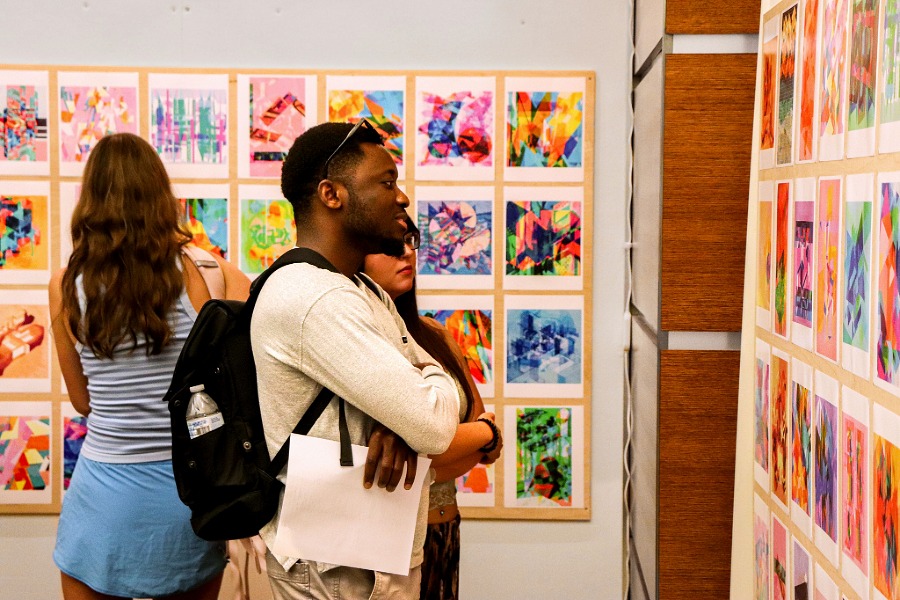
Gibbs College is pleased to present the exhibition 200 Digital Drawings by Professor Tiziana Proietti, currently on display in the Gould Hall Living Room.
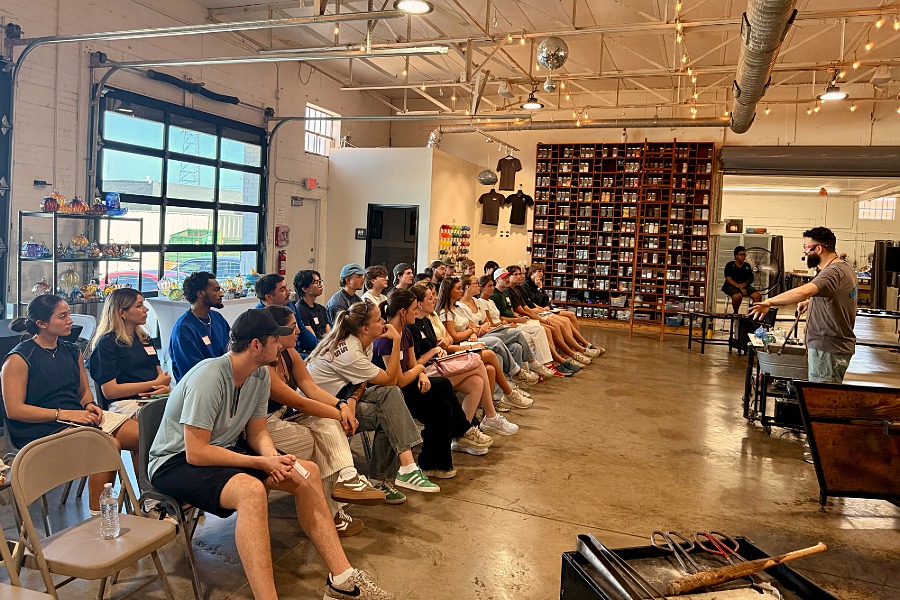
Gibbs College of Architecture Professors Amber Brown and Amy Leveno led 29 students to Dallas, Texas, in September for a learning experience as part of their Design 7 Studio course.
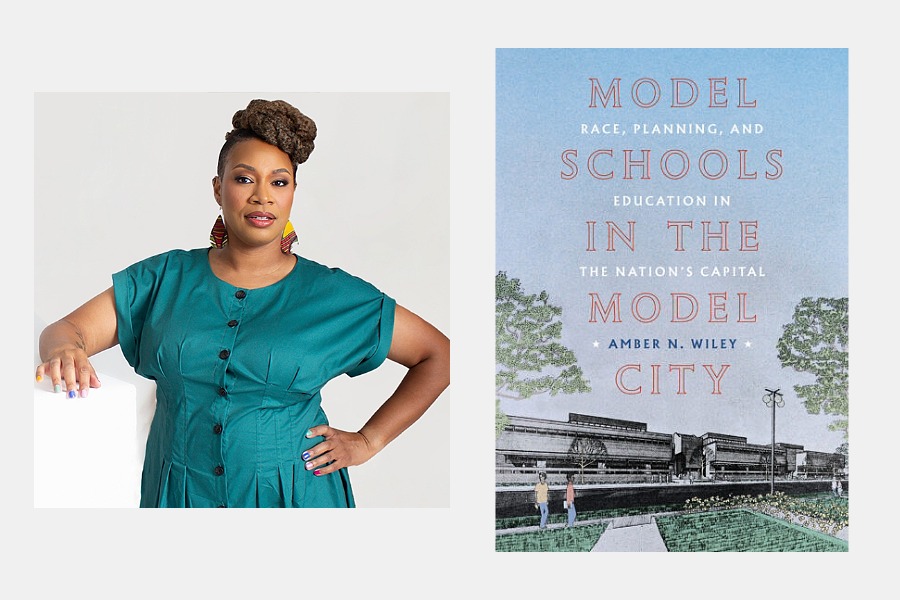
Christopher C. Gibbs College of Architecture professor and Institute for Quality Communities Director Dr. Amber N. Wiley’s book, Model Schools in the Model City: Race, Planning, and Education in the Nation’s Capital, has received two major honors from the Urban History Association.