Negar Matin, an assistant professor of Interior Design, was recently awarded funding as a part of the Gibb’s College of Architecture’s Program for Research Enhancement. Each year, this merit-based program grants funds to Gibb’s faculty members in order to increase their research and creative activities.
Dr. Matin received the grant to pursue her project A Human-Centric Responsive Façade, which will explore the effects of color variations in façades on human circadian rhythms. A responsive façade is a type of exterior wall that can change in response to the surrounding environment in order to improve its performance. They are the main source of daylight penetration, and they impact the intensity, color, and distribution of interior light.
Recent findings have confirmed the necessity of evaluating the circadian light performance of responsive façades, because they could be the main contributor to occupants’ comfort. Dr. Matin’s proposed façades will be tested with hourly adaptation and motion scenarios that address the effects of color temperature, light intensity, uniformity, and glare on human circadian rhythm.
Dr. Matin aims to use her study’s findings to design and develop a new type of responsive façades that will address all aspects of building occupants’ needs.
Gibbs College is pleased to present the exhibition 200 Digital Drawings by Professor Tiziana Proietti, currently on display in the Gould Hall Living Room.
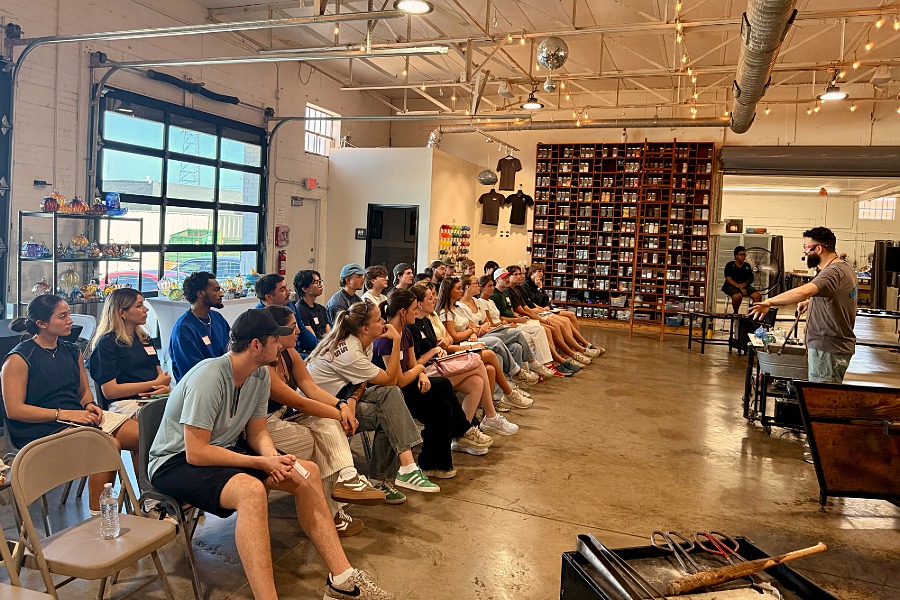
Gibbs College of Architecture Professors Amber Brown and Amy Leveno led 29 students to Dallas, Texas, in September for a learning experience as part of their Design 7 Studio course.
Christopher C. Gibbs College of Architecture professor and Institute for Quality Communities Director Dr. Amber N. Wiley’s book, Model Schools in the Model City: Race, Planning, and Education in the Nation’s Capital, has received two major honors from the Urban History Association.