NEWS

NORMAN, OKLA. – Hanping Ding, Ph.D., an assistant professor in the School of Aerospace and Mechanical Engineering at the University of Oklahoma, has been awarded a $3.1 million grant from the Hydrogen and Fuel Cell Technologies Office in the Department of Energy through the Bipartisan Infrastructure Law to further research in clean hydrogen production. The funding is part of a $750 million effort in President Biden’s Investing in American agenda. The money from the Department of Energy will go to 52 projects across 24 states to position the United States as a global leader in the clean hydrogen industry.
The combined outcomes of the 52 projects should allow the U.S. to produce enough technology per year to power 15% of medium- and heavy-duty trucks sold each year, produce an extra 1.3 million tons of clean hydrogen annually, and support more than 1,500 new jobs.
Ding’s three-year project will address the technical challenges of proton-conducting solid oxide electrolysis cell stacks, a type of technology that splits water into hydrogen and oxygen gases using electricity. By enabling this process, the stacks allow for the efficient conversion of electrical energy into chemical energy, producing hydrogen as a clean and renewable fuel source. Hydrogen produced through this method can result in zero greenhouse gas emissions. The goal of Ding’s project is to develop the technology to be suitable for real-world use.
“This project will advance the technology maturity of [the technology] and, from a bigger picture, promote the green hydrogen applications of the state of Oklahoma,” said Ding.

Finding a way to store and convert energy is necessary to make renewable and sustainable energy more feasible. Clean hydrogen is a way for industries to reduce emissions while continuing to provide services needed for modern life. Ding’s Advanced Materials and Clean Energy Laboratory researches technological improvements to reach net-zero emissions. The lab specializes in materials research, development and prototype system demonstration for fuel cells, hydrogen production and electrochemical processing.
Under this grant, OU will collaborate with researchers at Massachusetts Institute of Technology, Kansas State University, and Chemtronergy LLC to deliver this advanced electrolysis technology. The Idaho National Laboratory and Lawrence Livermore National Laboratory also support the research.
Ding’s project is well aligned with the goals of the Oklahoma Hydrogen Roadmap from the Hydrogen Production, Transportation and Infrastructure Task Force report, which includes a near-term goal of hydrogen storage and innovative technologies and long-term goals of low carbon hydrogen and equipment manufacturing.
About the project
The project, “Development of Readily Manufactured and Interface Engineered Proton-Conducting Solid Oxide Electrolysis Cells with High Efficiency and Durability,” is funded through the Department of Energy grant DE-FOA-0002922.
About the University of Oklahoma
Founded in 1890, the University of Oklahoma is a public research university located in Norman, Oklahoma. As the state’s flagship university, OU serves the educational, cultural, economic and health care needs of the state, region and nation. OU was named the state’s highest-ranking university in U.S. News & World Report’s most recent Best Colleges list. For more information about the university, visit ou.edu.
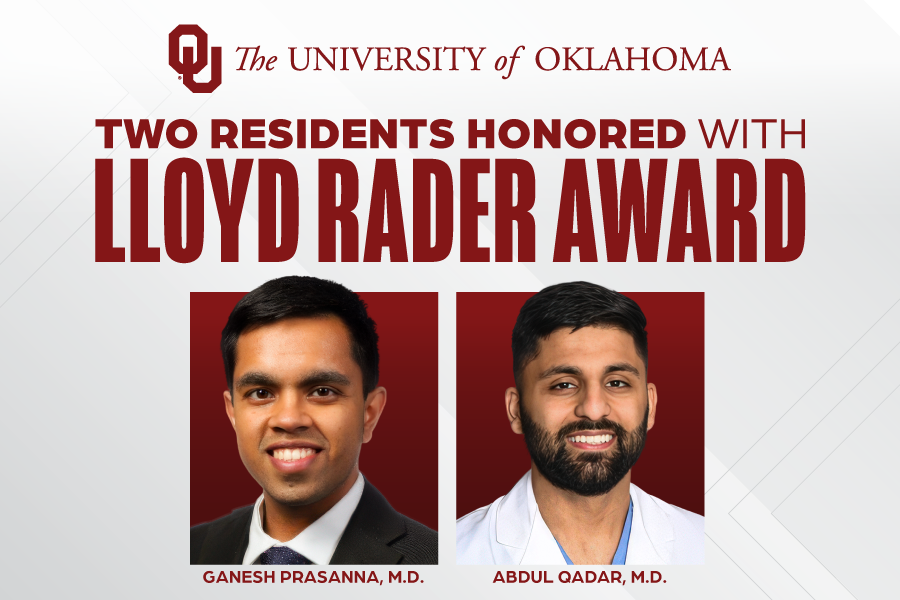
The University of Oklahoma College of Medicine has honored two residents with the Lloyd Rader Award, which recognizes outstanding clinical and research achievements in residency.
The University of Oklahoma will receive up to $220 million over five years from the U.S. Department of Commerce and the National Oceanic and Atmospheric Administration to continue the life-saving weather research led by the OU-NOAA Cooperative Institute for Severe and High-Impact Weather Research and Operations, extending a nearly 50-year partnership that has helped give Americans earlier, more accurate weather warnings
The OU Food Pantry won the annual Red River Food Fight, collecting 31,815.9 pounds of shelf-stable food and drinks to top UT Outpost’s 22,567 pounds. OU has won the competition four years in a row.