NEWS


OKLAHOMA CITY, OKLA. – University of Oklahoma researchers have deepened their understanding of a drug’s ability to prevent fat buildup in the liver, a condition that often occurs with obesity and can lead to serious fatty liver disease. Their findings – which illustrate the complexity of metabolic disorders – are published in The Proceedings of the National Academy of Sciences (PNAS), a peer-reviewed journal of the National Academy of Sciences.
The publication builds on a previous discovery made by Tiangang Li, Ph.D., and a team of researchers at OU Health Harold Hamm Diabetes Center: A drug developed to suppress cancerous tumors can also improve insulin sensitivity and lower blood glucose (sugar) levels. The drug, known as MLN4924, works by preventing the degradation of a specific protein needed for all cells to respond to insulin. After the finding, Li earned a grant from the National Institutes of Health to continue his research.
In the recently published study, conducted in mice, his research team eliminated a gene in the liver called Cul 3. When Cul 3 is present in the body, the drug inhibits it to prevent the degradation of the protein. Eliminating the gene provided a fuller understanding of what would happen when mice become obese on a high-fat diet.
His discovery was both anticipated and surprising. Without the gene, the mice eating a high-fat diet did not accumulate fat in their livers, despite being obese. However, the lack of fat build-up in the liver instead prompted fat to enter the bloodstream and into other tissues like muscle, where it’s not supposed to be stored. As a result, the muscle – the largest organ in the body – had a poorer response to insulin, and the mice developed high blood sugar.
“By eliminating the gene, we aggressively prevented fat accumulation in the liver, but this actually worsened insulin resistance in the muscle, which tells us that fat metabolism in these organs is interconnected,” Li said. “These findings suggest that, in addition to lowering liver fat, the simultaneous reduction of obesity and improvement of insulin sensitivity are important for treating fatty liver disease. That’s because these improvements outside the liver are critical for preventing the fat that enters the liver from also building up in other tissues.”
The research also illustrates why treating chronic conditions like Type 2 diabetes and fatty liver disease is never simple – an improvement in one area may trigger negative effects in another. Even so, the study was extremely helpful for understanding the process by which fatty liver disease occurs and what the drug is doing in the context of that disease, said study co-author Jed Friedman, Ph.D., director of OU Health Harold Hamm Diabetes Center and a professor in the OU College of Medicine.
“We have some promising ideas going forward to target potential pathways to lower liver fat accumulation while also improving insulin sensitivity,” Friedman said. “Drug repurposing like we’re doing in this study is exciting because so much is already known about the drug and its safety. We believe it holds a lot of possibility.”
About the project
This study was supported by grants from the National Institutes of Health. Read the full publication at https://www.pnas.org/doi/10.1073/pnas.2320934121.
About the University of Oklahoma
Founded in 1890, the University of Oklahoma is a public research university located in Norman, Oklahoma. As the state’s flagship university, OU serves the educational, cultural, economic and health care needs of the state, region and nation. OU was named the state’s highest-ranking university in U.S. News & World Report’s most recent Best Colleges list. For more information about the university, visit ou.edu.
The University of Oklahoma has received a transformative gift from Jon and Shannon McCartney, which will name the McCartney Family Tunnel of Champions, the McCartney Family Gate of the Gaylord Family - Oklahoma Memorial Stadium and the McCartney Family Grand Lecture Hall in the Michael F. Price College of Business. The gift will also support the Inspiring Champions and the Athletic Director’s Discretionary Fund, in addition to establishing the McCartney DFW Career Trek program at Price College.
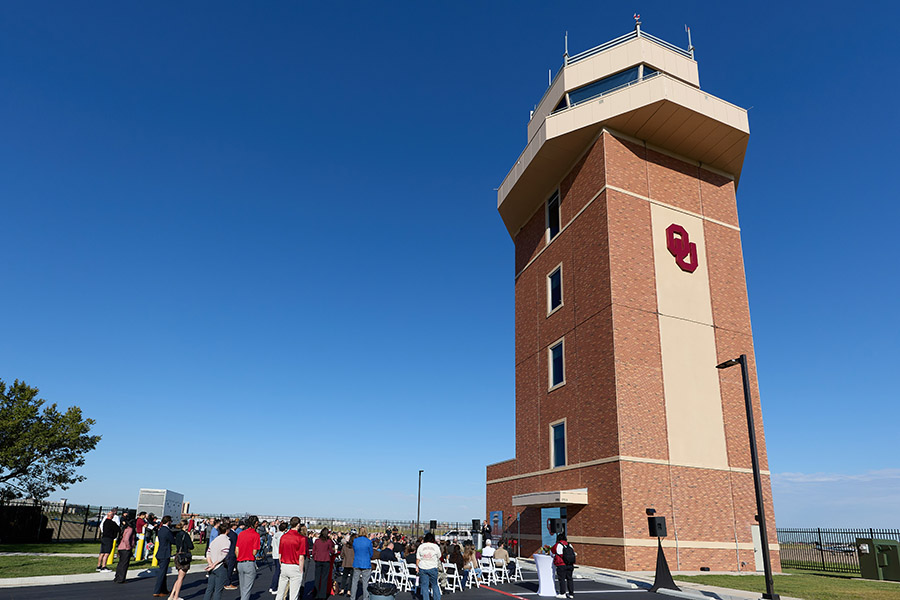
The University of Oklahoma today celebrated the opening of a new air traffic control tower at the OU Max Westheimer Airport. Standing 106 feet tall, more than double the current 52-foot facility, the new tower will modernize air traffic control operations and improve safety for pilots and students operating in the airspace.
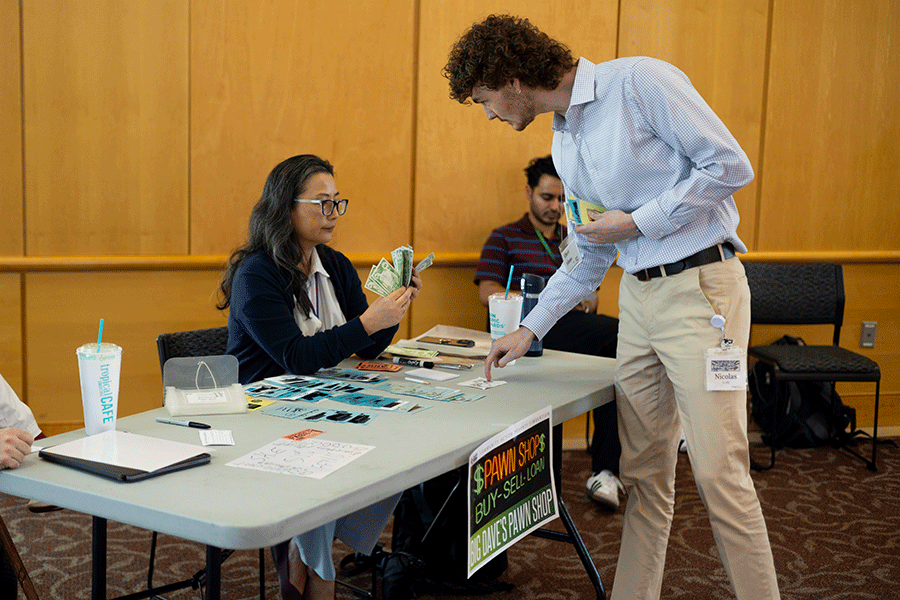
Do I buy groceries or pay the electric bill? Should I pawn some of my belongings to afford my prescription? My child is sick, so I will have to miss work to take care of him. Those are just a few of the difficult choices that OU-Tulsa health professional students confronted during the Community Access to Resources Experience. The role-playing activity challenged students to navigate the financial, family and other pressures that can affect a person’s health and ability to follow medical advice. Held annually during the SCM Institute orientation week, the experience is designed to generate understanding and build empathy.