NEWS


OKLAHOMA CITY, OKLA. – Research published Nov. 21 in the prestigious New England Journal of Medicine demonstrates a three-fold reduction in a risky repeat surgery for patients with subdural hematoma, a pooling of blood between the skull and the surface of the brain. The reduced risk was shown in patients whose hematoma was removed through traditional neurosurgery and who also underwent a less invasive procedure known as embolization to block the artery supplying blood to the hematoma.
The University of Oklahoma College of Medicine was one of 39 academic health institutions across the United States that enrolled patients in the EMBOLISE clinical trial. OU Health neurosurgeon Hakeem Shakir, M.D., an assistant professor of neurosurgery in the OU College of Medicine, led the study for OU. National trial leaders were Jason Davies, M.D., Ph.D., from the University of Buffalo and Jared Knopman, M.D., from Weill Cornell Medicine in New York City.
Subdural hematomas are most often caused by a head injury and can lead to headaches, confusion, vomiting and slurred speech because pooled blood is pushing on the brain. Severe hematomas require surgery in which the neurosurgeon either removes part of the skull to suction out the hematoma or drills holes and inserts tubes to drain the blood. While the surgeries are lifesaving and effective, subdural hematoma recurs in 8% to 20% of patients, necessitating a repeat surgery that often has poor outcomes and results in longer hospital stays, readmissions and higher costs.
To reduce the risk of repeat surgeries, the EMBOLISE trial studied the effectiveness of combining surgery with middle meningeal artery embolization, a nonsurgical procedure in which special tools pass through the blood vessels to block the artery sending blood to the hematoma. The 400 trial participants, ages 18 to 90, were randomly assigned to receive either surgery plus embolization (the treatment arm) or surgery alone (the control arm).
The study found that for every 100 patients, the combined approach of embolization and surgery reduced the risk of hematoma recurrence from about 11 patients to four.
“This study provides evidence for what we have believed in the neurosurgical and neuroendovascular community – that removing the hematoma surgically, followed by embolization, reduces the chance of a reoperation,” Shakir said. “It also showed that embolization is safe. We were seeking to change the paradigm of treatment, with particular benefit for an aging and elderly population. The study shows we have the opportunity to benefit even more patients than we had considered.”
The clinical trial was funded Medtronic, a medical device company whose Onyx Liquid Embolic System performed the embolization. The OU College of Medicine enrolled 20 patients in the trial.
“This study represents the importance of an academic health system and our tripartite mission of patient care, research and education,” Shakir said. “I’m afforded the opportunity to take care of patients while advancing modern medicine, and patients have access to cutting-edge technology and clinical trials.”
About the Project
The study, “Adjunctive Middle Meningeal Artery Embolization for Subdural Hematoma,” can be found in the New England Journal of Medicine at https://www.nejm.org/doi/full/10.1056/NEJMoa2313472#ap0.
About the University of Oklahoma
Founded in 1890, the University of Oklahoma is a public research university with campuses in Norman, Oklahoma City and Tulsa. As the state’s flagship university, OU serves the educational, cultural, economic and health care needs of the state, region and nation. In Oklahoma City, OU Health Sciences is one of the nation’s few academic health centers with seven health profession colleges located on the same campus. OU Health Sciences serves approximately 4,000 students in more than 70 undergraduate and graduate degree programs spanning Oklahoma City and Tulsa and is the leading research institution in Oklahoma. For more information about OU Health Sciences, visit www.ouhsc.edu.
The University of Oklahoma has received a transformative gift from Jon and Shannon McCartney, which will name the McCartney Family Tunnel of Champions, the McCartney Family Gate of the Gaylord Family - Oklahoma Memorial Stadium and the McCartney Family Grand Lecture Hall in the Michael F. Price College of Business. The gift will also support the Inspiring Champions and the Athletic Director’s Discretionary Fund, in addition to establishing the McCartney DFW Career Trek program at Price College.
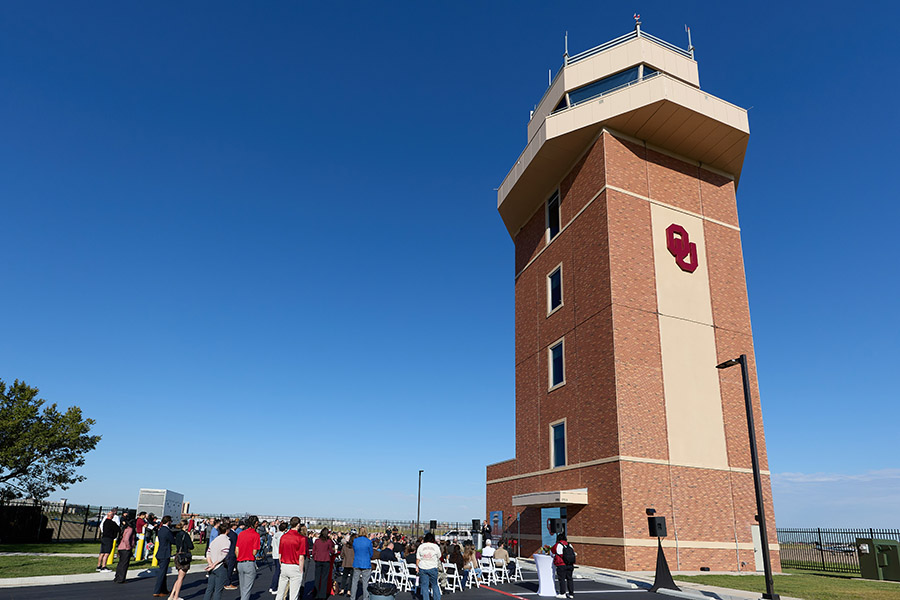
The University of Oklahoma today celebrated the opening of a new air traffic control tower at the OU Max Westheimer Airport. Standing 106 feet tall, more than double the current 52-foot facility, the new tower will modernize air traffic control operations and improve safety for pilots and students operating in the airspace.
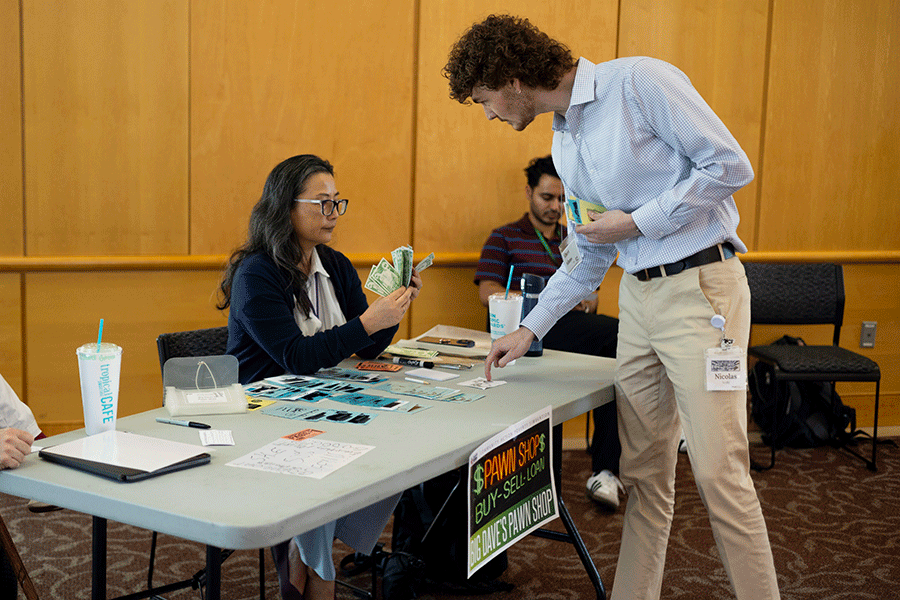
Do I buy groceries or pay the electric bill? Should I pawn some of my belongings to afford my prescription? My child is sick, so I will have to miss work to take care of him. Those are just a few of the difficult choices that OU-Tulsa health professional students confronted during the Community Access to Resources Experience. The role-playing activity challenged students to navigate the financial, family and other pressures that can affect a person’s health and ability to follow medical advice. Held annually during the SCM Institute orientation week, the experience is designed to generate understanding and build empathy.