NEWS


NORMAN, OKLA. – A groundbreaking algorithm developed by Prakash Vedula, Ph.D., a professor at the University of Oklahoma School of Aerospace and Mechanical Engineering, and Alok Shukla, Ph.D., a professor in the Mathematical and Physical Sciences division at Ahmedabad University, has been incorporated into advanced computing software developed by Google and IBM. The algorithm is remarkable for its exponential improvement over previous methods.
This significant breakthrough in the field of quantum computing was achieved during the summer of last year and published in Quantum Information Processing earlier this year. The algorithm focuses on creating uniform quantum superposition states, a critical part of quantum computing, and drastically reduces the complexity of this fundamental step. This efficiency is not just theoretical—it has practical applications across various fields, including quantum search, optimization, solution of differential equations, signal processing, cryptography, finance and artificial intelligence.
The Shukla–Vedula algorithm offers a substantially more efficient approach to reducing the complexity of a fundamental step required for many quantum algorithms.
Recently, major quantum software platforms developed by Google and IBM—Cirq and Qiskit, respectively—integrated the Shukla–Vedula algorithm into their latest software versions. These platforms are widely used in industry and academia, and the adoption of this algorithm highlights its significance. Additionally, Goldman Sachs has already begun using this algorithm to analyze financial risks in financial derivatives.
“In our research group, we focus on high-risk, high-impact projects. Exponential advancements in any scientific discipline are extremely rare,” said Vedula. “Our algorithm demonstrates an exponential improvement over previous methods in the literature, all without the need for additional resources.”
As the algorithm continues to gain traction, Professor Vedula is optimistic about its future impact. “We expect this innovation to drive significant improvements in quantum computing across various applications. These are truly exciting times for the field of quantum computing.”
Details on the implementation of this algorithm and its associated user interface can be found on the software documentations of Cirq and Qiskit.
About the University of Oklahoma
Founded in 1890, the University of Oklahoma is a public research university located in Norman, Oklahoma. As the state’s flagship university, OU serves the educational, cultural, economic and health care needs of the state, region and nation. OU was named the state’s highest-ranking university in U.S. News & World Report’s most recent Best Colleges list. For more information about the university, visit ou.edu.
This article was edited on September 13, 2024 to accurately reflect the collaboritve effort between Vedula and Shukla and to note that the breakthrough was made in the summer of 2023.
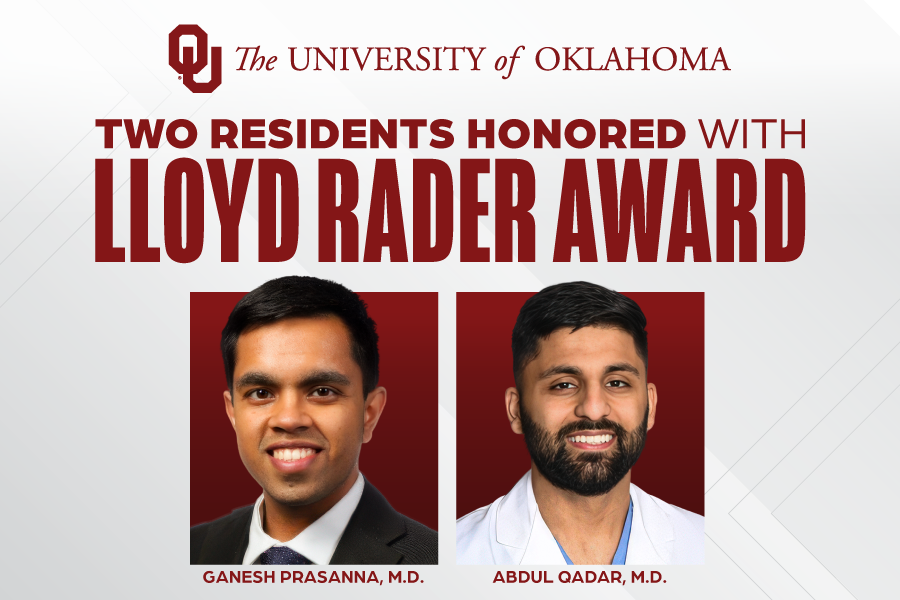
The University of Oklahoma College of Medicine has honored two residents with the Lloyd Rader Award, which recognizes outstanding clinical and research achievements in residency.
The University of Oklahoma will receive up to $220 million over five years from the U.S. Department of Commerce and the National Oceanic and Atmospheric Administration to continue the life-saving weather research led by the OU-NOAA Cooperative Institute for Severe and High-Impact Weather Research and Operations, extending a nearly 50-year partnership that has helped give Americans earlier, more accurate weather warnings
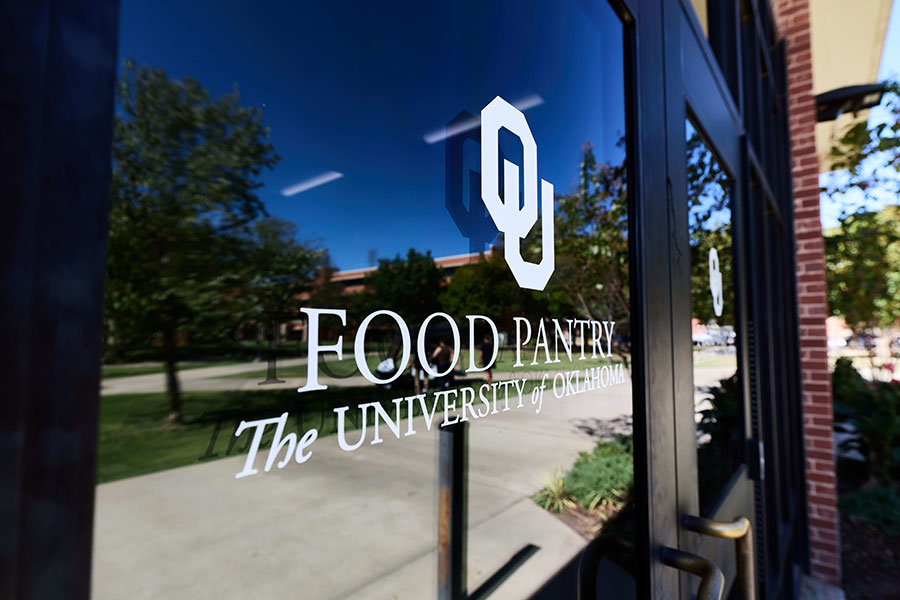
The OU Food Pantry won the annual Red River Food Fight, collecting 31,815.9 pounds of shelf-stable food and drinks to top UT Outpost’s 22,567 pounds. OU has won the competition four years in a row.