NEWS


NORMAN, OKLA. – Teams of first-year engineering students at the University of Oklahoma spent a month solving a problem few would expect: how to help a one-legged goose walk again.
Named Peebly, the goose belonging to a local farmer, lost a leg to injury. OU’s 2025 Engineering Summer Bridge students were asked to design Peebly a custom prosthetic limb. Using CAD software, biomechanics, circuitry and 3D printing, student teams developed terrain-adaptive devices tailored to Peebly’s movement, weight and needs.
Summer Bridge is OU’s flagship experience for first-year students in the Gallogly College of Engineering and the Mewbourne College of Earth and Energy. This year’s program took place from July 5-Aug. 1, gathering 54 students from 11 states and over 30 towns. One in three students participating in the program are the first in their families to go to college.
The program is a student success initiative rooted in access, academic support and community building, says Brandon Abbott, program director.
“We introduce students to the rigor and responsibility of engineering and science programs, while scaffolding the academic, psychosocial and professional support they need to thrive. At its core, the program challenges students to expand their perspectives and engage more deeply with what it means to design ethical, effective solutions to the complex and interconnected problems facing our communities and society,” Abbott said.
Zahara Boston, an incoming OU Engineering student from Norman, applied to the program because she says OU is a special place and she wanted to explore that more during the summer transition to her first year.
“Through the program, I have a newfound community of friends, family and mentors. It was so much more than what I could have asked for. Ultimately, this month showed me that I can do hard things, and it showed me that if I keep going, there will always be a light at the end of the tunnel,” Boston said.
The project wasn’t just about novelty. It was about applying the engineering design process to a complex, real-world scenario. Students used human-centered design to see how engineering impacts lives, not just Peebly, but also farmers, land and communities. They practiced sociotechnical engineering, where human needs and social contexts influence technical solutions.
Rebecca Scott, Ph.D., assistant professor of biomedical engineering and faculty project lead, emphasizes that the project wasn’t just about helping a goose, but it was about teaching students that engineering requires systems thinking, where technical accuracy, user needs and ethical responsibility all matter.
“Programs like the Engineering Summer Bridge program are critical in teaching students to approach engineering as a layered process, where design, impact and responsibility all carry equal weight,” Scott said.
The program sets the foundation for STEM success, Scott says. Over four weeks, students live on campus building a peer community, take a for-credit math course to sharpen academic readiness, engage in workshops with faculty and industry leader and collaborate on hands-on design challenges with real-world relevance.
“During the Engineering Summer Bridge program, I learned to keep an open mind and be open to learning from both my peers and mentors,” said Rishi Patel, an incoming OU Engineering student from Sayre. “One of the biggest lessons I learned was to never be afraid to ask for help, whether it’s related to math, a project or even something personal. Most importantly, I built strong connections with faculty, staff and peers, creating an early bond that will support me throughout my college journey.”
Abbott says the long-term success of the program is evident. “When students are given early, intentional support, the impact extends far beyond their first year,” he said. “It strengthens the college, enhances the broader university ecosystem and ripples into industry, where these students go on to lead, innovate and solve real-world challenges.”
Corporate partners and donors support the Engineering Summer Bridge program. The 2025 program sponsors included Dolese, ExxonMobil, Williams, ConocoPhillips, Phillips 66, Chevron and AT&T.
Applications for the 2026 Engineering Summer Bridge open Dec. 1, 2025. To learn more, visit the program’s webpage or email brandonabbott@ou.edu.
About the University of Oklahoma
Founded in 1890, the University of Oklahoma is a public research university located in Norman, Oklahoma. As the state’s flagship university, OU serves the educational, cultural, economic and health care needs of the state, region and nation. For more information about the university, visit www.ou.edu.
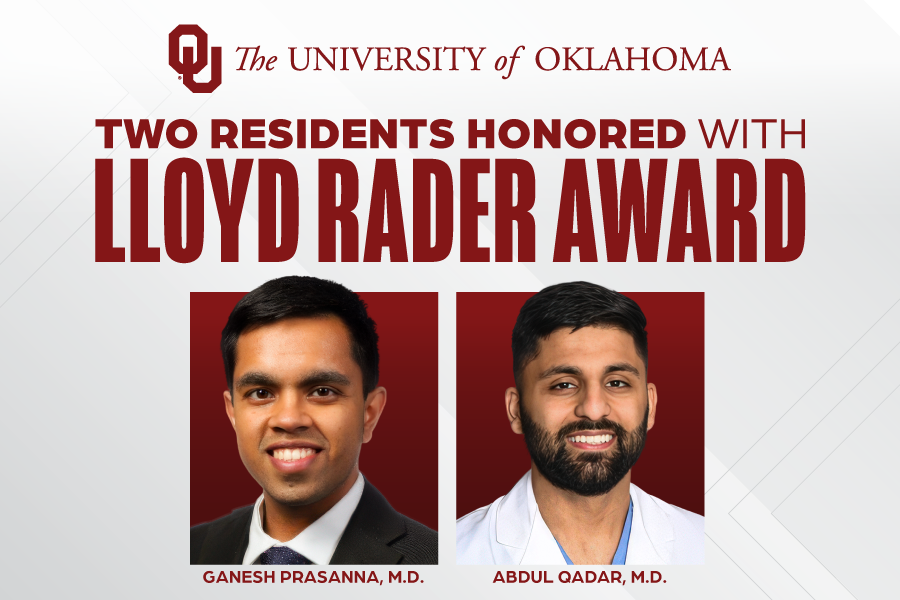
The University of Oklahoma College of Medicine has honored two residents with the Lloyd Rader Award, which recognizes outstanding clinical and research achievements in residency.
The University of Oklahoma will receive up to $220 million over five years from the U.S. Department of Commerce and the National Oceanic and Atmospheric Administration to continue the life-saving weather research led by the OU-NOAA Cooperative Institute for Severe and High-Impact Weather Research and Operations, extending a nearly 50-year partnership that has helped give Americans earlier, more accurate weather warnings
The OU Food Pantry won the annual Red River Food Fight, collecting 31,815.9 pounds of shelf-stable food and drinks to top UT Outpost’s 22,567 pounds. OU has won the competition four years in a row.