NEWS


NORMAN, OKLA. – Chen Wang, Ph.D., a postdoctoral researcher in the University of Oklahoma’s Biophotonic Imaging Laboratory, has been awarded a fellowship from the Prevent Cancer Foundation. His research aims to improve kidney biopsy imaging, leading to fewer failed surgeries.
Wang’s research delves into techniques for diagnostic surgery for kidney cancer. Through this fellowship, he will research a new technique for imaging navigation during biopsies by developing an optical coherence tomography (OCT) probe.
Currently, ultrasounds are the standard for visualizing kidney tissue biopsies. However, traditional ultrasound does not give doctors an accurate location of the biopsy needle tip, so kidney tissue and blood vessel information in front of the needle cannot be clearly identified.
“Navigation to a small tumor, perhaps two or three millimeters in size, might be difficult using traditional imaging methods during biopsy,” said Wang. “Our technique offers localized imaging right in front of the needle.”
That line of sight could make a difference in surgery outcomes. According to a 16-year analysis from a national biopsy laboratory, 14% of kidney biopsy surgeries fail to acquire the adequate tissue necessary for diagnosis, costing patients time and money and requiring repeat biopsy procedures. This technology will help to bring that number down. Additionally, the OCT probe system's ability to offer visibility of blood vessels could decrease cases of renal hemorrhage in patients.
In addition to aiding doctors in seeing the path of the procedural needle, the OCT probe could help them identify the type of tumor they are examining.
According to the American Cancer Society, the rates of new kidney cancer cases are steadily on the rise. Wang says that improvements in these diagnostic procedures will help address the critical challenge of early and accurate detection of the disease and lead to improved health outcomes for patients.
About the Award
The two-year project, “Early Detection of Renal Cancer by a Novel Imaging Platform,” grant 1351517, is funded by the Prevent Cancer Foundation.
About the Prevent Cancer Foundation
The Prevent Cancer Foundation’s mission is to empower people to stay ahead of cancer through prevention and early detection.
About the University of Oklahoma
Founded in 1890, the University of Oklahoma is a public research university located in Norman, Oklahoma. As the state’s flagship university, OU serves the educational, cultural, economic and health care needs of the state, region and nation. For more information about the university, visit www.ou.edu.
The University of Oklahoma has received a transformative gift from Jon and Shannon McCartney, which will name the McCartney Family Tunnel of Champions, the McCartney Family Gate of the Gaylord Family - Oklahoma Memorial Stadium and the McCartney Family Grand Lecture Hall in the Michael F. Price College of Business. The gift will also support the Inspiring Champions and the Athletic Director’s Discretionary Fund, in addition to establishing the McCartney DFW Career Trek program at Price College.
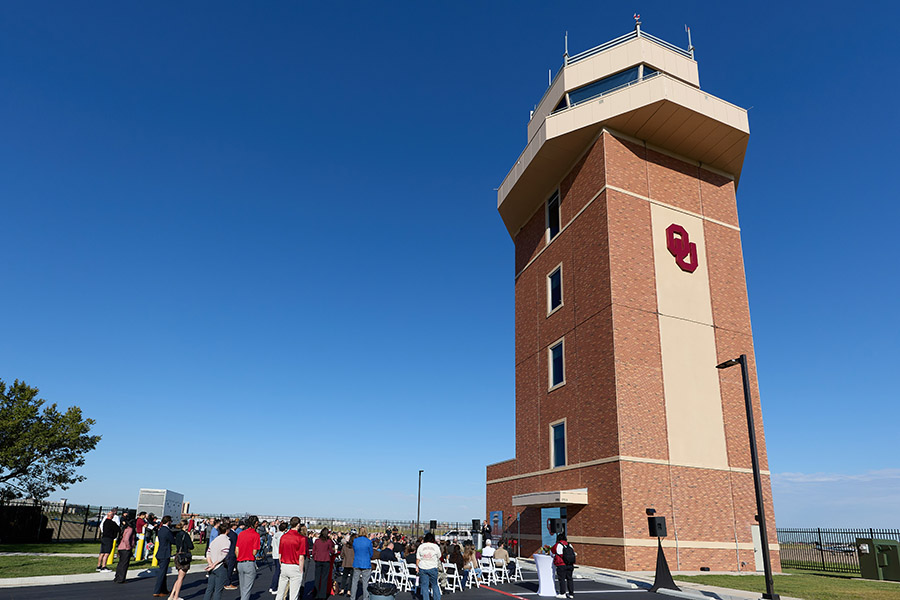
The University of Oklahoma today celebrated the opening of a new air traffic control tower at the OU Max Westheimer Airport. Standing 106 feet tall, more than double the current 52-foot facility, the new tower will modernize air traffic control operations and improve safety for pilots and students operating in the airspace.
Do I buy groceries or pay the electric bill? Should I pawn some of my belongings to afford my prescription? My child is sick, so I will have to miss work to take care of him. Those are just a few of the difficult choices that OU-Tulsa health professional students confronted during the Community Access to Resources Experience. The role-playing activity challenged students to navigate the financial, family and other pressures that can affect a person’s health and ability to follow medical advice. Held annually during the SCM Institute orientation week, the experience is designed to generate understanding and build empathy.