NEWS


NORMAN, OKLA. – A research team from the University of Oklahoma has pioneered a groundbreaking method that could accelerate drug discovery and reduce pharmaceutical development costs. Their work, published in the Journal of the American Chemical Society, introduces a safe, sustainable way to insert a single carbon atom into drug molecules at room temperature. These atoms have versatile diversification handles for further modifications that allow researchers to enhancing chemical diversity without compromising sensitive structures.
Nitrogen atoms and nitrogen-containing rings, known as heterocycles, play crucial roles in the development of medicines. A research team led by OU Presidential Professor Indrajeet Sharma has found a way to change these rings by adding just one carbon atom using a fast-reacting chemical called sulfenylcarbene. This method, called skeletal editing, transforms existing molecules into new drug candidates.
“By selectively adding one carbon atom to these existing drug heterocycles in the later stages of development, we can change the molecule’s biological and pharmacological properties without changing its functionalities,” he said. “This could open uncharted regions of chemical space in drug discovery.”
Previous studies have demonstrated a similar concept but relied on potentially explosive reagents, exhibited limited functional group compatibility, and posed significant safety concerns for industrial-scale applications.
Sharma’s team has developed a bench-stable reagent that generates sulfenylcarbenes under metal-free conditions at room temperature, achieving yields as high as 98%. Avoiding metal-based carbenes helps reduce environmental and health risks because many metals are known to have some level of human toxicity.

The researchers are also exploring how this chemistry could revolutionize a fast-growing area in pharmaceutical science known as DNA-encoded library (DEL) technology. DEL platforms allow researchers to rapidly screen billions of small molecules for their potential to bind to disease-relevant proteins.
The metal-free, room-temperature conditions of the team’s new carbon insertion strategy make it a compelling candidate for use in DNA-encoded libraries. Unlike other reactions that need harsh chemicals or high heat, this new method works in water-friendly liquids and is gentle enough to use with molecules attached to DNA.
By enabling precise skeletal editing in collaboration with the Damian Young group at the Baylor College of Medicine, Sharma’s approach could significantly enhance the chemical diversity and biological relevance of DEL libraries. Importantly, these are two key bottlenecks in drug discovery.
“The cost of many drugs depends on the number of steps involved in making them, and drug companies are interested in finding ways to reduce these steps. Adding a carbon atom in the late stages of development can make new drugs cheaper. It’s like renovating a building rather than building it from scratch,” Sharma said. “By making these drugs easier to produce at large scale, we could reduce the cost of healthcare for populations around the world.”
Read about Sharma’s earlier work with nitrogen atom insertion for drug discovery and using blue light to fight drug-resistant infections.
About the project
This research was led by Indrajeet Sharma, associate professor of chemistry and biochemistry in the University of Oklahoma Dodge Family College of Arts and Sciences. Prakash Kafle is the lead author of the study and a fourth-year doctoral student in Sharma’s lab. Deacon Herndon is a co-author. The study, titled "Sulfenylcarbene-Mediated Carbon Atom Insertion for the Late-Stage Functionalization of N-Heterocycles," was published in the Journal of the American Chemical Society, DOI no. 10.1021/jacs.5c02012. This work was supported by the National Science Foundation under grant CHE-1753187.
About the University of Oklahoma
Founded in 1890, the University of Oklahoma is a public research university located in Norman, Oklahoma. As the state’s flagship university, OU serves the educational, cultural, economic and health care needs of the state, region and nation. For more information about the university, visit www.ou.edu.
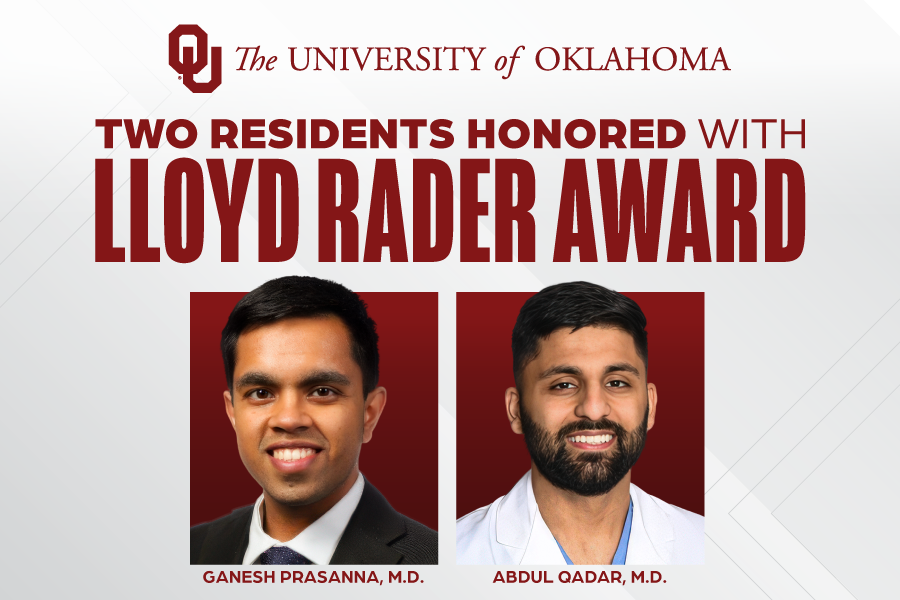
The University of Oklahoma College of Medicine has honored two residents with the Lloyd Rader Award, which recognizes outstanding clinical and research achievements in residency.
The University of Oklahoma will receive up to $220 million over five years from the U.S. Department of Commerce and the National Oceanic and Atmospheric Administration to continue the life-saving weather research led by the OU-NOAA Cooperative Institute for Severe and High-Impact Weather Research and Operations, extending a nearly 50-year partnership that has helped give Americans earlier, more accurate weather warnings
The OU Food Pantry won the annual Red River Food Fight, collecting 31,815.9 pounds of shelf-stable food and drinks to top UT Outpost’s 22,567 pounds. OU has won the competition four years in a row.