NEWS


OKLAHOMA CITY – The University of Oklahoma Health Sciences has achieved a new Carnegie Classification for its research enterprise and medical school program from the American Council on Education and the Carnegie Foundation for the Advancement of Teaching.
“The Carnegie Classification for our research and medical school is a testament to the expertise of our faculty members and the dedication of our students, who will be the physicians-researchers of tomorrow,” said Gary Raskob, Ph.D., senior vice president and provost of OU Health Sciences.
The Carnegie Classification is the leading framework for recognizing and describing institutional diversity in U.S. higher education. In 1970, the Carnegie Commission on Higher Education began developing a classification of colleges and universities to support its research and policy analysis program. The framework was first published in 1973 and is updated every three years to reflect changes among colleges and universities.
The Carnegie Classification for medical schools and centers is a new category. It includes 68 institutions, representing 2% of U.S. colleges and universities in the Institutional Classification, which organizes institutions by multiple characteristics to create groups of similar institution types.
The OU College of Medicine is the largest of seven health professional colleges on the OU Health Sciences campus and the only Doctor of Medicine (M.D.) program in Oklahoma. For 2024-2025, the College of Medicine has 682 students enrolled in its medical program. For the current first-year class of medical students, representing the Class of 2028, the program received 2,142 total applications and admitted 188 students.
The research program at OU Health Sciences achieved a Carnegie Classification for “High Research Spending and Doctorate Production,” with total spending of $131,160,000. This year, OU Health Sciences also earned its highest ranking ever in National Institutes of Health funding, according to the Blue Ridge Institute for Medical Research. Funding from the NIH is considered the key benchmark for health sciences research productivity and reputation. NIH funding increased to $75.2 million in the previous federal fiscal year, improving the campus’s ranking to 102 out of 2,838 institutions that receive NIH funding.
The University of Oklahoma holds an R1 designation from the Carnegie Classification of Institutions of Higher Education, which is the highest level of research activity according to the Carnegie Classification.
About the University of Oklahoma
Founded in 1890, the University of Oklahoma is a public research university with campuses in Norman, Oklahoma City and Tulsa. As the state’s flagship university, OU serves the educational, cultural, economic and health care needs of the state, region and nation. In Oklahoma City, OU Health Sciences is one of the nation’s few academic health centers with seven health profession colleges located on the same campus. OU Health Sciences serves approximately 4,000 students in more than 70 undergraduate and graduate degree programs spanning Oklahoma City and Tulsa and is the leading research institution in Oklahoma. For more information about OU Health Sciences, visit www.ouhsc.edu.
The University of Oklahoma has received a transformative gift from Jon and Shannon McCartney, which will name the McCartney Family Tunnel of Champions, the McCartney Family Gate of the Gaylord Family - Oklahoma Memorial Stadium and the McCartney Family Grand Lecture Hall in the Michael F. Price College of Business. The gift will also support the Inspiring Champions and the Athletic Director’s Discretionary Fund, in addition to establishing the McCartney DFW Career Trek program at Price College.
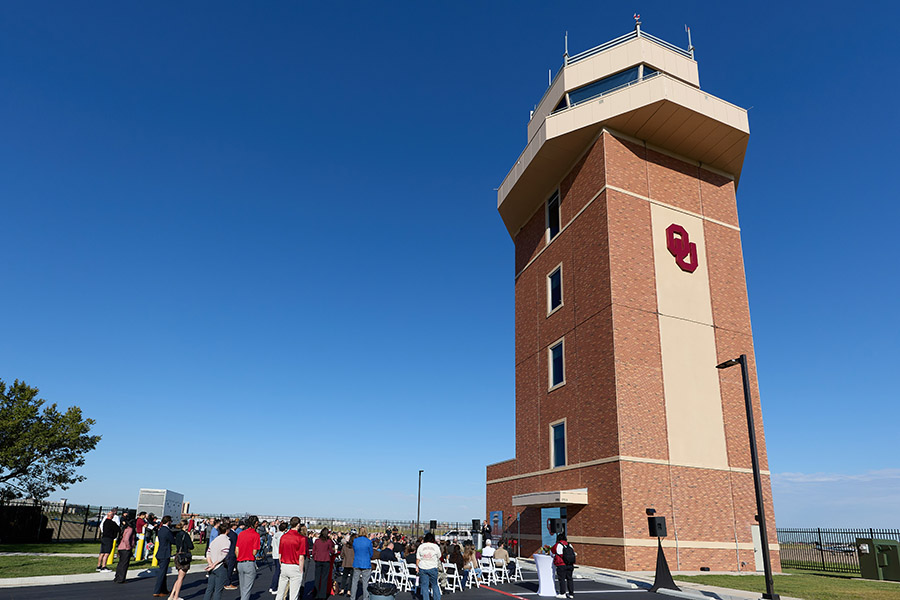
The University of Oklahoma today celebrated the opening of a new air traffic control tower at the OU Max Westheimer Airport. Standing 106 feet tall, more than double the current 52-foot facility, the new tower will modernize air traffic control operations and improve safety for pilots and students operating in the airspace.
Do I buy groceries or pay the electric bill? Should I pawn some of my belongings to afford my prescription? My child is sick, so I will have to miss work to take care of him. Those are just a few of the difficult choices that OU-Tulsa health professional students confronted during the Community Access to Resources Experience. The role-playing activity challenged students to navigate the financial, family and other pressures that can affect a person’s health and ability to follow medical advice. Held annually during the SCM Institute orientation week, the experience is designed to generate understanding and build empathy.