NEWS


OKLAHOMA CITY – University of Oklahoma researchers have discovered that some bacteria in the gut have their own unique “weapon system” to compete against other bacteria for dominance. Importantly, there is promising evidence that this system can be repurposed to target diseased cells like cancer.
The research is from the laboratory of Rodney Tweten, Ph.D., professor of microbiology and immunology at the University of Oklahoma College of Medicine and recent National Academy of Sciences inductee. His lab studies a genus of bacteria called Bacteroides, which constitutes nearly 50% of the microbes that live in the intestines. The bacteria play an important role in good health, helping the body break down complex carbohydrates and nutrients.
The bacteria are also fierce protectors of their own turf. They produce proteins called cholesterol-dependent cytolysin-like (CDCL) toxins that punch holes in rival bacteria, causing them to burst and die. The toxins only activate their weapons when they touch an enzyme on the surface of the target bacteria; otherwise, they remain harmless. The CDCLs can also shield themselves from harm by employing a protective protein over their surface.
“There are trillions of these bacteria in your gut,” said Hunter Abrahamsen, a doctoral student in Tweten’s lab. “It’s a competitive atmosphere, and they need all the tools they can get to win the fight.”
Tweten’s team published its discovery of CDCLs last year in the journal Nature Communications. In a recent follow-up study in Science Advances, they provide detailed images of how the CDCLs actually form pores (or punch holes) in other bacteria.
Now, they are using CDCLs to target their hole-punching weapon against the cells of deadly diseases, including glioblastoma and HER2-positive breast cancer. The research team essentially teaches the CDCLs to recognize things other than their fellow bacteria, in this case, the binding receptors for cancer cells.
“It’s like the guidance system in your car saying, ‘Make a right turn here.’ That’s basically what we’ve done – we’ve told these proteins what to target,” said doctoral student Tristan Sanford. Both Sanford and Abrahamsen were co-authors on the papers.
Such targeted immuno-toxins are not new, Tweten said, but they have been largely unsuccessful. His lab’s toxins operate differently – they kill cells from the outside through punching holes; others have to find their way into the cell and kill from the inside.
“They work surprisingly well in the lab,” Tweten said. “The way we would envision them working is with glioblastoma, for example, we would place these toxins into the tumor cavity after surgery so they can kill off any remaining tumor cells that weren’t removed. This is an exciting new area of research for our lab.”
About the project
The Nature Communications study, “Distant relatives of a eukaryotic cell-specific toxin family evolved a complement-like mechanism to kill bacteria,” can be found at https://doi.org/10.1038/s41467-024-49103-5. The Science Advances study, “Structural basis for the pore-forming activity of a complement-like toxin, can be found at https://www.science.org/doi/10.1126/sciadv.adt2127.
About the University of Oklahoma
Founded in 1890, the University of Oklahoma is a public research university with campuses in Norman, Oklahoma City and Tulsa. As the state’s flagship university, OU serves the educational, cultural, economic and health care needs of the state, region and nation. In Oklahoma City, OU Health Sciences is one of the nation’s few academic health centers with seven health profession colleges located on the same campus. OU Health Sciences serves approximately 4,000 students in more than 70 undergraduate and graduate degree programs spanning Oklahoma City and Tulsa and is the leading research institution in Oklahoma. For more information about OU Health Sciences, visit www.ouhsc.edu.
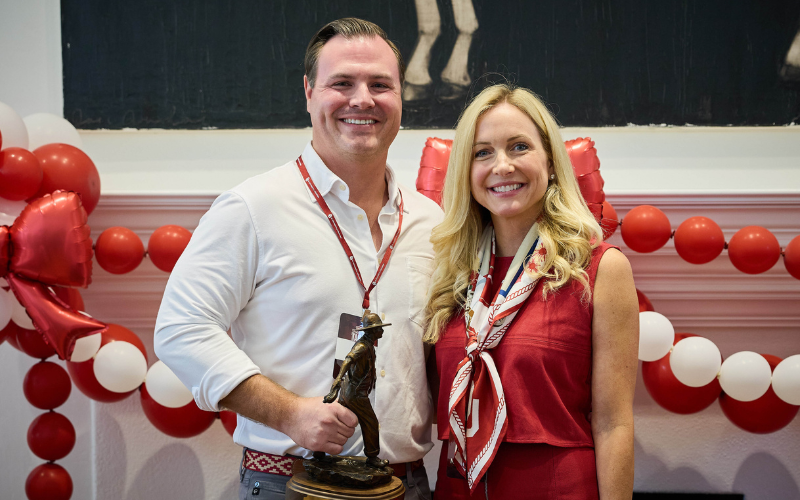
The University of Oklahoma has received a transformative gift from Jon and Shannon McCartney, which will name the McCartney Family Tunnel of Champions, the McCartney Family Gate of the Gaylord Family - Oklahoma Memorial Stadium and the McCartney Family Grand Lecture Hall in the Michael F. Price College of Business. The gift will also support the Inspiring Champions and the Athletic Director’s Discretionary Fund, in addition to establishing the McCartney DFW Career Trek program at Price College.
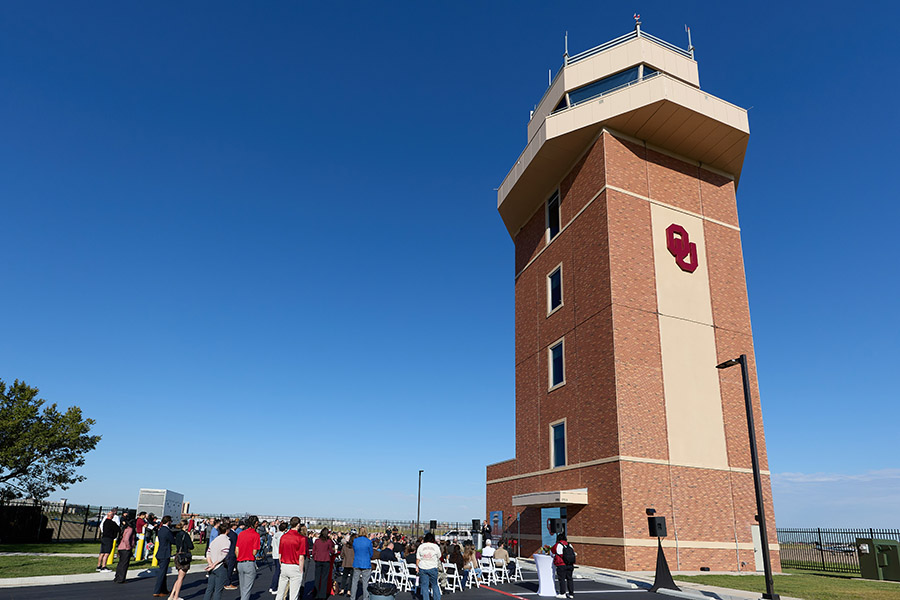
The University of Oklahoma today celebrated the opening of a new air traffic control tower at the OU Max Westheimer Airport. Standing 106 feet tall, more than double the current 52-foot facility, the new tower will modernize air traffic control operations and improve safety for pilots and students operating in the airspace.
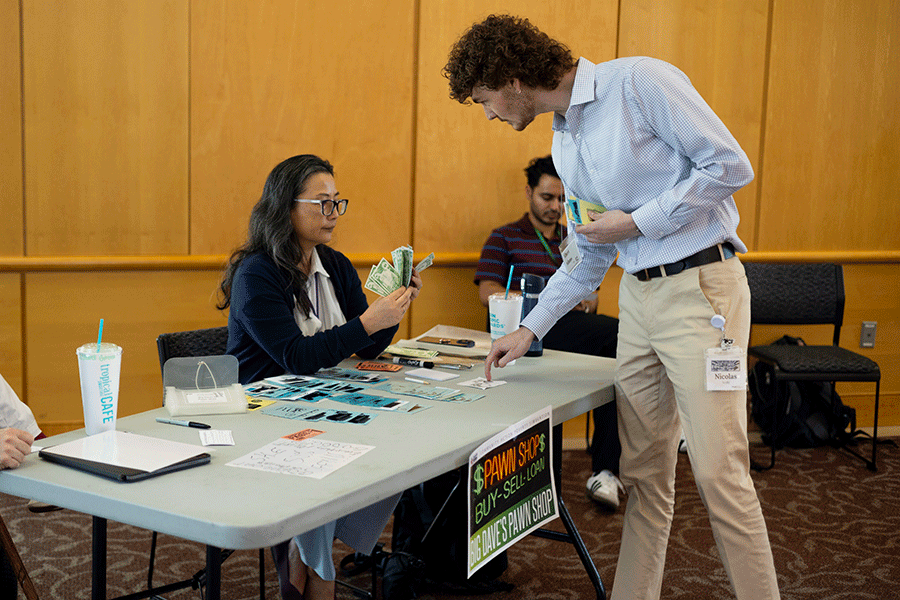
Do I buy groceries or pay the electric bill? Should I pawn some of my belongings to afford my prescription? My child is sick, so I will have to miss work to take care of him. Those are just a few of the difficult choices that OU-Tulsa health professional students confronted during the Community Access to Resources Experience. The role-playing activity challenged students to navigate the financial, family and other pressures that can affect a person’s health and ability to follow medical advice. Held annually during the SCM Institute orientation week, the experience is designed to generate understanding and build empathy.