NEWS


OKLAHOMA CITY – Min Li, Ph.D., George Lynn Cross Research Professor of Medicine, Surgery and Cell Biology at the University of Oklahoma College of Medicine, has been named president-elect of the International Association of Pancreatology (IAP).
The IAP, established in 1985, works with national and regional societies to promote pancreatology throughout the world and to find new treatments for pancreatic disorders. The organization has more than 3,500 members, both basic scientists and clinical investigators, from 32 countries.
“It is a tremendous honor to serve as president-elect of the International Association of Pancreatology,” Li said. “Pancreatic diseases remain among the most challenging in medicine. Through international collaboration, we can accelerate discovery, improve patient outcomes and bring hope to those affected worldwide. I look forward to working with colleagues across the globe to advance research, education and innovation in pancreatology.”
Li has been with the OU College of Medicine since 2014. He has been awarded a significant amount of federal funding for his research on pancreatic cancer and cachexia, a muscle-wasting condition that often occurs in people with pancreatic cancer. He has published high-impact articles for several consecutive years in leading journals, including Cancer Cell, Proceedings of the National Academy of Sciences (PNAS), EMBO Molecular Medicine, Gastroenterology, Cancer Research, and Clinical Cancer Research. To date, he has published 225 articles in peer-reviewed or refereed journals.
Several of his publications have focused on the protein ZIP4, which transports zinc throughout the body. Each study has focused on a different role for ZIP4, which serves as a “master switch” for several things to occur in pancreatic cancer and cachexia. He discovered that overexpression of ZIP4 causes pancreatic cancer cells to be more resistant to chemotherapy and prompts tumor cells to transform themselves so they can stealthily travel to the body’s other organs. In addition, he found that ZIP4 plays a critical role in the onset of cachexia.
Li is past president of the American Pancreatic Association, and he is editor-in-chief of the journal Cancer Letters. He also holds the Virginia Kerley Cade Endowed Chair in Cancer Treatment at the OU College of Medicine, and he serves as Associate Director for Global Oncology for OU Health Stephenson Cancer Center.
About the University of Oklahoma
Founded in 1890, the University of Oklahoma is a public research university with campuses in Norman, Oklahoma City and Tulsa. As the state’s flagship university, OU serves the educational, cultural, economic and health care needs of the state, region and nation. In Oklahoma City, the OU Health Campus is one of the nation’s few academic health centers with seven health profession colleges located on the same campus. The OU Health Campus serves approximately 4,000 students in more than 70 undergraduate and graduate degree programs spanning Oklahoma City and Tulsa and is the leading research institution in Oklahoma. For more information about the OU Health Campus, visit www.ouhsc.edu.
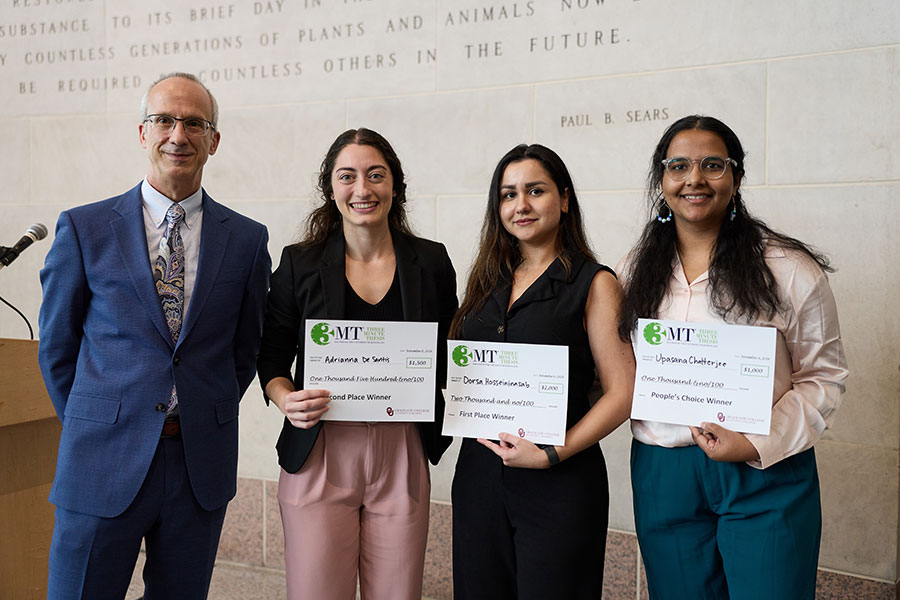
Three University of Oklahoma graduate students earned top honors in the 2026 Three Minute Thesis (3MT) competition, an annual event that challenges students to explain their research to a general audience in 3 minutes.
Researchers at the OU Health Harold Hamm Diabetes Center are investigating diabetes from numerous angles, including how the disease affects other organs, what factors contribute to its development and complications, and how new approaches to prevention and treatment could improve health.
A new five-year, $3 million grant from the National Cancer Institute will enable researchers at OU’s TSET Health Promotion Research Center (HPRC) to scale up a smartphone-based mHealth solution that uses targeted and tailored messages to motivate smokers to kick the habit.