NEWS


OKLAHOMA CITY – New research from the University of Oklahoma, published today in Cancer Cell, describes for the first time a “triangle regulation theory” of cancer-induced cachexia and anorexia.
Cachexia is a muscle-wasting and fat-loss condition that most often occurs in people diagnosed with pancreatic cancer. Cachexia is frequently accompanied by cancer-induced anorexia, a severe loss of appetite that adds to the patient’s debilitation.
OU College of Medicine Professor Min Li, Ph.D., led a team of researchers who discovered another piece of the puzzle in how cachexia and anorexia develop. In their triangle regulation theory, the cancer cells recruit and activate macrophages (a type of immune cell), which, in turn, enlist the involvement of the central nervous system. That three-part cascade of events triggers excess production of growth and differentiation factor 15 (GDF15), which is known to be elevated in people with cachexia.
“These actions represent a vicious cycle that drives the progression of cachexia and the suppressed appetite of anorexia. GDF15 is the key player. It involves the central nervous system because the receptor for GDF15 is in the brainstem,” said Li, associate director for global oncology for OU Health Stephenson Cancer Center.
Robert Mannel, M.D., director of the OU Health Stephenson Cancer Center, said, “Dr. Li’s work has created a paradigm shift in our understanding of cancer cachexia and is critical in developing new therapeutic strategies.”
Because patients with cachexia and anorexia are so weak, their ability to withstand aggressive treatment for pancreatic cancer is greatly reduced. There are no good treatments for cachexia, nor does nutritional support reverse the symptoms.
“Eight out of 10 patients with pancreatic cancer develop cachexia,” Li said. “It doesn’t happen with every type of cancer; people with brain tumors or breast cancer, for example, tend not to lose body weight. We believe our research contributes to the search for a cachexia treatment, which would help pancreatic cancer patients better tolerate treatment like chemotherapy.”
In this study, Li and his team also tested an antibody for its ability to neutralize or block the production of GDF15. In mice, the antibody was effective in reducing the symptoms of cachexia and anorexia. Pharmaceutical companies are also developing antibodies to target cachexia, and a Phase 3 clinical trial is underway, Li said.
Li’s research has evolved to a more sophisticated understanding of the cause of cachexia. In a 2024 paper also published in Cancer Cell, he discovered that “crosstalk” between pancreatic cancer cells and macrophages is the first step toward the onset of cachexia. In his current paper, the involvement of the central nervous system creates the triad of actions responsible for the onset of cachexia.
“Our research will continue because this whole process is very dynamic,” he said. “The three ‘players’ of the triangle regulation can change over time, and there may be multiple triangles working together. We’re very excited about what we will continue to find.”
About the project
The Cancer Cell paper, “Tumor-immune-neural circuit disrupts energy homeostasis in cancer cachexia,” is published online ahead of the May journal publication. It can be found at https://www.cell.com/cancer-cell/fulltext/S1535-6108(26)00053-X.
About the University of Oklahoma
Founded in 1890, the University of Oklahoma is a public research university with campuses in Norman, Oklahoma City and Tulsa. As the state’s flagship university, OU serves the educational, cultural, economic and health care needs of the state, region and nation. In Oklahoma City, the OU Health Campus is one of the nation’s few academic health centers with seven health profession colleges located on the same campus. The OU Health Campus serves approximately 4,000 students in more than 70 undergraduate and graduate degree programs spanning Oklahoma City and Tulsa and is the leading research institution in Oklahoma. For more information about the OU Health Campus, visit www.ouhsc.edu.
The University of Oklahoma has received a transformative gift from Jon and Shannon McCartney, which will name the McCartney Family Tunnel of Champions, the McCartney Family Gate of the Gaylord Family - Oklahoma Memorial Stadium and the McCartney Family Grand Lecture Hall in the Michael F. Price College of Business. The gift will also support the Inspiring Champions and the Athletic Director’s Discretionary Fund, in addition to establishing the McCartney DFW Career Trek program at Price College.
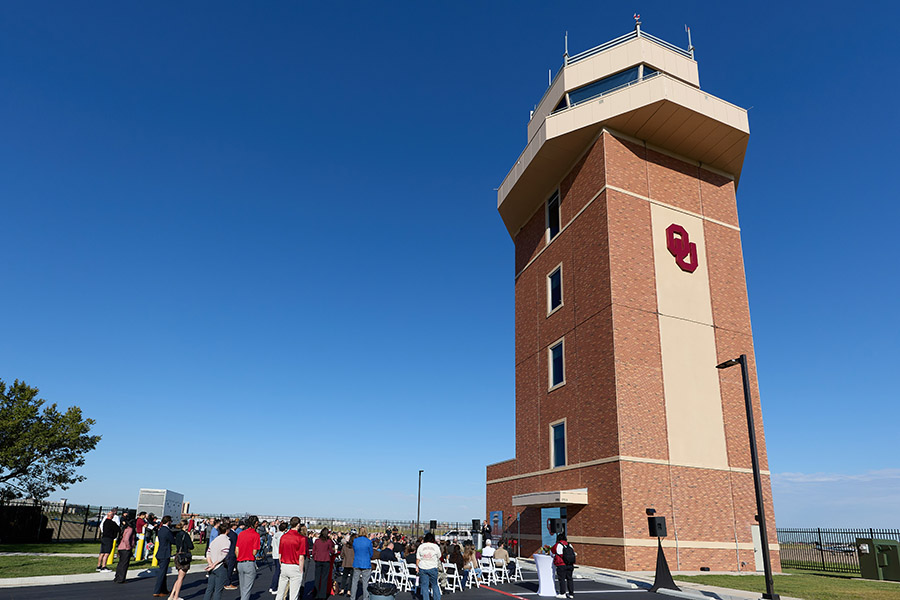
The University of Oklahoma today celebrated the opening of a new air traffic control tower at the OU Max Westheimer Airport. Standing 106 feet tall, more than double the current 52-foot facility, the new tower will modernize air traffic control operations and improve safety for pilots and students operating in the airspace.
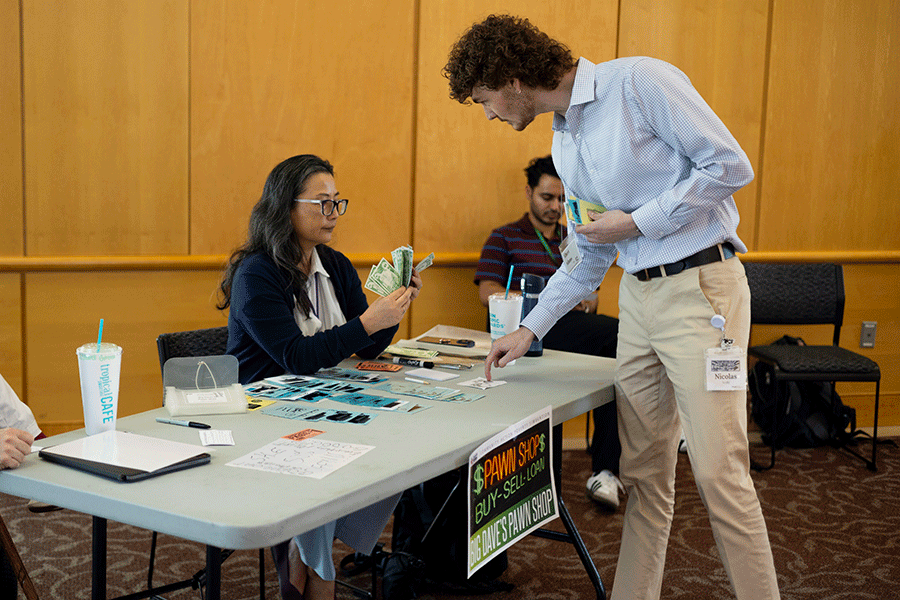
Do I buy groceries or pay the electric bill? Should I pawn some of my belongings to afford my prescription? My child is sick, so I will have to miss work to take care of him. Those are just a few of the difficult choices that OU-Tulsa health professional students confronted during the Community Access to Resources Experience. The role-playing activity challenged students to navigate the financial, family and other pressures that can affect a person’s health and ability to follow medical advice. Held annually during the SCM Institute orientation week, the experience is designed to generate understanding and build empathy.