NEWS


OKLAHOMA CITY – University of Oklahoma researchers have created a new drug delivery system that helps cancer cells take in much more of a treatment, improving its ability to kill tumors. The findings are published in Science Advances.
The delivery system packages messenger RNA (the therapeutic component) together with gold nanoparticles inside a tiny, round carrier. Once the carrier enters a cancer cell, the gold nanoparticles essentially open the “main gate” to the cell, allowing more of the therapeutic to enter and ultimately prompting the cell to die.
“The delivery system is like a Trojan horse,” said Joshua Seaberg, Ph.D., the doctoral student who created the system. “The end result is that we get a flood of the therapeutic inside the cell rather than individual pieces creeping in one at a time.”
Seaberg is the lead author of the paper, which comes from the laboratory of Priyabrata Mukherjee, Ph.D., a professor of pathology in the OU College of Medicine. Mukherjee encourages his trainees to think in novel ways and to consider that the delivery system itself could be part of the treatment process rather than merely a vehicle for the therapeutic.
Messenger RNA (mRNA) is notoriously difficult to get into cancer cells, but once there, it can instruct the cell to make proteins that trigger apoptosis, or cell death. To overcome these delivery challenges, Seaberg created a vehicle called an aurniosove, a stable carrier designed to hold both the gold nanoparticles and mRNA. Once inside the cancer cell, the gold nanoparticles bind to two key proteins, triggering a process that allows more carriers and their cargo to enter.
The delivery system was tested in laboratory studies and in mouse models of ovarian and liver cancer. In laboratory studies, aurniosoves entered cancer cells more efficiently than carriers without gold nanoparticles, and in mice, the treatment slowed tumor growth.
“Many delivery systems have approached this problem in different ways, but ultimately, the efficiency of the delivery is still very low,” Seaberg said. “There are many barriers between designing a medicine and getting it to where it needs to go. We saw that gap and thought we had a unique approach that could dramatically increase the delivery efficiency.”
While this delivery system focused on mRNA, the vehicle could carry other treatments, such as chemotherapy or another type of RNA called small interfering RNA (siRNA). Seaberg said the delivery system is designed to be adaptable, and the team is now testing it with additional therapies. They have also applied for a patent for the delivery system and its fabrication process.
“Traditionally, researchers have thought that the delivery vehicle is innocuous, that it doesn’t contribute to the therapy,” Mukherjee said. “Our work shows that the delivery system can play an active role in treatment. This shift in thinking opens up entirely new possibilities.”
About the project
The paper, “Enhancing mRNA therapy through iterative delivery,” can be found at https://www.science.org/doi/10.1126/sciadv.adx0916.
About the University of Oklahoma
Founded in 1890, the University of Oklahoma is a public research university with campuses in Norman, Oklahoma City and Tulsa. As the state’s flagship university, OU serves the educational, cultural, economic and health care needs of the state, region and nation. In Oklahoma City, the OU Health Campus is one of the nation’s few academic health centers with seven health profession colleges located on the same campus. The OU Health Campus serves approximately 4,000 students in more than 70 undergraduate and graduate degree programs spanning Oklahoma City and Tulsa and is the leading research institution in Oklahoma. For more information about the OU Health Campus, visit www.ouhsc.edu.
The University of Oklahoma has received a transformative gift from Jon and Shannon McCartney, which will name the McCartney Family Tunnel of Champions, the McCartney Family Gate of the Gaylord Family - Oklahoma Memorial Stadium and the McCartney Family Grand Lecture Hall in the Michael F. Price College of Business. The gift will also support the Inspiring Champions and the Athletic Director’s Discretionary Fund, in addition to establishing the McCartney DFW Career Trek program at Price College.
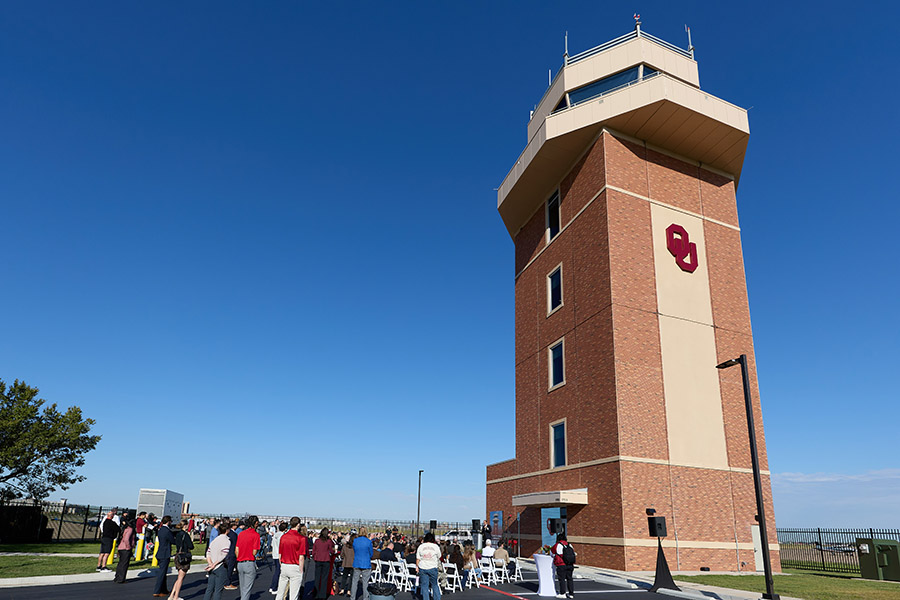
The University of Oklahoma today celebrated the opening of a new air traffic control tower at the OU Max Westheimer Airport. Standing 106 feet tall, more than double the current 52-foot facility, the new tower will modernize air traffic control operations and improve safety for pilots and students operating in the airspace.
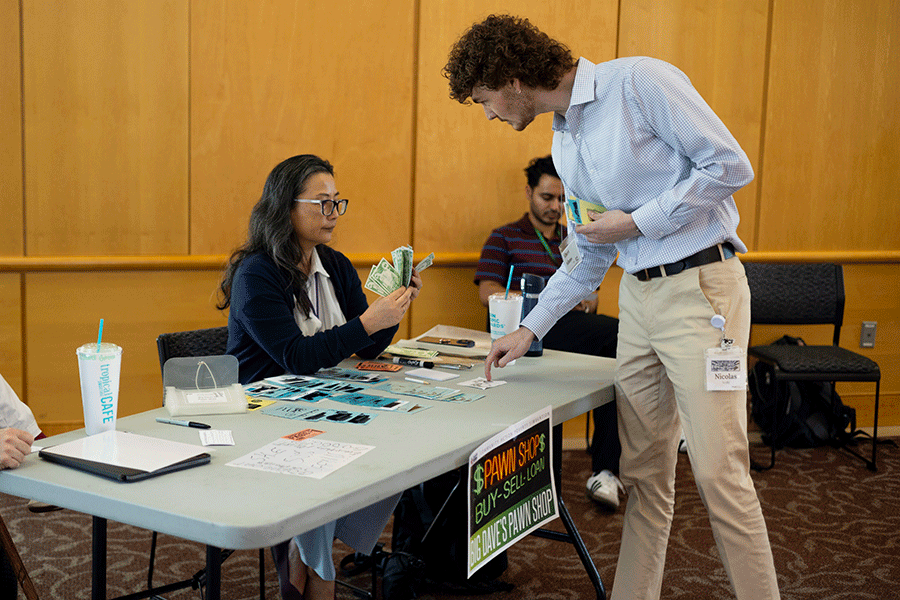
Do I buy groceries or pay the electric bill? Should I pawn some of my belongings to afford my prescription? My child is sick, so I will have to miss work to take care of him. Those are just a few of the difficult choices that OU-Tulsa health professional students confronted during the Community Access to Resources Experience. The role-playing activity challenged students to navigate the financial, family and other pressures that can affect a person’s health and ability to follow medical advice. Held annually during the SCM Institute orientation week, the experience is designed to generate understanding and build empathy.