NEWS


Media Contact
April Wilkerson
april-j-wilkerson@ouhsc.edu
Date
OKLAHOMA CITY – U.S. Poison Centers save $3.1 billion every year in medical costs and lost productivity, according to a new independent study released by America’s Poison Centers®. Conducted by RAND, the report confirms that U.S. Poison Centers provide substantial economic and societal benefits for communities across the country. In 2025, the Oklahoma Poison Center managed 31,462 human exposure cases and handled a total of 36,167 incoming calls, including 4,580 informational calls. To ensure patient safety and continuity of care, specialists conducted 34,335 follow-up calls, resulting in more than 70,500 total calls answered and placed in support of Oklahoma families and health care providers.
The RAND report, “Poison Prevention, Treatment, and Detection as Public Health Investments,” found that for every $1 invested in Poison Center services, communities receive $16.77 in benefits. These cost-savings reflect reduced emergency department use, shortened hospital stays, decreased mortality risk, enhanced public health surveillance and improved patient outcomes.
However, despite their growing value, overall funding for Poison Centers has decreased by 8% from 2011 to 2024 in real dollars, in addition to a decrease in subsidized support. Amid rising health care costs, these budget cuts are an increasing threat to the ability of Poison Centers to provide life-saving services and essential 24/7 coverage.
“This study confirms what we experience on every call – fast access to our specialists can keep people safe at home, prevent costly ER visits, and guide health care providers in treating complex cases,” said Kristie Edelen, Pharm.D., managing director, Oklahoma Poison Center. “We are here 24/7 for Oklahoma families, caregivers and clinicians.”
In addition to providing 24/7 expert guidance to the public and health care professionals, the Oklahoma Poison Center manages the majority of exposure cases while people are safely at home, reducing unnecessary emergency department visits and costs. The Oklahoma Poison Center also supports the state through medication safety education, substance use and overdose prevention initiatives, public health surveillance, and real-time consultation for hospitals, EMS and clinics. During public health emergencies and disasters, the Oklahoma Poison Center serves as a trusted clinical and informational resource for both the public and health care system.
For additional information or to read the full report, visit poisoncenters.org/national-impact-study.
For fast, free, confidential help for a potential poisoning or question, contact the Poison Helpline at 1-800-222-1222, PoisonHelp.org, or reach your local poison center by visiting oklahomapoison.org.
About the University of Oklahoma
Founded in 1890, the University of Oklahoma is a public research university with campuses in Norman, Oklahoma City and Tulsa. As the state’s flagship university, OU serves the educational, cultural, economic and health care needs of the state, region and nation. In Oklahoma City, the OU Health Campus is one of the nation’s few academic health centers with seven health profession colleges located on the same campus. The OU Health Campus serves approximately 4,000 students in more than 70 undergraduate and graduate degree programs spanning Oklahoma City and Tulsa and is the leading research institution in Oklahoma. For more information about the OU Health Campus, visit www.ouhsc.edu.
Price College of Business associate professor Yaron Levi, Ph.D., has explored how changes to an app's dashboard affected thousands of users’ financial management over nearly two years.
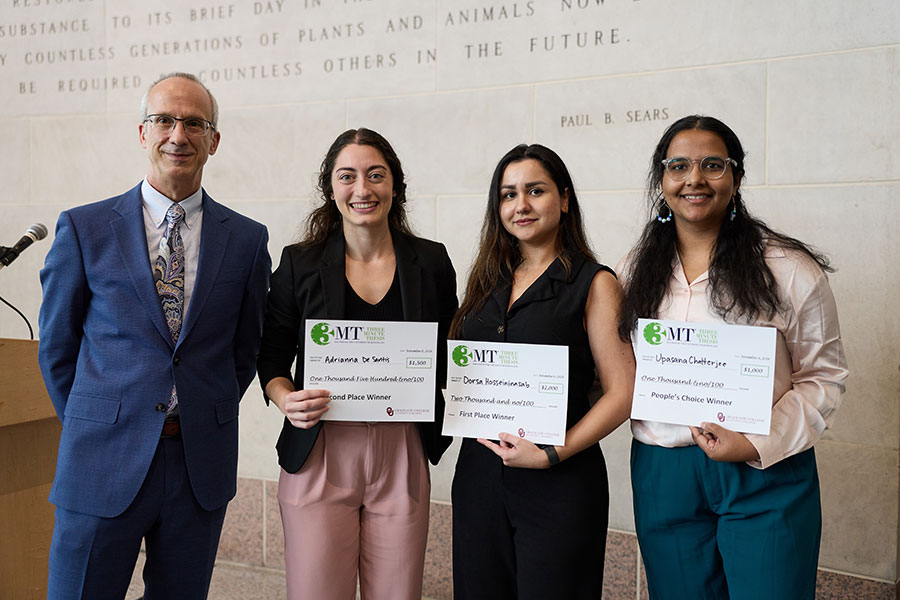
Three University of Oklahoma graduate students earned top honors in the 2026 Three Minute Thesis (3MT) competition, an annual event that challenges students to explain their research to a general audience in 3 minutes.
Researchers at the OU Health Harold Hamm Diabetes Center are investigating diabetes from numerous angles, including how the disease affects other organs, what factors contribute to its development and complications, and how new approaches to prevention and treatment could improve health.